Mains · descriptive
Uttarakhand Civil Judge Mains 2019 Question Paper
Page 1 is free to read. Sign in to read the whole paper. All Uttarakhand Civil Judge papers
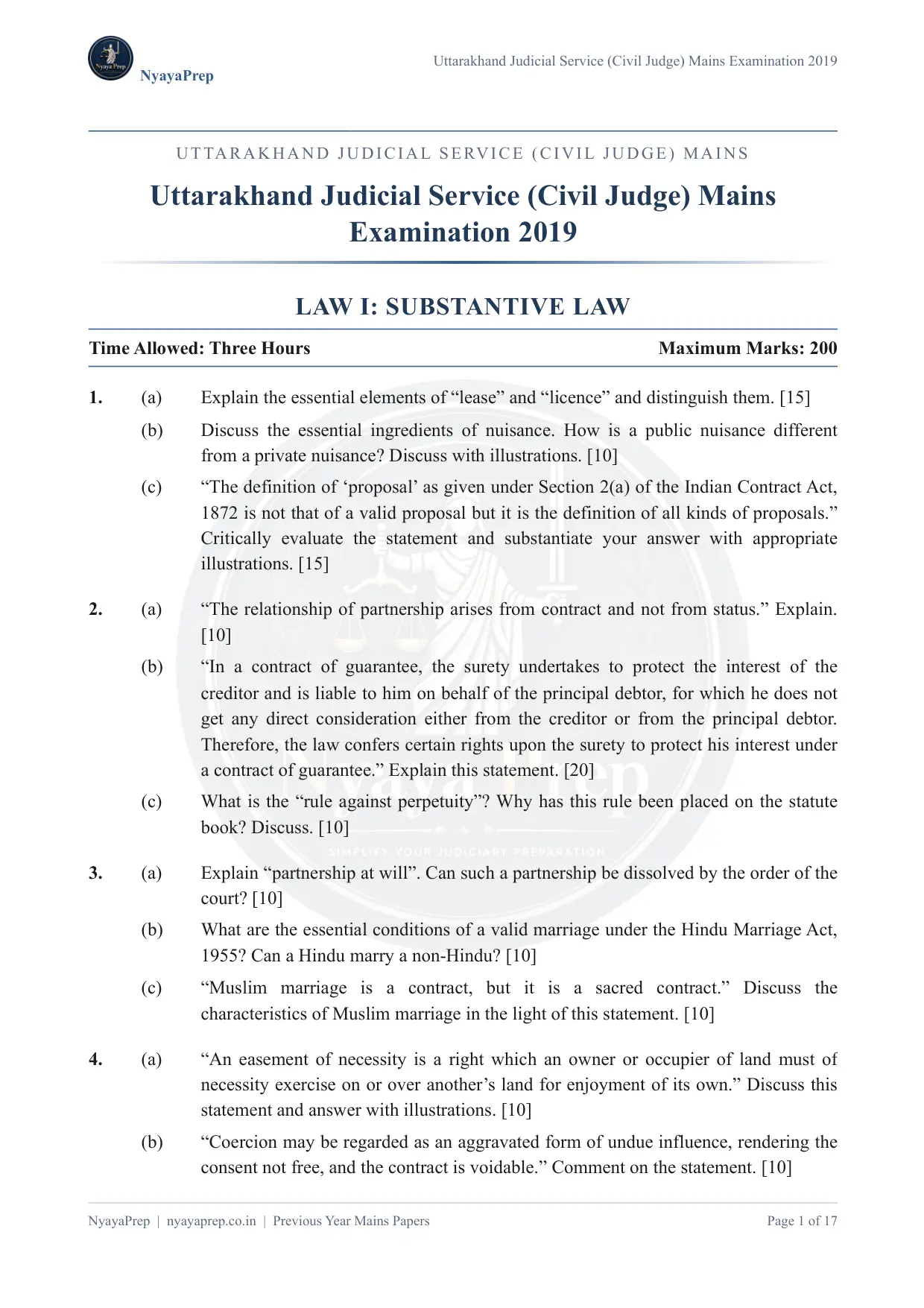
Page 1 as text
Uttarakhand Judicial Service (Civil Judge) Mains Examination 2019
UTTARAKHAND JUDICIAL SERVICE (CIVIL JUDGE) MAINS
Uttarakhand Judicial Service (Civil Judge) Mains
Examination 2019
LAW I: SUBSTANTIVE LAW
Time Allowed: Three Hours
Maximum Marks: 200
1. (a) Explain the essential elements of “lease” and “licence” and distinguish them. [15]
(b) Discuss the essential ingredients of nuisance. How is a public nuisance different
from a private nuisance? Discuss with illustrations. [10]
(c) “The definition of ‘proposal’ as given under Section 2(a) of the Indian Contract Act,
1872 is not that of a valid proposal but it is the definition of all kinds of proposals.”
Critically evaluate the statement and substantiate your answer with appropriate
illustrations. [15]
2. “The relationship of partnership arises from contract and not from status.” Explain.
[10]
“In a contract of guarantee, the surety undertakes to protect the interest of the
creditor and is liable to him on behalf of the principal debtor, for which he does not
get any direct consideration either from the creditor or from the principal debtor.
Therefore, the law confers certain rights upon the surety to protect his interest under
a contract of guarantee.” Explain this statement. [20]
What is the “rule against perpetuity”? Why has this rule been placed on the statute
book? Discuss. [10]
3. Explain “partnership at will”. Can such a partnership be dissolved by the order of the
court? [10]
What are the essential conditions of a valid marriage under the Hindu Marriage Act,
1955? Can a Hindu marry a non-Hindu? [10]
“Muslim marriage is a contract, but it is a sacred contract.” Discuss the
characteristics of Muslim marriage in the light of this statement. [10]
4. “An easement of necessity is a right which an owner or occupier of land must of
necessity exercise on or over another’s land for enjoyment of its own.” Discuss this
statement and answer with illustrations. [10]
“Coercion may be regarded as an aggravated form of undue influence, rendering the
consent not free, and the contract is voidable.” Comment on the statement. [10]