Mains · descriptive
Uttarakhand Civil Judge Mains 2016 Question Paper
Page 1 is free to read. Sign in to read the whole paper. All Uttarakhand Civil Judge papers
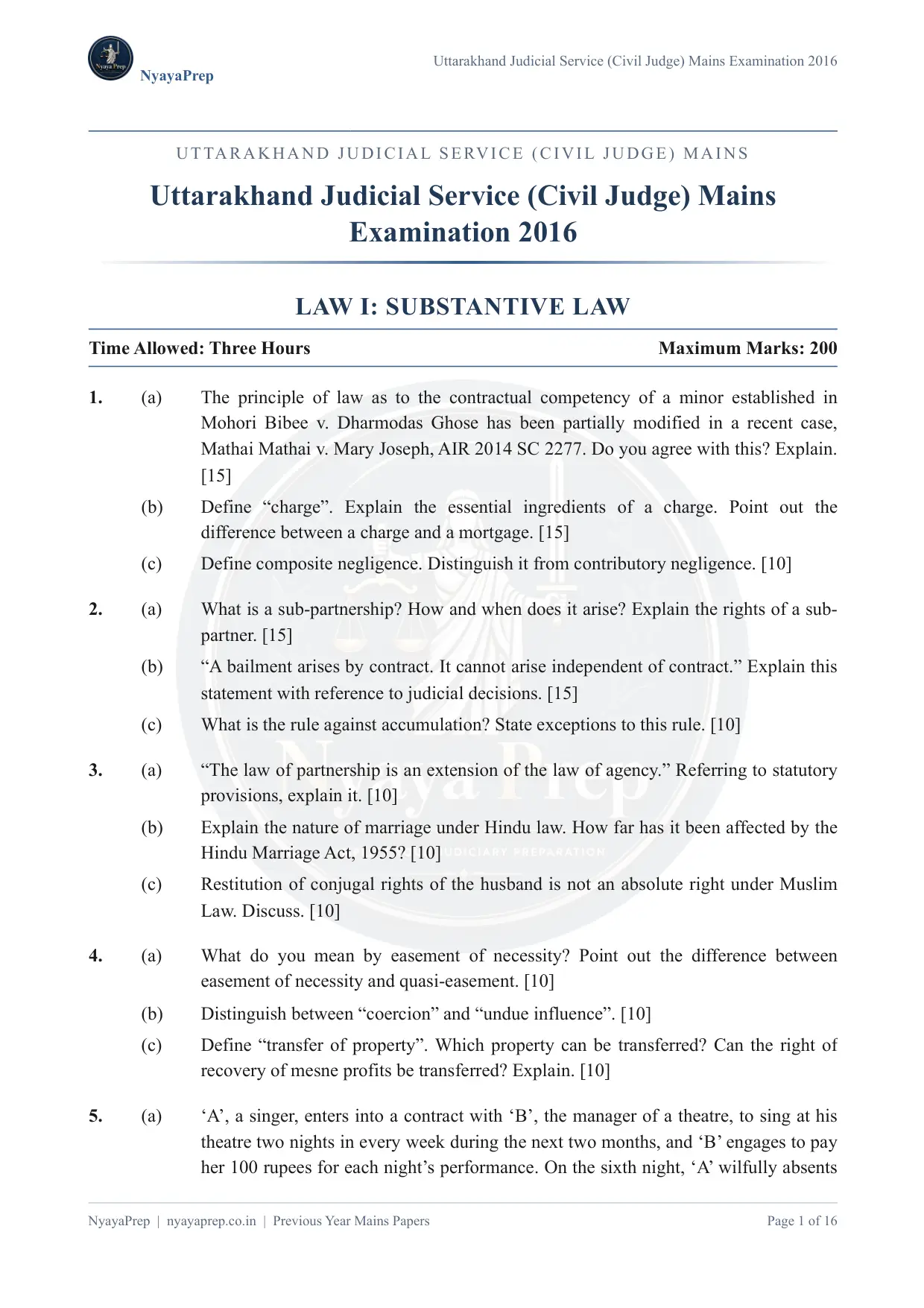
Page 1 as text
Uttarakhand Judicial Service (Civil Judge) Mains Examination 2016
UTTARAKHAND JUDICIAL SERVICE (CIVIL JUDGE) MAINS
Uttarakhand Judicial Service (Civil Judge) Mains
Examination 2016
LAW I: SUBSTANTIVE LAW
Time Allowed: Three Hours
Maximum Marks: 200
1. (a) The principle of law as to the contractual competency of a minor established in
Mohori Bibee v. Dharmodas Ghose has been partially modified in a recent case,
Mathai Mathai v. Mary Joseph, AIR 2014 SC 2277. Do you agree with this? Explain.
[15]
(b) Define “charge”. Explain the essential ingredients of a charge. Point out the
difference between a charge and a mortgage. [15]
(c) Define composite negligence. Distinguish it from contributory negligence. [10]
2. What is a sub-partnership? How and when does it arise? Explain the rights of a sub-
partner. [15]
“A bailment arises by contract. It cannot arise independent of contract.” Explain this
statement with reference to judicial decisions. [15]
What is the rule against accumulation? State exceptions to this rule. [10]
3. “The law of partnership is an extension of the law of agency.” Referring to statutory
provisions, explain it. [10]
Explain the nature of marriage under Hindu law. How far has it been affected by the
Hindu Marriage Act, 1955? [10]
Restitution of conjugal rights of the husband is not an absolute right under Muslim
Law. Discuss. [10]
4. What do you mean by easement of necessity? Point out the difference between
easement of necessity and quasi-easement. [10]
Distinguish between “coercion” and “undue influence”. [10]
Define “transfer of property”. Which property can be transferred? Can the right of
recovery of mesne profits be transferred? Explain. [10]
5. ‘A’, a singer, enters into a contract with ‘B’, the manager of a theatre, to sing at his
theatre two nights in every week during the next two months, and ‘B’ engages to pay
her 100 rupees for each night’s performance. On the sixth night, ‘A’ wilfully absents