Mains · descriptive
Uttarakhand Civil Judge Mains 2015 Question Paper
Page 1 is free to read. Sign in to read the whole paper. All Uttarakhand Civil Judge papers
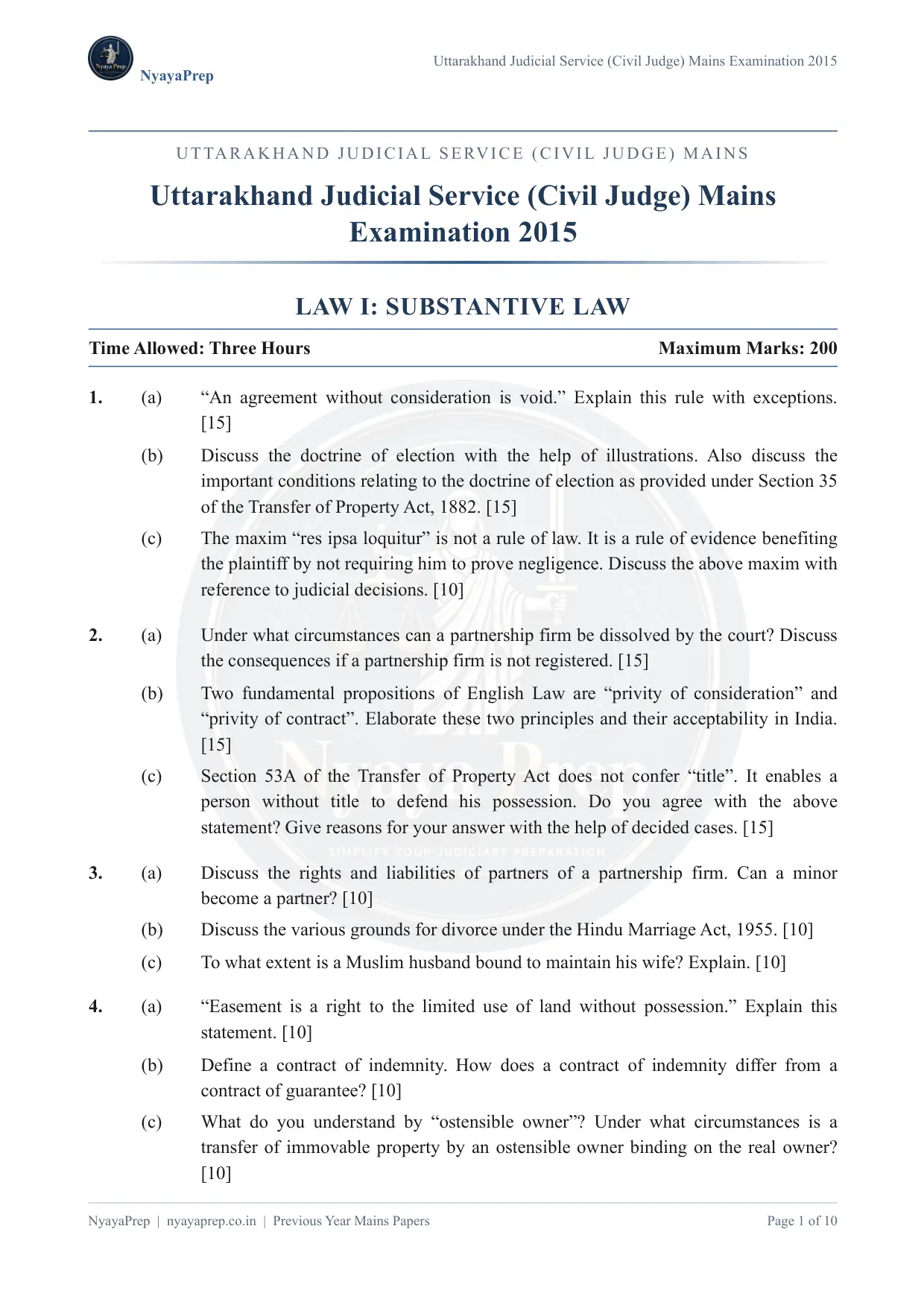
Page 1 as text
Uttarakhand Judicial Service (Civil Judge) Mains Examination 2015
UTTARAKHAND JUDICIAL SERVICE (CIVIL JUDGE) MAINS
Uttarakhand Judicial Service (Civil Judge) Mains
Examination 2015
LAW I: SUBSTANTIVE LAW
Time Allowed: Three Hours
Maximum Marks: 200
1. (a) “An agreement without consideration is void.” Explain this rule with exceptions.
[15]
(b) Discuss the doctrine of election with the help of illustrations. Also discuss the
important conditions relating to the doctrine of election as provided under Section 35
of the Transfer of Property Act, 1882. [15]
(c) The maxim “res ipsa loquitur” is not a rule of law. It is a rule of evidence benefiting
the plaintiff by not requiring him to prove negligence. Discuss the above maxim with
reference to judicial decisions. [10]
2. Under what circumstances can a partnership firm be dissolved by the court? Discuss
the consequences if a partnership firm is not registered. [15]
Two fundamental propositions of English Law are “privity of consideration” and
“privity of contract”. Elaborate these two principles and their acceptability in India.
Section 53A of the Transfer of Property Act does not confer “title”. It enables a
person without title to defend his possession. Do you agree with the above
statement? Give reasons for your answer with the help of decided cases. [15]
3. Discuss the rights and liabilities of partners of a partnership firm. Can a minor
become a partner? [10]
Discuss the various grounds for divorce under the Hindu Marriage Act, 1955. [10]
To what extent is a Muslim husband bound to maintain his wife? Explain. [10]
4. “Easement is a right to the limited use of land without possession.” Explain this
statement. [10]
Define a contract of indemnity. How does a contract of indemnity differ from a
contract of guarantee? [10]
What do you understand by “ostensible owner”? Under what circumstances is a
transfer of immovable property by an ostensible owner binding on the real owner?
[10]