Mains · descriptive
Uttarakhand Civil Judge Mains 2014 Question Paper
Page 1 is free to read. Sign in to read the whole paper. All Uttarakhand Civil Judge papers
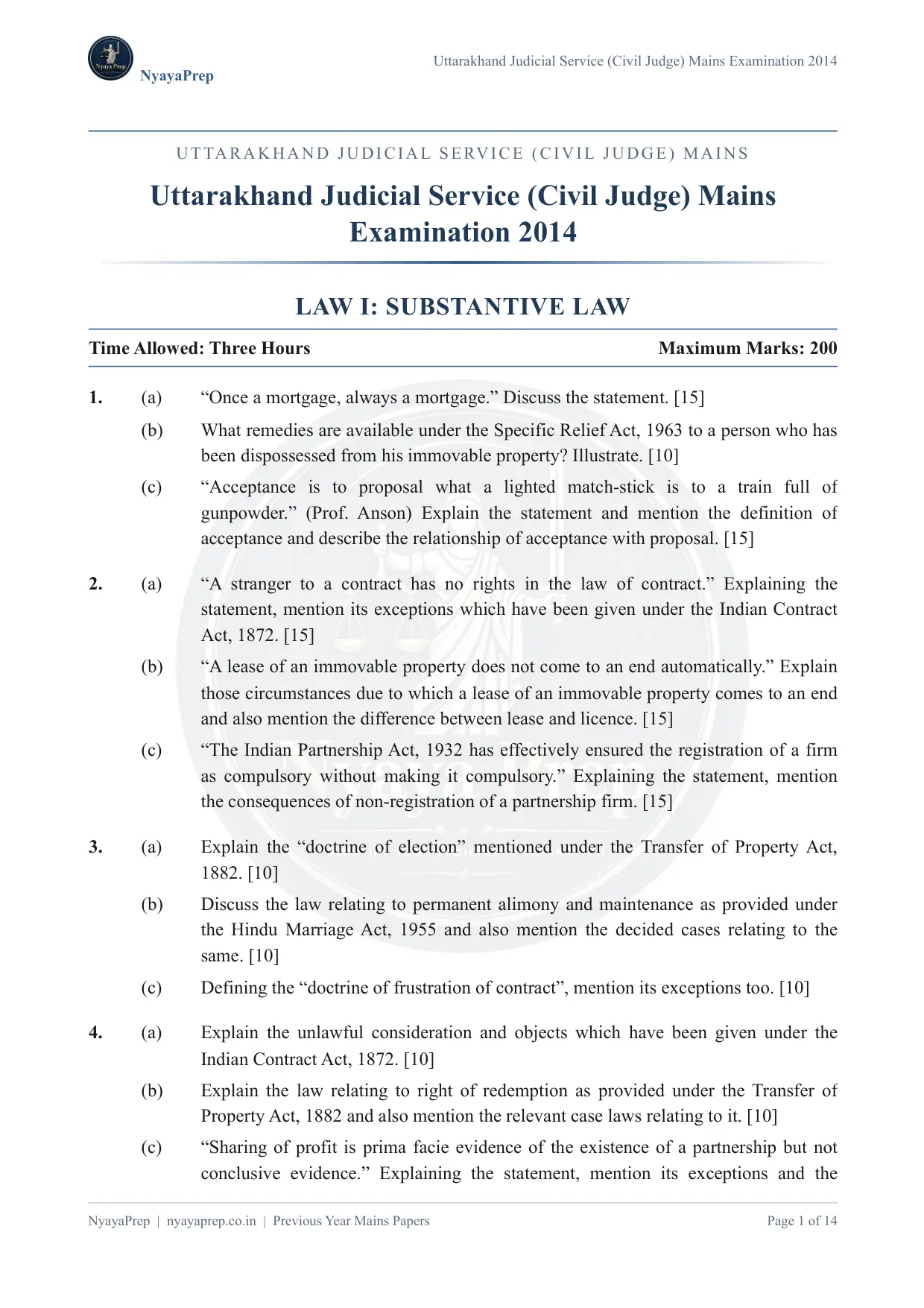
Page 1 as text
Uttarakhand Judicial Service (Civil Judge) Mains Examination 2014
UTTARAKHAND JUDICIAL SERVICE (CIVIL JUDGE) MAINS
Uttarakhand Judicial Service (Civil Judge) Mains
Examination 2014
LAW I: SUBSTANTIVE LAW
Time Allowed: Three Hours
Maximum Marks: 200
1. (a) “Once a mortgage, always a mortgage.” Discuss the statement. [15]
(b) What remedies are available under the Specific Relief Act, 1963 to a person who has
been dispossessed from his immovable property? Illustrate. [10]
(c) “Acceptance is to proposal what a lighted match-stick is to a train full of
gunpowder.” (Prof. Anson) Explain the statement and mention the definition of
acceptance and describe the relationship of acceptance with proposal. [15]
2. “A stranger to a contract has no rights in the law of contract.” Explaining the
statement, mention its exceptions which have been given under the Indian Contract
Act, 1872. [15]
“A lease of an immovable property does not come to an end automatically.” Explain
those circumstances due to which a lease of an immovable property comes to an end
and also mention the difference between lease and licence. [15]
“The Indian Partnership Act, 1932 has effectively ensured the registration of a firm
as compulsory without making it compulsory.” Explaining the statement, mention
the consequences of non-registration of a partnership firm. [15]
3. Explain the “doctrine of election” mentioned under the Transfer of Property Act,
1882. [10]
Discuss the law relating to permanent alimony and maintenance as provided under
the Hindu Marriage Act, 1955 and also mention the decided cases relating to the
same. [10]
Defining the “doctrine of frustration of contract”, mention its exceptions too. [10]
4. Explain the unlawful consideration and objects which have been given under the
Indian Contract Act, 1872. [10]
Explain the law relating to right of redemption as provided under the Transfer of
Property Act, 1882 and also mention the relevant case laws relating to it. [10]
“Sharing of profit is prima facie evidence of the existence of a partnership but not
conclusive evidence.” Explaining the statement, mention its exceptions and the