Mains · descriptive
Rajasthan Civil Judge Mains 2018 Question Paper
Page 1 is free to read. Sign in to read the whole paper. All Rajasthan Civil Judge papers
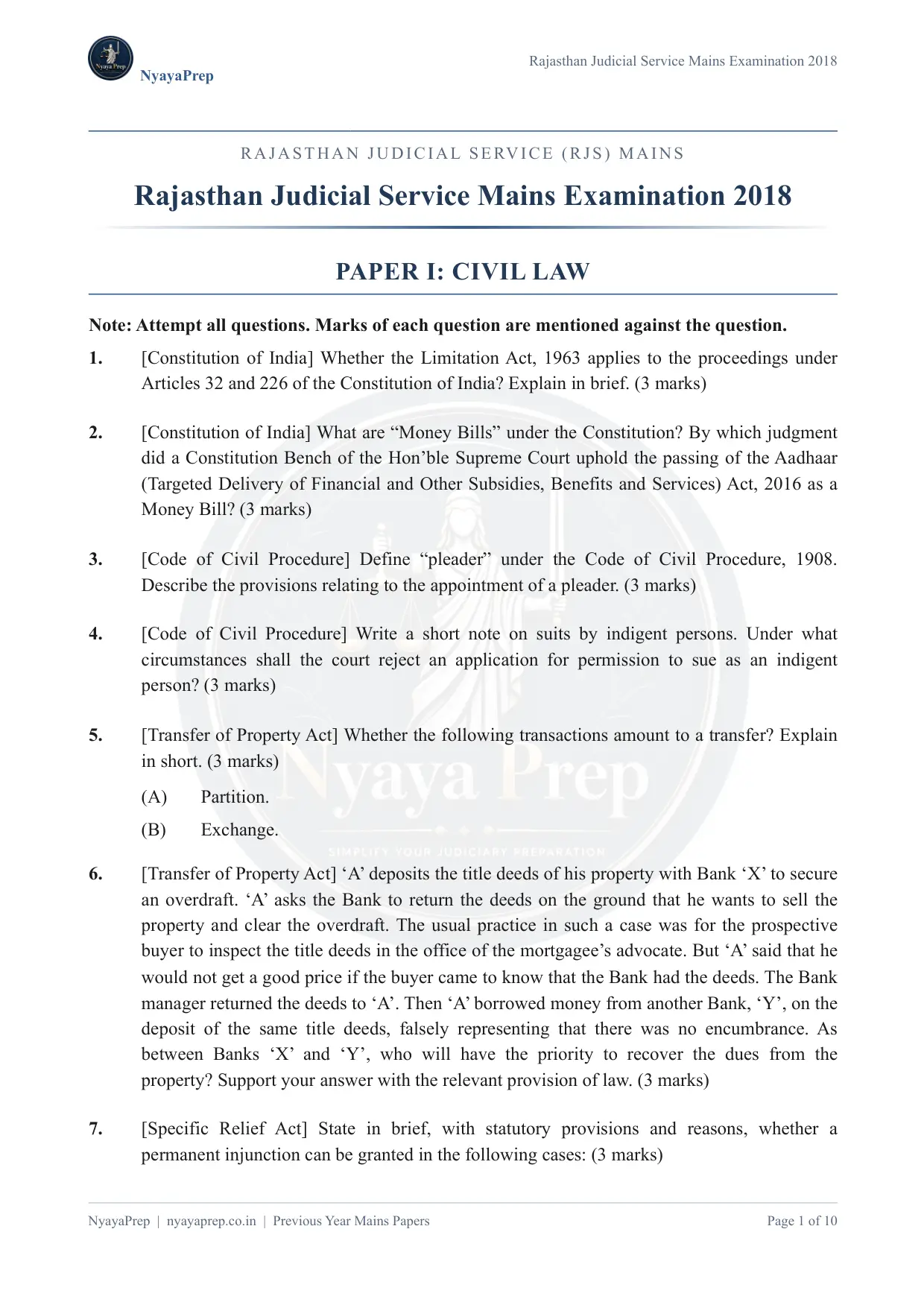
Page 1 as text
Rajasthan Judicial Service Mains Examination 2018
RAJASTHAN JUDICIAL SERVICE (RJS) MAINS
PAPER I: CIVIL LAW
Note: Attempt all questions. Marks of each question are mentioned against the question.
1. [Constitution of India] Whether the Limitation Act, 1963 applies to the proceedings under
Articles 32 and 226 of the Constitution of India? Explain in brief. (3 marks)
2. [Constitution of India] What are “Money Bills” under the Constitution? By which judgment
did a Constitution Bench of the Hon’ble Supreme Court uphold the passing of the Aadhaar
(Targeted Delivery of Financial and Other Subsidies, Benefits and Services) Act, 2016 as a
Money Bill? (3 marks)
3. [Code of Civil Procedure] Define “pleader” under the Code of Civil Procedure, 1908.
Describe the provisions relating to the appointment of a pleader. (3 marks)
4. [Code of Civil Procedure] Write a short note on suits by indigent persons. Under what
circumstances shall the court reject an application for permission to sue as an indigent
person? (3 marks)
5. [Transfer of Property Act] Whether the following transactions amount to a transfer? Explain
in short. (3 marks)
(A) Partition.
(B) Exchange.
6. [Transfer of Property Act] ‘A’ deposits the title deeds of his property with Bank ‘X’ to secure
an overdraft. ‘A’ asks the Bank to return the deeds on the ground that he wants to sell the
property and clear the overdraft. The usual practice in such a case was for the prospective
buyer to inspect the title deeds in the office of the mortgagee’s advocate. But ‘A’ said that he
would not get a good price if the buyer came to know that the Bank had the deeds. The Bank
manager returned the deeds to ‘A’. Then ‘A’ borrowed money from another Bank, ‘Y’, on the
deposit of the same title deeds, falsely representing that there was no encumbrance. As
between Banks ‘X’ and ‘Y’, who will have the priority to recover the dues from the
property? Support your answer with the relevant provision of law. (3 marks)
7. [Specific Relief Act] State in brief, with statutory provisions and reasons, whether a
permanent injunction can be granted in the following cases: (3 marks)