Mains · descriptive
Maharashtra Civil Judge Mains 2014 Question Paper
Page 1 is free to read. Sign in to read the whole paper. All Maharashtra Civil Judge papers
Page 1 as text
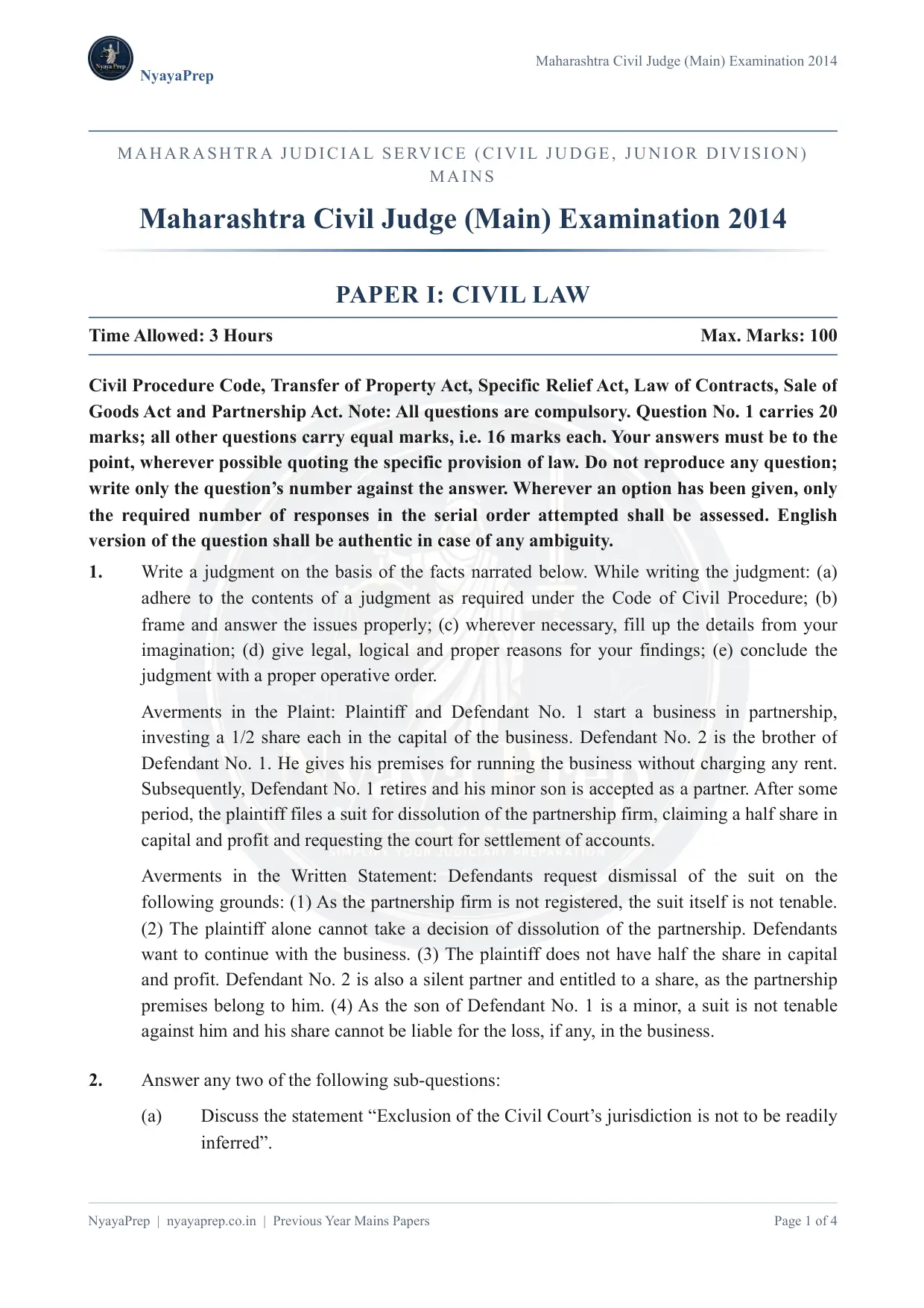
Maharashtra Civil Judge (Main) Examination 2014
MAHARASHTRA JUDICIAL SERVICE (CIVIL JUDGE, JUNIOR DIVISION)
MAINS
PAPER I: CIVIL LAW
Time Allowed: 3 Hours
Max. Marks: 100
Civil Procedure Code, Transfer of Property Act, Specific Relief Act, Law of Contracts, Sale of
Goods Act and Partnership Act. Note: All questions are compulsory. Question No. 1 carries 20
marks; all other questions carry equal marks, i.e. 16 marks each. Your answers must be to the
point, wherever possible quoting the specific provision of law. Do not reproduce any question;
write only the question’s number against the answer. Wherever an option has been given, only
the required number of responses in the serial order attempted shall be assessed. English
version of the question shall be authentic in case of any ambiguity.
1. Write a judgment on the basis of the facts narrated below. While writing the judgment: (a)
adhere to the contents of a judgment as required under the Code of Civil Procedure; (b)
frame and answer the issues properly; (c) wherever necessary, fill up the details from your
imagination; (d) give legal, logical and proper reasons for your findings; (e) conclude the
judgment with a proper operative order.
Averments in the Plaint: Plaintiff and Defendant No. 1 start a business in partnership,
investing a 1/2 share each in the capital of the business. Defendant No. 2 is the brother of
Defendant No. 1. He gives his premises for running the business without charging any rent.
Subsequently, Defendant No. 1 retires and his minor son is accepted as a partner. After some
period, the plaintiff files a suit for dissolution of the partnership firm, claiming a half share in
capital and profit and requesting the court for settlement of accounts.
Averments in the Written Statement: Defendants request dismissal of the suit on the
following grounds: (1) As the partnership firm is not registered, the suit itself is not tenable.
(2) The plaintiff alone cannot take a decision of dissolution of the partnership. Defendants
want to continue with the business. (3) The plaintiff does not have half the share in capital
and profit. Defendant No. 2 is also a silent partner and entitled to a share, as the partnership
premises belong to him. (4) As the son of Defendant No. 1 is a minor, a suit is not tenable
against him and his share cannot be liable for the loss, if any, in the business.
2. Answer any two of the following sub-questions:
(a) Discuss the statement “Exclusion of the Civil Court’s jurisdiction is not to be readily
inferred”.