Mains · descriptive
J&K Civil Judge Mains 2018 Question Paper
Page 1 is free to read. Sign in to read the whole paper. All J&K Civil Judge papers
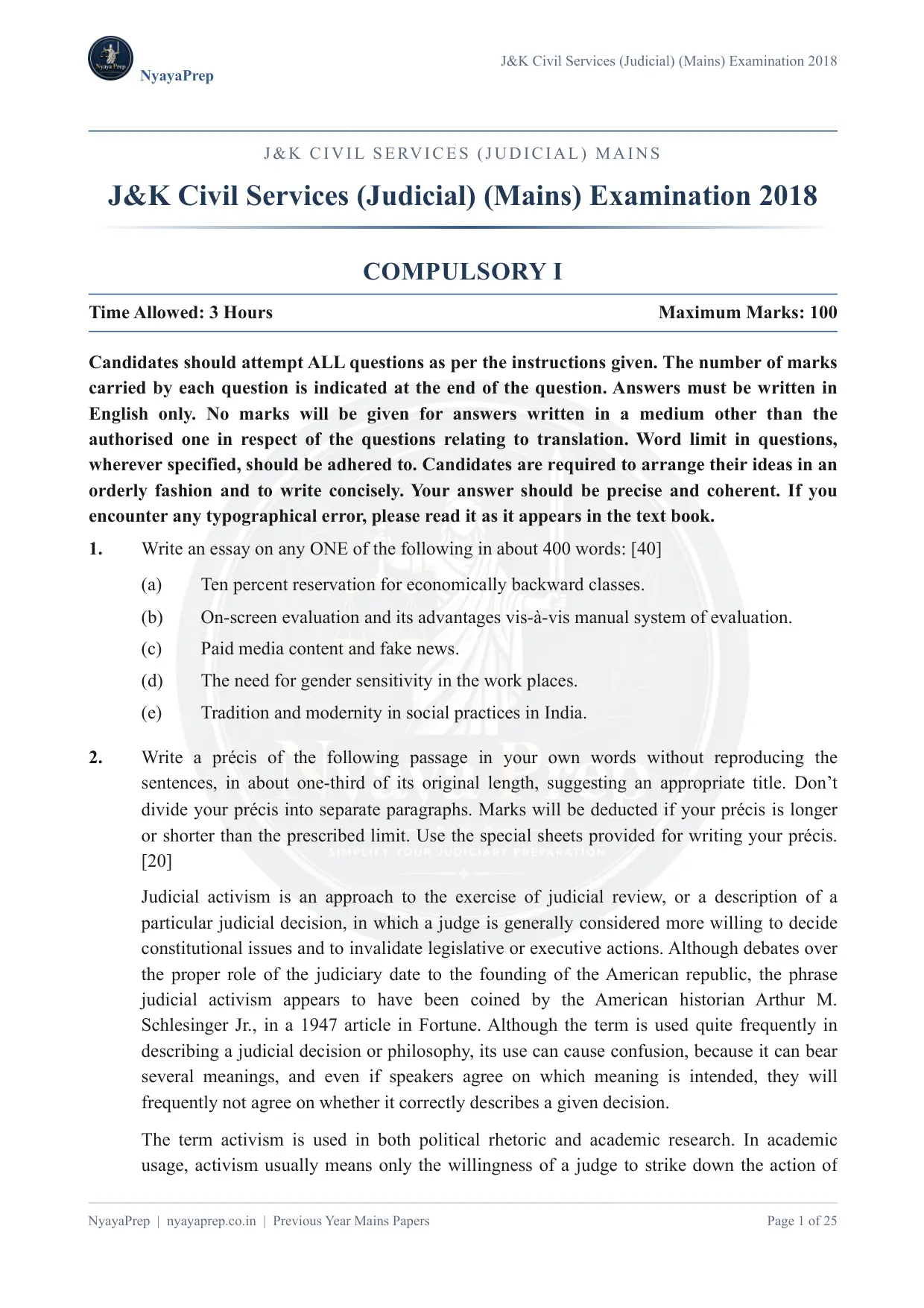
Page 1 as text
J&K Civil Services (Judicial) (Mains) Examination 2018
J&K CIVIL SERVICES (JUDICIAL) MAINS
COMPULSORY I
Time Allowed: 3 Hours
Maximum Marks: 100
Candidates should attempt ALL questions as per the instructions given. The number of marks
carried by each question is indicated at the end of the question. Answers must be written in
English only. No marks will be given for answers written in a medium other than the
authorised one in respect of the questions relating to translation. Word limit in questions,
wherever specified, should be adhered to. Candidates are required to arrange their ideas in an
orderly fashion and to write concisely. Your answer should be precise and coherent. If you
encounter any typographical error, please read it as it appears in the text book.
1. Write an essay on any ONE of the following in about 400 words: [40]
(a) Ten percent reservation for economically backward classes.
(b) On-screen evaluation and its advantages vis-à-vis manual system of evaluation.
(c) Paid media content and fake news.
(d) The need for gender sensitivity in the work places.
(e) Tradition and modernity in social practices in India.
2. Write a précis of the following passage in your own words without reproducing the
sentences, in about one-third of its original length, suggesting an appropriate title. Don’t
divide your précis into separate paragraphs. Marks will be deducted if your précis is longer
or shorter than the prescribed limit. Use the special sheets provided for writing your précis.
[20]
Judicial activism is an approach to the exercise of judicial review, or a description of a
particular judicial decision, in which a judge is generally considered more willing to decide
constitutional issues and to invalidate legislative or executive actions. Although debates over
the proper role of the judiciary date to the founding of the American republic, the phrase
judicial activism appears to have been coined by the American historian Arthur M.
Schlesinger Jr., in a 1947 article in Fortune. Although the term is used quite frequently in
describing a judicial decision or philosophy, its use can cause confusion, because it can bear
several meanings, and even if speakers agree on which meaning is intended, they will
frequently not agree on whether it correctly describes a given decision.
The term activism is used in both political rhetoric and academic research. In academic
usage, activism usually means only the willingness of a judge to strike down the action of