Mains · descriptive
HP Civil Judge Mains 2018 Question Paper
Page 1 is free to read. Sign in to read the whole paper. All HP Civil Judge papers
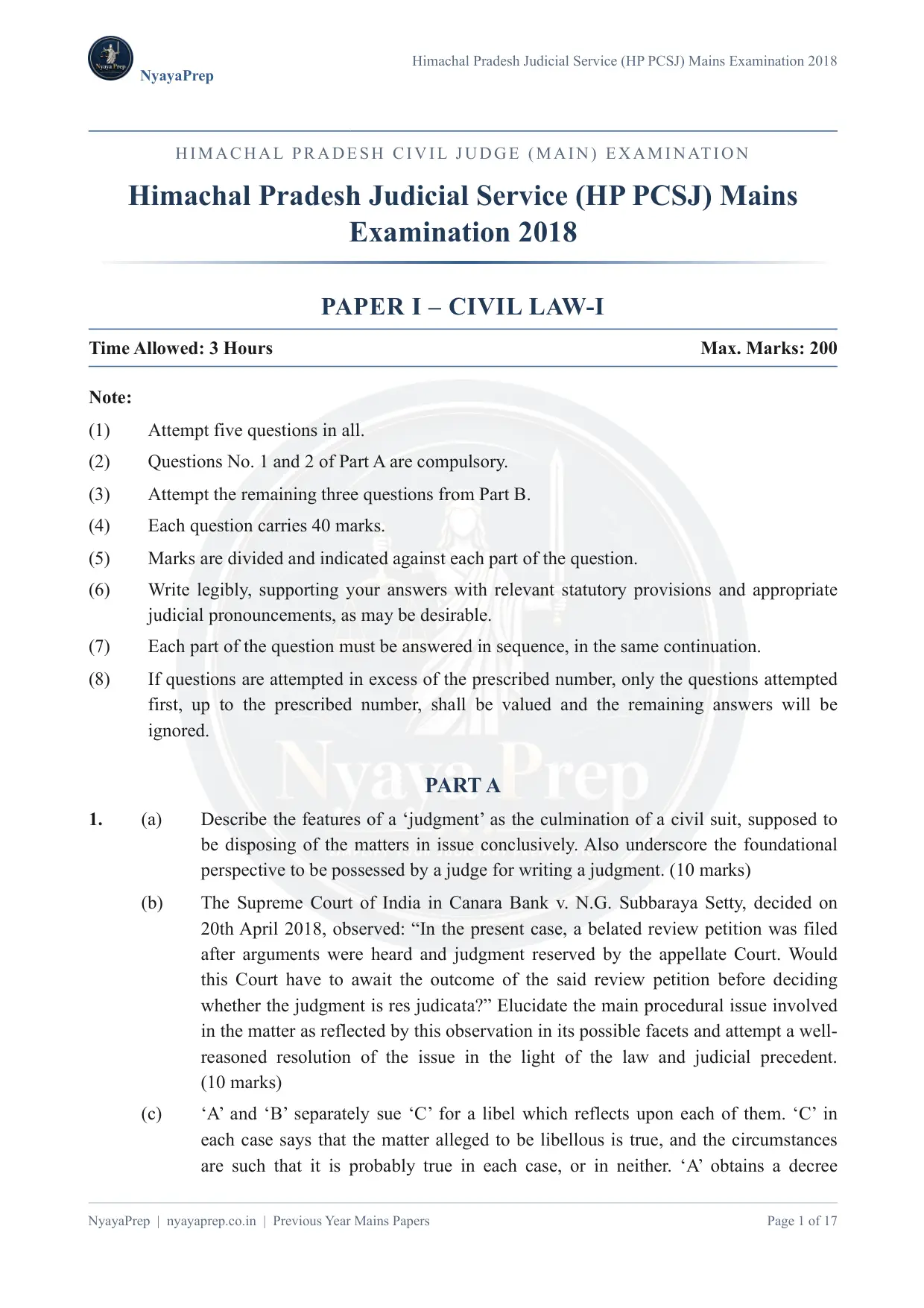
Page 1 as text
Himachal Pradesh Judicial Service (HP PCSJ) Mains Examination 2018
HIMACHAL PRADESH CIVIL JUDGE (MAIN) EXAMINATION
Himachal Pradesh Judicial Service (HP PCSJ) Mains
Examination 2018
PAPER I – CIVIL LAW-I
Time Allowed: 3 Hours
Max. Marks: 200
Note:
(1) Attempt five questions in all.
(2) Questions No. 1 and 2 of Part A are compulsory.
(3) Attempt the remaining three questions from Part B.
(4) Each question carries 40 marks.
(5) Marks are divided and indicated against each part of the question.
(6) Write legibly, supporting your answers with relevant statutory provisions and appropriate
judicial pronouncements, as may be desirable.
(7) Each part of the question must be answered in sequence, in the same continuation.
(8) If questions are attempted in excess of the prescribed number, only the questions attempted
first, up to the prescribed number, shall be valued and the remaining answers will be
ignored.
PART A
1. (a) Describe the features of a ‘judgment’ as the culmination of a civil suit, supposed to
be disposing of the matters in issue conclusively. Also underscore the foundational
perspective to be possessed by a judge for writing a judgment. (10 marks)
(b) The Supreme Court of India in Canara Bank v. N.G. Subbaraya Setty, decided on
20th April 2018, observed: “In the present case, a belated review petition was filed
after arguments were heard and judgment reserved by the appellate Court. Would
this Court have to await the outcome of the said review petition before deciding
whether the judgment is res judicata?” Elucidate the main procedural issue involved
in the matter as reflected by this observation in its possible facets and attempt a well-
reasoned resolution of the issue in the light of the law and judicial precedent.
(10 marks)
(c) ‘A’ and ‘B’ separately sue ‘C’ for a libel which reflects upon each of them. ‘C’ in
each case says that the matter alleged to be libellous is true, and the circumstances
are such that it is probably true in each case, or in neither. ‘A’ obtains a decree