Mains · descriptive
HP Civil Judge Mains 2016 Question Paper
Page 1 is free to read. Sign in to read the whole paper. All HP Civil Judge papers
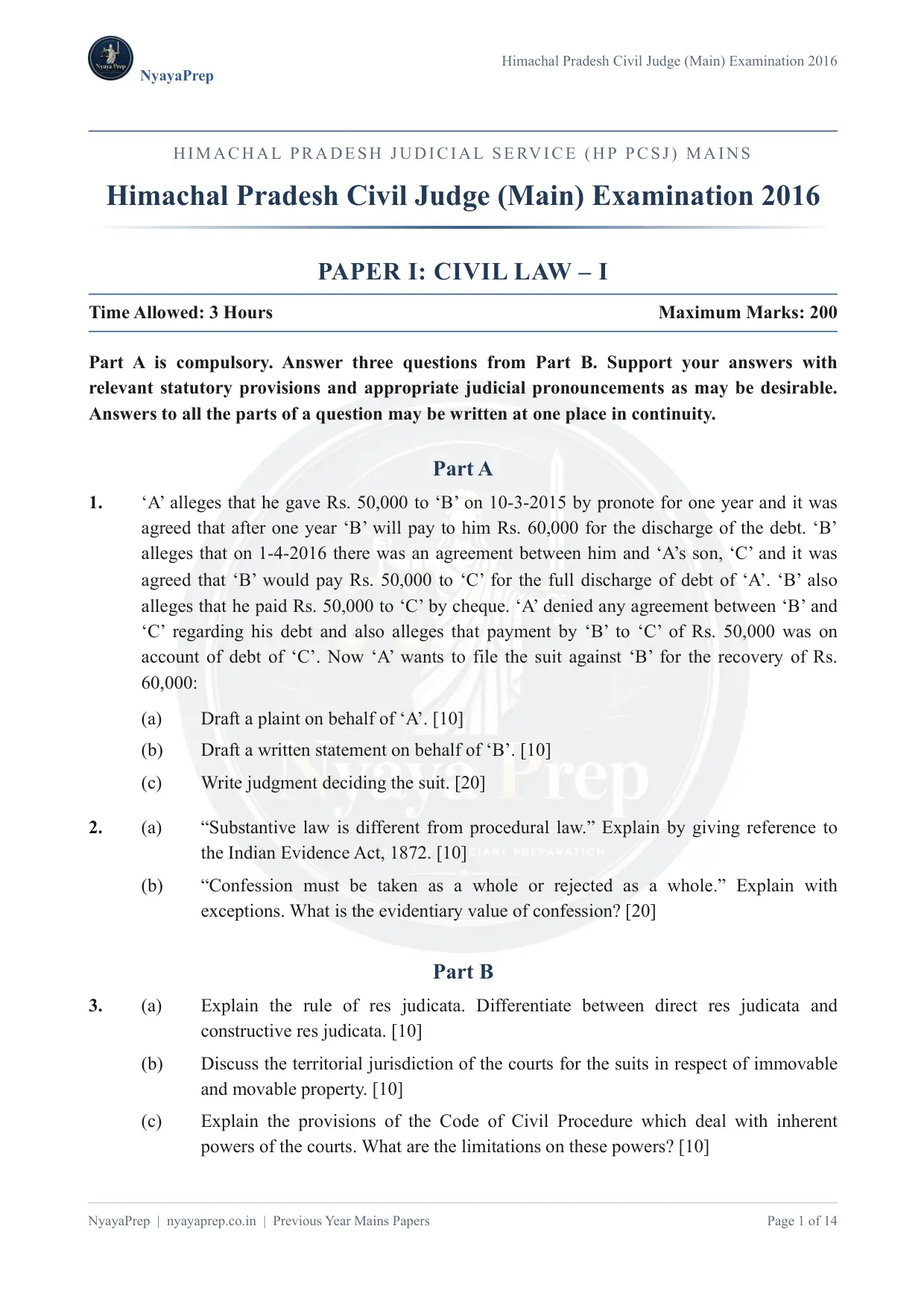
Page 1 as text
Himachal Pradesh Civil Judge (Main) Examination 2016
HIMACHAL PRADESH JUDICIAL SERVICE (HP PCSJ) MAINS
PAPER I: CIVIL LAW – I
Time Allowed: 3 Hours
Maximum Marks: 200
Part A is compulsory. Answer three questions from Part B. Support your answers with
relevant statutory provisions and appropriate judicial pronouncements as may be desirable.
Answers to all the parts of a question may be written at one place in continuity.
Part A
1. ‘A’ alleges that he gave Rs. 50,000 to ‘B’ on 10-3-2015 by pronote for one year and it was
agreed that after one year ‘B’ will pay to him Rs. 60,000 for the discharge of the debt. ‘B’
alleges that on 1-4-2016 there was an agreement between him and ‘A’s son, ‘C’ and it was
agreed that ‘B’ would pay Rs. 50,000 to ‘C’ for the full discharge of debt of ‘A’. ‘B’ also
alleges that he paid Rs. 50,000 to ‘C’ by cheque. ‘A’ denied any agreement between ‘B’ and
‘C’ regarding his debt and also alleges that payment by ‘B’ to ‘C’ of Rs. 50,000 was on
account of debt of ‘C’. Now ‘A’ wants to file the suit against ‘B’ for the recovery of Rs.
60,000:
(a) Draft a plaint on behalf of ‘A’. [10]
(b) Draft a written statement on behalf of ‘B’. [10]
(c) Write judgment deciding the suit. [20]
2. “Substantive law is different from procedural law.” Explain by giving reference to
the Indian Evidence Act, 1872. [10]
“Confession must be taken as a whole or rejected as a whole.” Explain with
exceptions. What is the evidentiary value of confession? [20]
Part B
3. Explain the rule of res judicata. Differentiate between direct res judicata and
constructive res judicata. [10]
Discuss the territorial jurisdiction of the courts for the suits in respect of immovable
and movable property. [10]
Explain the provisions of the Code of Civil Procedure which deal with inherent
powers of the courts. What are the limitations on these powers? [10]