Mains · descriptive
HP Civil Judge Mains 2015 Question Paper
Page 1 is free to read. Sign in to read the whole paper. All HP Civil Judge papers
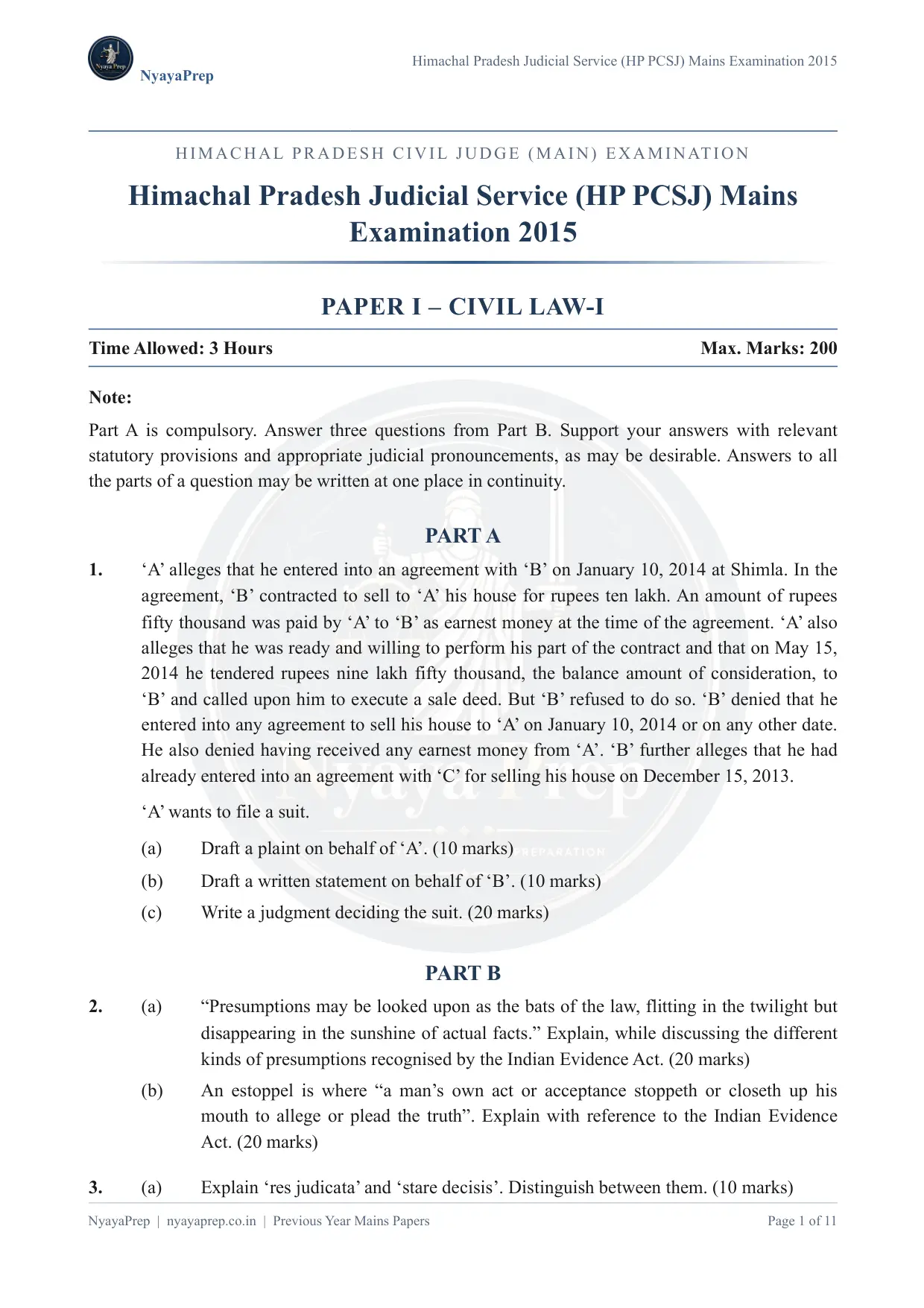
Page 1 as text
Himachal Pradesh Judicial Service (HP PCSJ) Mains Examination 2015
HIMACHAL PRADESH CIVIL JUDGE (MAIN) EXAMINATION
Himachal Pradesh Judicial Service (HP PCSJ) Mains
Examination 2015
PAPER I – CIVIL LAW-I
Time Allowed: 3 Hours
Max. Marks: 200
Note:
Part A is compulsory. Answer three questions from Part B. Support your answers with relevant
statutory provisions and appropriate judicial pronouncements, as may be desirable. Answers to all
the parts of a question may be written at one place in continuity.
PART A
1. ‘A’ alleges that he entered into an agreement with ‘B’ on January 10, 2014 at Shimla. In the
agreement, ‘B’ contracted to sell to ‘A’ his house for rupees ten lakh. An amount of rupees
fifty thousand was paid by ‘A’ to ‘B’ as earnest money at the time of the agreement. ‘A’ also
alleges that he was ready and willing to perform his part of the contract and that on May 15,
2014 he tendered rupees nine lakh fifty thousand, the balance amount of consideration, to
‘B’ and called upon him to execute a sale deed. But ‘B’ refused to do so. ‘B’ denied that he
entered into any agreement to sell his house to ‘A’ on January 10, 2014 or on any other date.
He also denied having received any earnest money from ‘A’. ‘B’ further alleges that he had
already entered into an agreement with ‘C’ for selling his house on December 15, 2013.
‘A’ wants to file a suit.
(a) Draft a plaint on behalf of ‘A’. (10 marks)
(b) Draft a written statement on behalf of ‘B’. (10 marks)
(c) Write a judgment deciding the suit. (20 marks)
PART B
2. “Presumptions may be looked upon as the bats of the law, flitting in the twilight but
disappearing in the sunshine of actual facts.” Explain, while discussing the different
kinds of presumptions recognised by the Indian Evidence Act. (20 marks)
An estoppel is where “a man’s own act or acceptance stoppeth or closeth up his
mouth to allege or plead the truth”. Explain with reference to the Indian Evidence
Act. (20 marks)
3. Explain ‘res judicata’ and ‘stare decisis’. Distinguish between them. (10 marks)