Mains · descriptive
Haryana Civil Judge Mains 2019 Question Paper
Page 1 is free to read. Sign in to read the whole paper. All Haryana Civil Judge papers
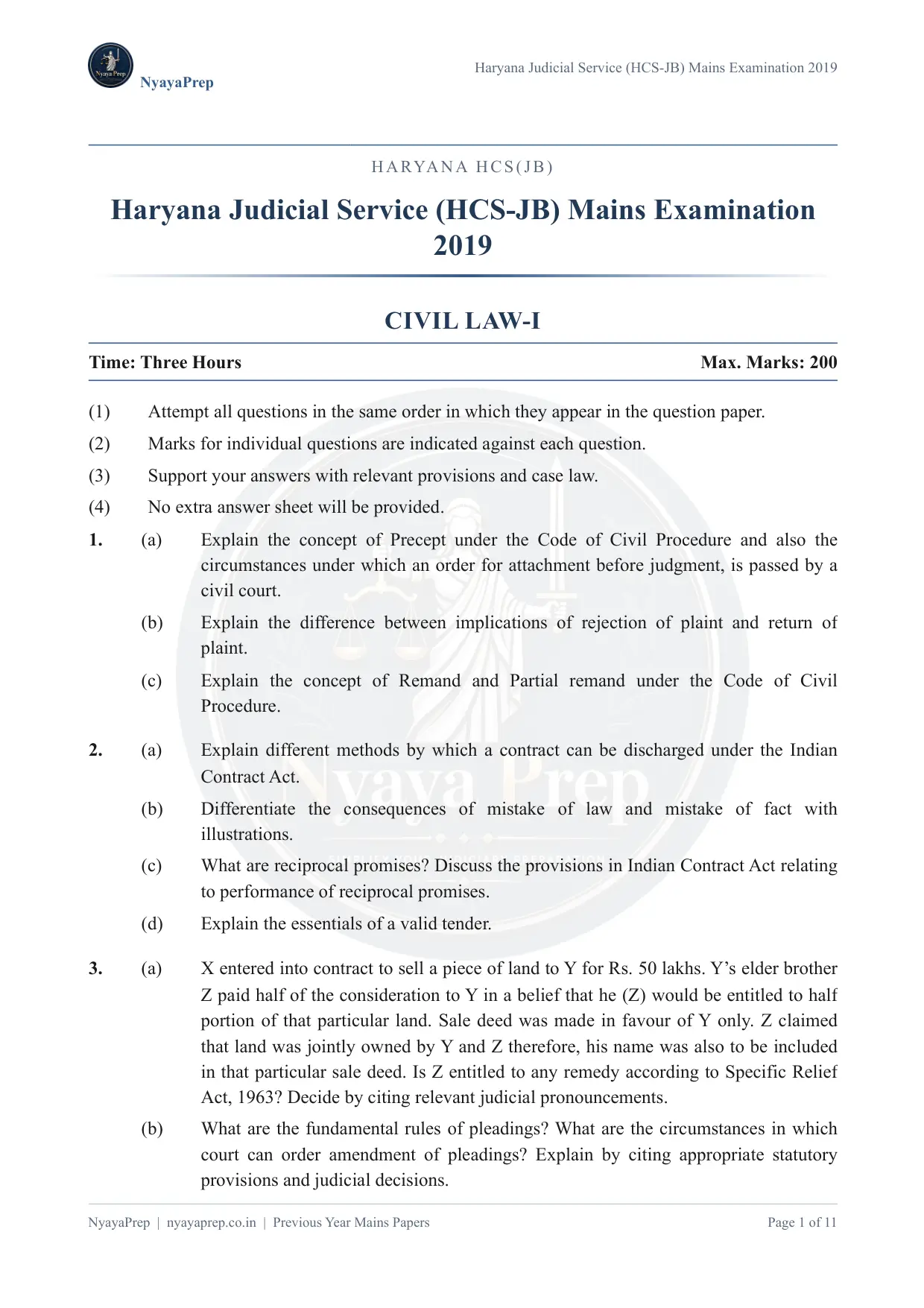
Page 1 as text
Haryana Judicial Service (HCS-JB) Mains Examination 2019
HARYANA HCS(JB)
Haryana Judicial Service (HCS-JB) Mains Examination
2019
CIVIL LAW-I
Time: Three Hours
Max. Marks: 200
(1) Attempt all questions in the same order in which they appear in the question paper.
(2) Marks for individual questions are indicated against each question.
(3) Support your answers with relevant provisions and case law.
(4) No extra answer sheet will be provided.
1. (a) Explain the concept of Precept under the Code of Civil Procedure and also the
circumstances under which an order for attachment before judgment, is passed by a
civil court.
(b) Explain the difference between implications of rejection of plaint and return of
plaint.
(c) Explain the concept of Remand and Partial remand under the Code of Civil
Procedure.
2. Explain different methods by which a contract can be discharged under the Indian
Contract Act.
Differentiate the consequences of mistake of law and mistake of fact with
illustrations.
What are reciprocal promises? Discuss the provisions in Indian Contract Act relating
to performance of reciprocal promises.
(d) Explain the essentials of a valid tender.
3. X entered into contract to sell a piece of land to Y for Rs. 50 lakhs. Y’s elder brother
Z paid half of the consideration to Y in a belief that he (Z) would be entitled to half
portion of that particular land. Sale deed was made in favour of Y only. Z claimed
that land was jointly owned by Y and Z therefore, his name was also to be included
in that particular sale deed. Is Z entitled to any remedy according to Specific Relief
Act, 1963? Decide by citing relevant judicial pronouncements.
What are the fundamental rules of pleadings? What are the circumstances in which
court can order amendment of pleadings? Explain by citing appropriate statutory
provisions and judicial decisions.