Mains · descriptive
Haryana Civil Judge Mains 2015 Question Paper
Page 1 is free to read. Sign in to read the whole paper. All Haryana Civil Judge papers
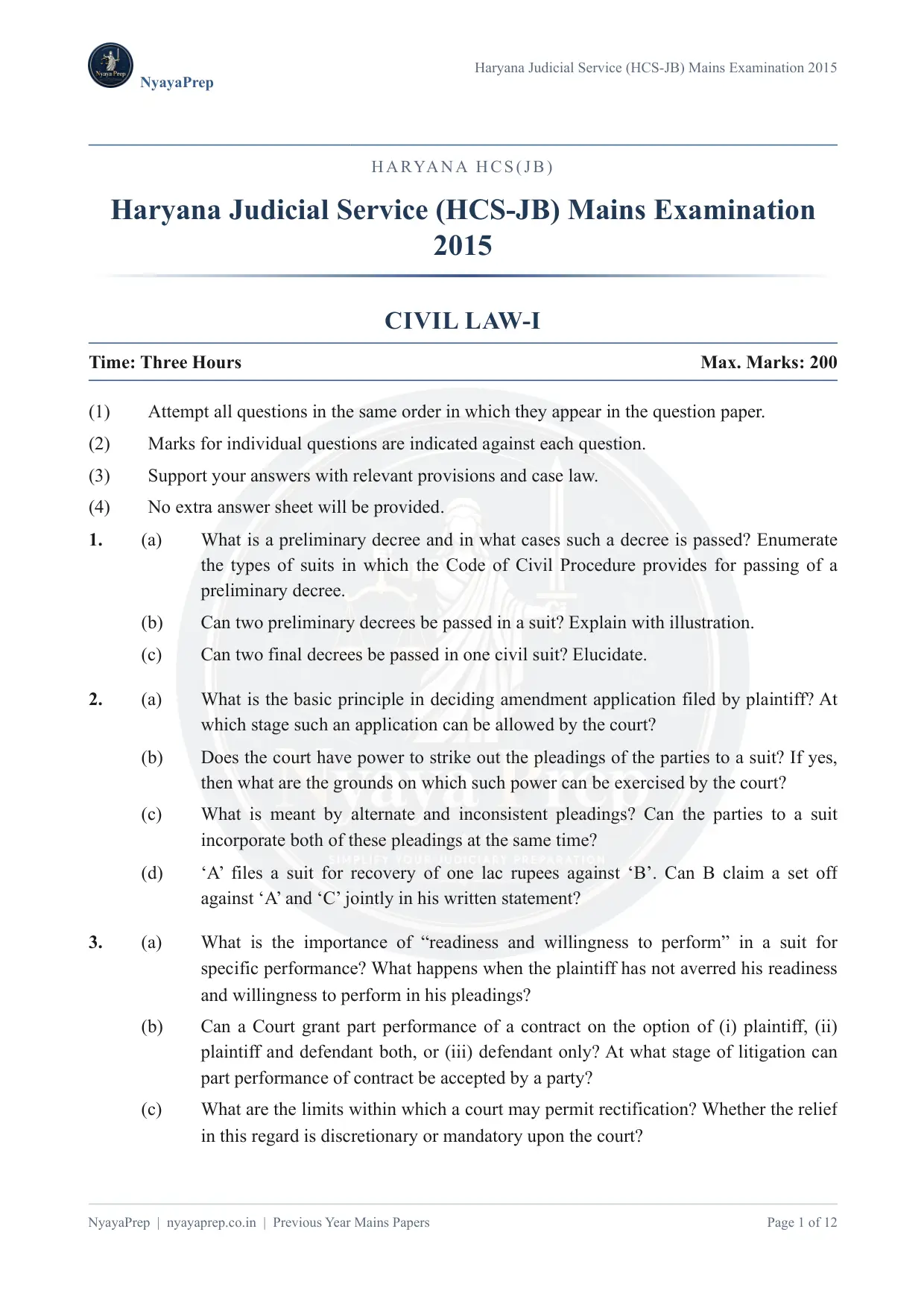
Page 1 as text
Haryana Judicial Service (HCS-JB) Mains Examination 2015
HARYANA HCS(JB)
Haryana Judicial Service (HCS-JB) Mains Examination
2015
CIVIL LAW-I
Time: Three Hours
Max. Marks: 200
(1) Attempt all questions in the same order in which they appear in the question paper.
(2) Marks for individual questions are indicated against each question.
(3) Support your answers with relevant provisions and case law.
(4) No extra answer sheet will be provided.
1. (a) What is a preliminary decree and in what cases such a decree is passed? Enumerate
the types of suits in which the Code of Civil Procedure provides for passing of a
preliminary decree.
(b) Can two preliminary decrees be passed in a suit? Explain with illustration.
(c) Can two final decrees be passed in one civil suit? Elucidate.
2. What is the basic principle in deciding amendment application filed by plaintiff? At
which stage such an application can be allowed by the court?
Does the court have power to strike out the pleadings of the parties to a suit? If yes,
then what are the grounds on which such power can be exercised by the court?
What is meant by alternate and inconsistent pleadings? Can the parties to a suit
incorporate both of these pleadings at the same time?
(d) ‘A’ files a suit for recovery of one lac rupees against ‘B’. Can B claim a set off
against ‘A’ and ‘C’ jointly in his written statement?
3. What is the importance of “readiness and willingness to perform” in a suit for
specific performance? What happens when the plaintiff has not averred his readiness
and willingness to perform in his pleadings?
Can a Court grant part performance of a contract on the option of (i) plaintiff, (ii)
plaintiff and defendant both, or (iii) defendant only? At what stage of litigation can
part performance of contract be accepted by a party?
What are the limits within which a court may permit rectification? Whether the relief
in this regard is discretionary or mandatory upon the court?