Mains · descriptive
Haryana Civil Judge Mains 2011 Question Paper
Page 1 is free to read. Sign in to read the whole paper. All Haryana Civil Judge papers
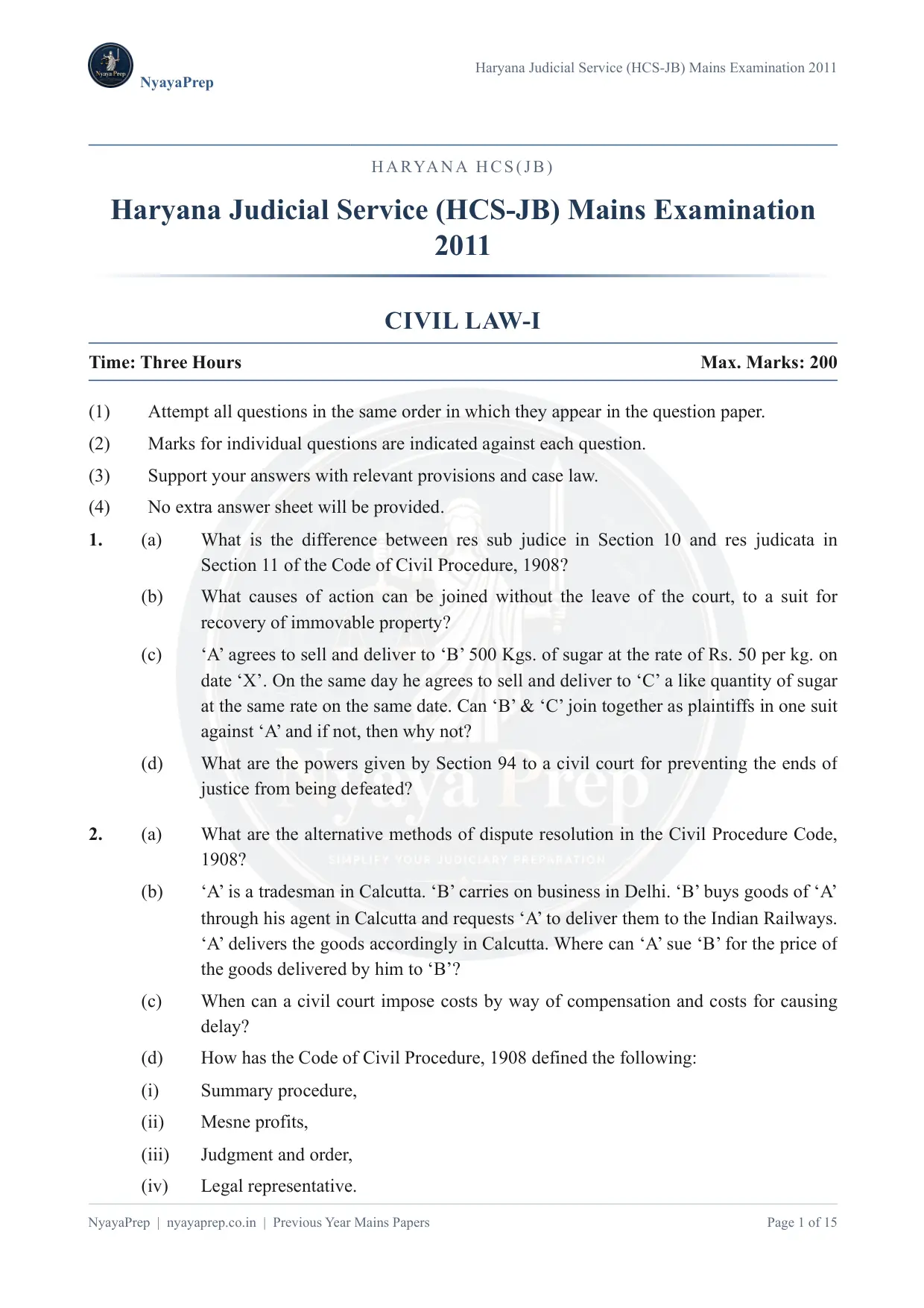
Page 1 as text
Haryana Judicial Service (HCS-JB) Mains Examination 2011
HARYANA HCS(JB)
Haryana Judicial Service (HCS-JB) Mains Examination
2011
CIVIL LAW-I
Time: Three Hours
Max. Marks: 200
(1) Attempt all questions in the same order in which they appear in the question paper.
(2) Marks for individual questions are indicated against each question.
(3) Support your answers with relevant provisions and case law.
(4) No extra answer sheet will be provided.
1. (a) What is the difference between res sub judice in Section 10 and res judicata in
Section 11 of the Code of Civil Procedure, 1908?
(b) What causes of action can be joined without the leave of the court, to a suit for
recovery of immovable property?
(c) ‘A’ agrees to sell and deliver to ‘B’ 500 Kgs. of sugar at the rate of Rs. 50 per kg. on
date ‘X’. On the same day he agrees to sell and deliver to ‘C’ a like quantity of sugar
at the same rate on the same date. Can ‘B’ & ‘C’ join together as plaintiffs in one suit
against ‘A’ and if not, then why not?
(d) What are the powers given by Section 94 to a civil court for preventing the ends of
justice from being defeated?
2. What are the alternative methods of dispute resolution in the Civil Procedure Code,
1908?
‘A’ is a tradesman in Calcutta. ‘B’ carries on business in Delhi. ‘B’ buys goods of ‘A’
through his agent in Calcutta and requests ‘A’ to deliver them to the Indian Railways.
‘A’ delivers the goods accordingly in Calcutta. Where can ‘A’ sue ‘B’ for the price of
the goods delivered by him to ‘B’?
When can a civil court impose costs by way of compensation and costs for causing
delay?
How has the Code of Civil Procedure, 1908 defined the following:
(i) Summary procedure,
(ii) Mesne profits,
(iii) Judgment and order,
(iv) Legal representative.