Mains · descriptive
Haryana Civil Judge Mains 2003 Question Paper
Page 1 is free to read. Sign in to read the whole paper. All Haryana Civil Judge papers
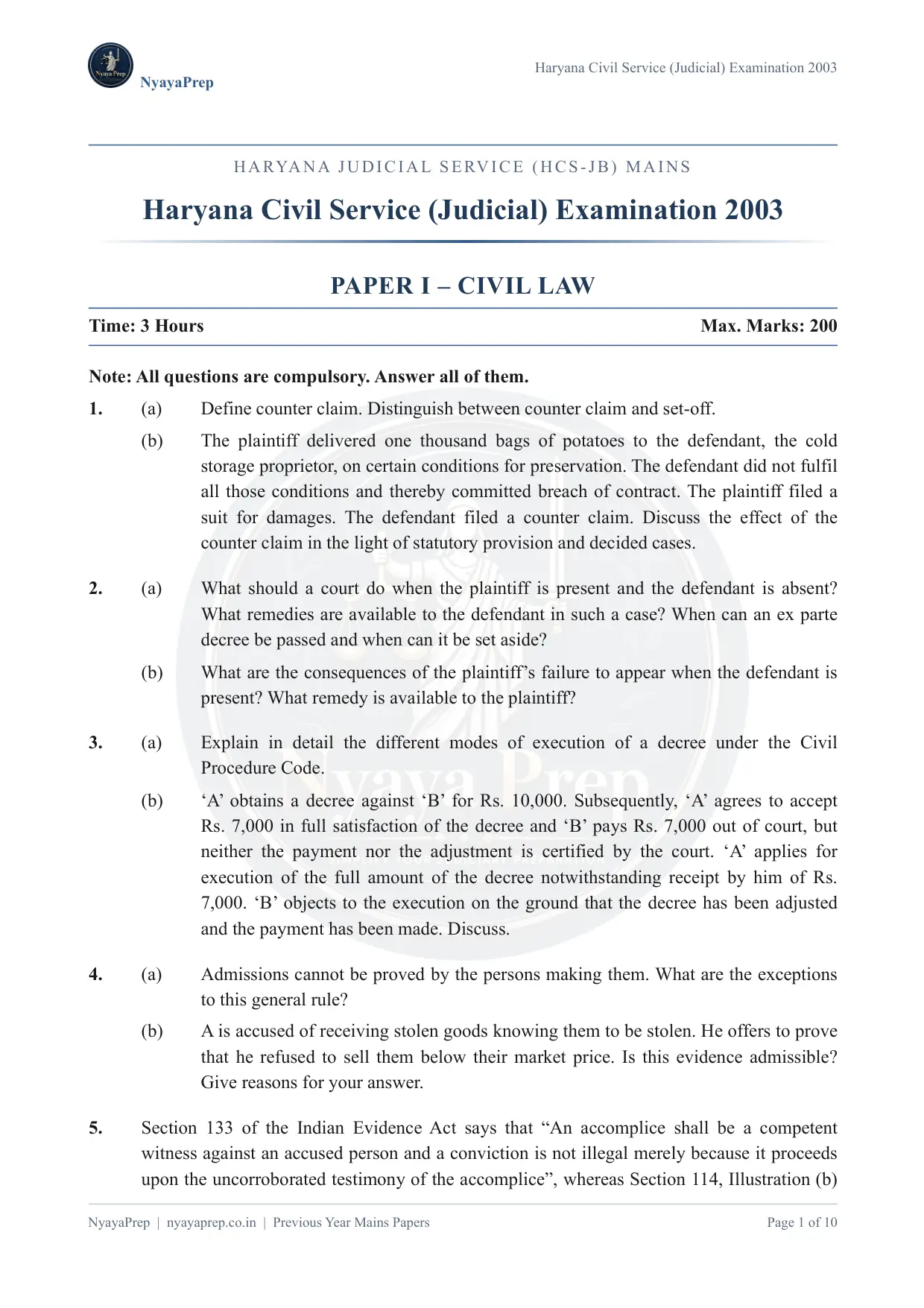
Page 1 as text
Haryana Civil Service (Judicial) Examination 2003
HARYANA JUDICIAL SERVICE (HCS-JB) MAINS
PAPER I – CIVIL LAW
Time: 3 Hours
Max. Marks: 200
Note: All questions are compulsory. Answer all of them.
1. (a) Define counter claim. Distinguish between counter claim and set-off.
(b) The plaintiff delivered one thousand bags of potatoes to the defendant, the cold
storage proprietor, on certain conditions for preservation. The defendant did not fulfil
all those conditions and thereby committed breach of contract. The plaintiff filed a
suit for damages. The defendant filed a counter claim. Discuss the effect of the
counter claim in the light of statutory provision and decided cases.
2. What should a court do when the plaintiff is present and the defendant is absent?
What remedies are available to the defendant in such a case? When can an ex parte
decree be passed and when can it be set aside?
What are the consequences of the plaintiff’s failure to appear when the defendant is
present? What remedy is available to the plaintiff?
3. Explain in detail the different modes of execution of a decree under the Civil
Procedure Code.
‘A’ obtains a decree against ‘B’ for Rs. 10,000. Subsequently, ‘A’ agrees to accept
Rs. 7,000 in full satisfaction of the decree and ‘B’ pays Rs. 7,000 out of court, but
neither the payment nor the adjustment is certified by the court. ‘A’ applies for
execution of the full amount of the decree notwithstanding receipt by him of Rs.
7,000. ‘B’ objects to the execution on the ground that the decree has been adjusted
and the payment has been made. Discuss.
4. Admissions cannot be proved by the persons making them. What are the exceptions
to this general rule?
A is accused of receiving stolen goods knowing them to be stolen. He offers to prove
that he refused to sell them below their market price. Is this evidence admissible?
Give reasons for your answer.
5. Section 133 of the Indian Evidence Act says that “An accomplice shall be a competent
witness against an accused person and a conviction is not illegal merely because it proceeds
upon the uncorroborated testimony of the accomplice”, whereas Section 114, Illustration (b)