Mains · descriptive
Delhi Civil Judge Mains 2022 Question Paper
Page 1 is free to read. Sign in to read the whole paper. All Delhi Civil Judge papers
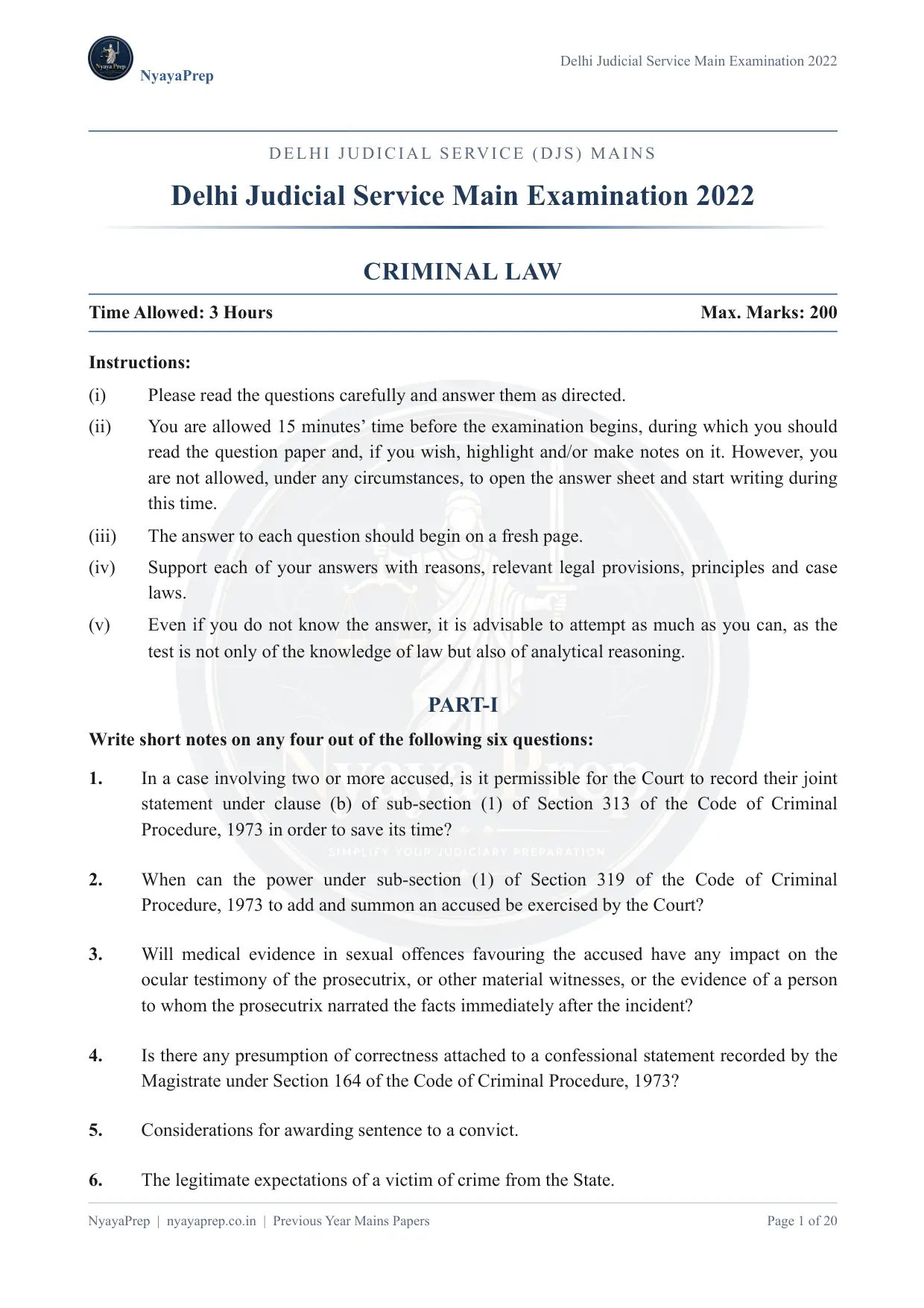
Page 1 as text
Delhi Judicial Service Main Examination 2022
DELHI JUDICIAL SERVICE (DJS) MAINS
CRIMINAL LAW
Time Allowed: 3 Hours
Max. Marks: 200
Instructions:
(i) Please read the questions carefully and answer them as directed.
(ii) You are allowed 15 minutes’ time before the examination begins, during which you should
read the question paper and, if you wish, highlight and/or make notes on it. However, you
are not allowed, under any circumstances, to open the answer sheet and start writing during
this time.
(iii) The answer to each question should begin on a fresh page.
(iv) Support each of your answers with reasons, relevant legal provisions, principles and case
laws.
(v) Even if you do not know the answer, it is advisable to attempt as much as you can, as the
test is not only of the knowledge of law but also of analytical reasoning.
PART-I
Write short notes on any four out of the following six questions:
1. In a case involving two or more accused, is it permissible for the Court to record their joint
statement under clause (b) of sub-section (1) of Section 313 of the Code of Criminal
Procedure, 1973 in order to save its time?
2. When can the power under sub-section (1) of Section 319 of the Code of Criminal
Procedure, 1973 to add and summon an accused be exercised by the Court?
3. Will medical evidence in sexual offences favouring the accused have any impact on the
ocular testimony of the prosecutrix, or other material witnesses, or the evidence of a person
to whom the prosecutrix narrated the facts immediately after the incident?
4. Is there any presumption of correctness attached to a confessional statement recorded by the
Magistrate under Section 164 of the Code of Criminal Procedure, 1973?
5. Considerations for awarding sentence to a convict.
6. The legitimate expectations of a victim of crime from the State.