Mains · descriptive
Delhi Civil Judge Mains 2019 (I 9 10 Feb) Question Paper
Page 1 is free to read. Sign in to read the whole paper. All Delhi Civil Judge papers
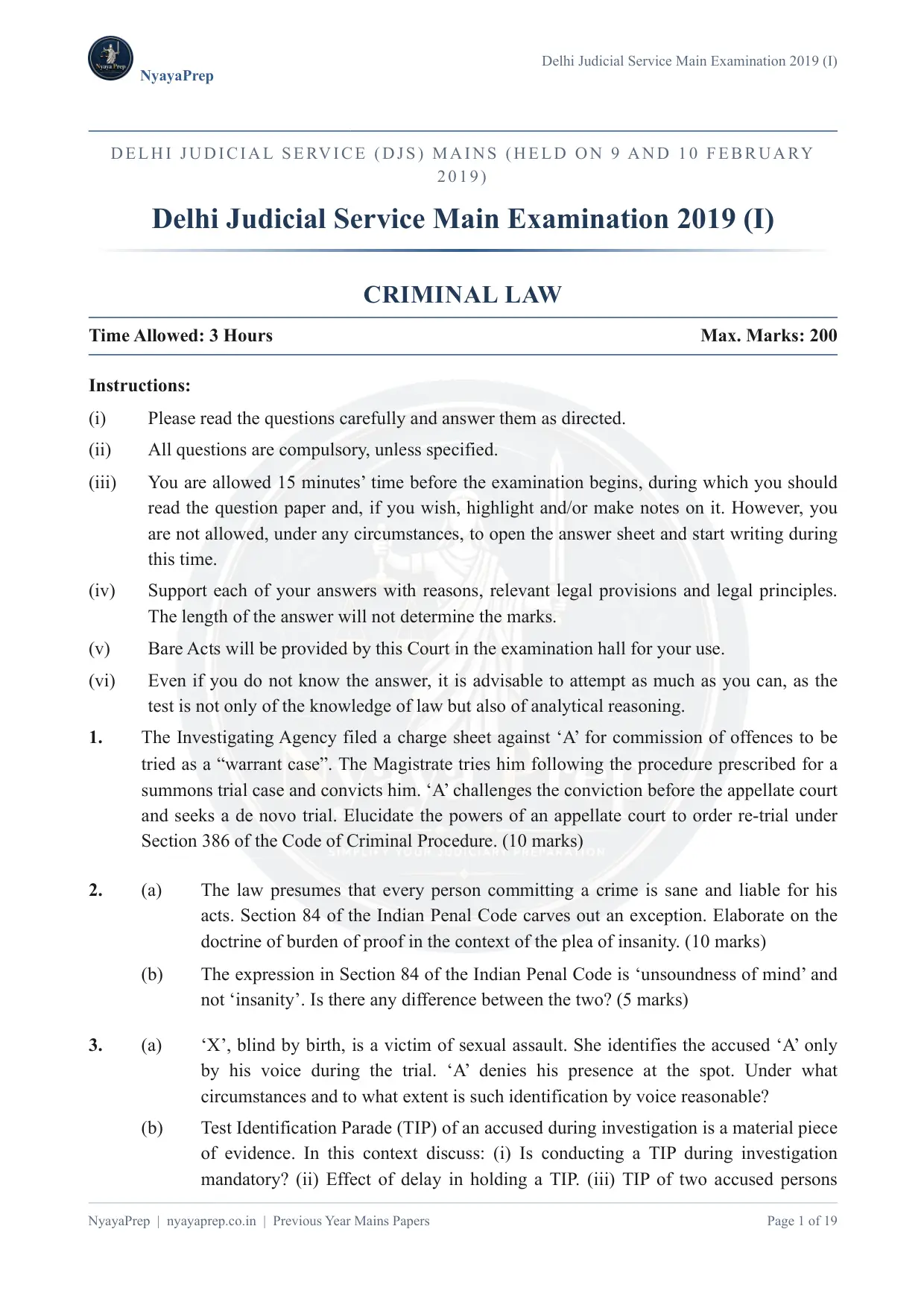
Page 1 as text
Delhi Judicial Service Main Examination 2019 (I)
DELHI JUDICIAL SERVICE (DJS) MAINS (HELD ON 9 AND 10 FEBRUARY
2019)
CRIMINAL LAW
Time Allowed: 3 Hours
Max. Marks: 200
Instructions:
(i) Please read the questions carefully and answer them as directed.
(ii) All questions are compulsory, unless specified.
(iii) You are allowed 15 minutes’ time before the examination begins, during which you should
read the question paper and, if you wish, highlight and/or make notes on it. However, you
are not allowed, under any circumstances, to open the answer sheet and start writing during
this time.
(iv) Support each of your answers with reasons, relevant legal provisions and legal principles.
The length of the answer will not determine the marks.
(v) Bare Acts will be provided by this Court in the examination hall for your use.
(vi) Even if you do not know the answer, it is advisable to attempt as much as you can, as the
test is not only of the knowledge of law but also of analytical reasoning.
1. The Investigating Agency filed a charge sheet against ‘A’ for commission of offences to be
tried as a “warrant case”. The Magistrate tries him following the procedure prescribed for a
summons trial case and convicts him. ‘A’ challenges the conviction before the appellate court
and seeks a de novo trial. Elucidate the powers of an appellate court to order re-trial under
Section 386 of the Code of Criminal Procedure. (10 marks)
2. (a) The law presumes that every person committing a crime is sane and liable for his
acts. Section 84 of the Indian Penal Code carves out an exception. Elaborate on the
doctrine of burden of proof in the context of the plea of insanity. (10 marks)
(b) The expression in Section 84 of the Indian Penal Code is ‘unsoundness of mind’ and
not ‘insanity’. Is there any difference between the two? (5 marks)
3. ‘X’, blind by birth, is a victim of sexual assault. She identifies the accused ‘A’ only
by his voice during the trial. ‘A’ denies his presence at the spot. Under what
circumstances and to what extent is such identification by voice reasonable?
Test Identification Parade (TIP) of an accused during investigation is a material piece
of evidence. In this context discuss: (i) Is conducting a TIP during investigation
mandatory? (ii) Effect of delay in holding a TIP. (iii) TIP of two accused persons