Mains · descriptive
Delhi Civil Judge Mains 2018 Question Paper
Page 1 is free to read. Sign in to read the whole paper. All Delhi Civil Judge papers
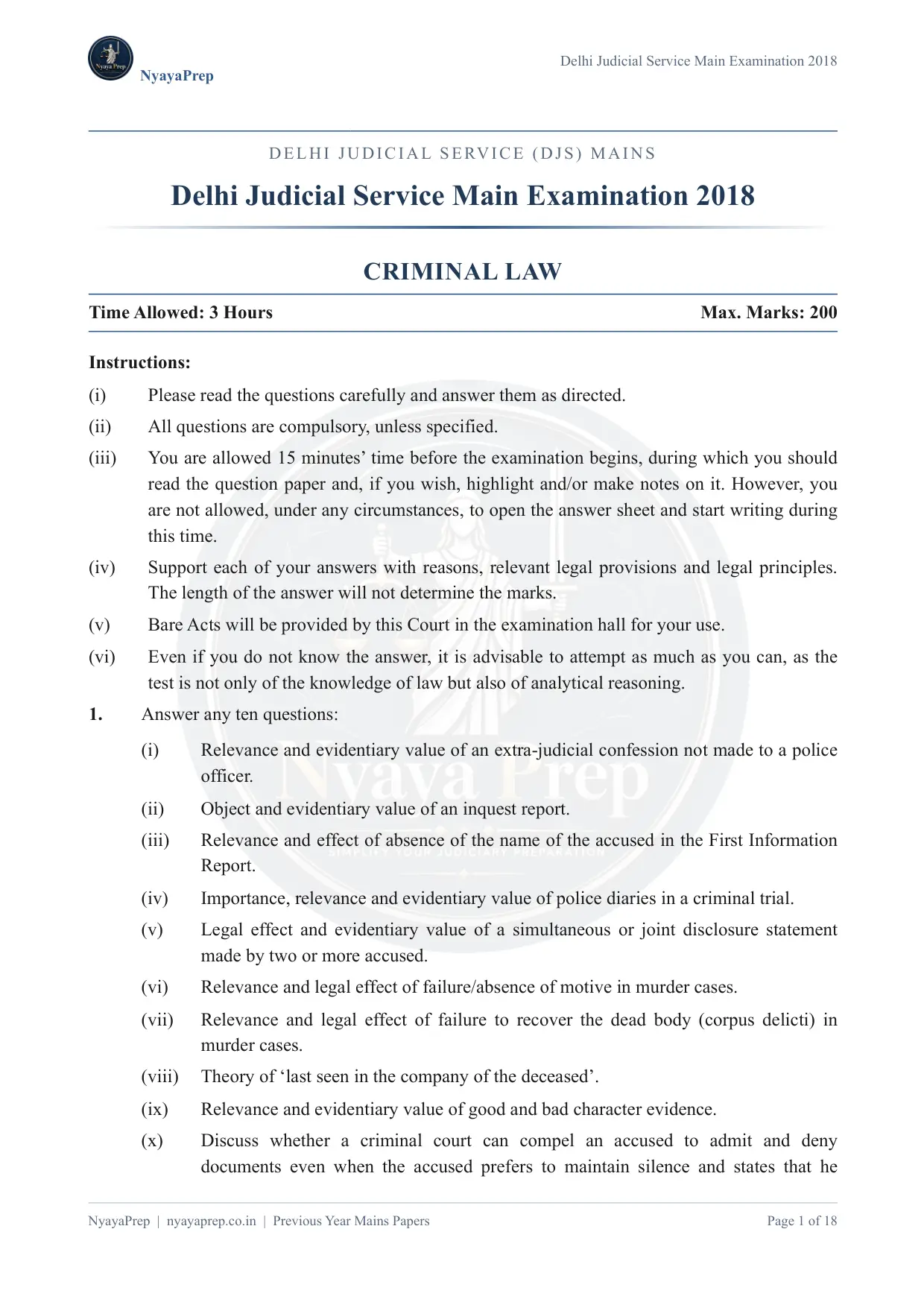
Page 1 as text
Delhi Judicial Service Main Examination 2018
DELHI JUDICIAL SERVICE (DJS) MAINS
CRIMINAL LAW
Time Allowed: 3 Hours
Max. Marks: 200
Instructions:
(i) Please read the questions carefully and answer them as directed.
(ii) All questions are compulsory, unless specified.
(iii) You are allowed 15 minutes’ time before the examination begins, during which you should
read the question paper and, if you wish, highlight and/or make notes on it. However, you
are not allowed, under any circumstances, to open the answer sheet and start writing during
this time.
(iv) Support each of your answers with reasons, relevant legal provisions and legal principles.
The length of the answer will not determine the marks.
(v) Bare Acts will be provided by this Court in the examination hall for your use.
(vi) Even if you do not know the answer, it is advisable to attempt as much as you can, as the
test is not only of the knowledge of law but also of analytical reasoning.
1. Answer any ten questions:
Relevance and evidentiary value of an extra-judicial confession not made to a police
officer.
Object and evidentiary value of an inquest report.
Relevance and effect of absence of the name of the accused in the First Information
Report.
Importance, relevance and evidentiary value of police diaries in a criminal trial.
Legal effect and evidentiary value of a simultaneous or joint disclosure statement
made by two or more accused.
Relevance and legal effect of failure/absence of motive in murder cases.
(vii) Relevance and legal effect of failure to recover the dead body (corpus delicti) in
murder cases.
(viii) Theory of ‘last seen in the company of the deceased’.
(ix) Relevance and evidentiary value of good and bad character evidence.
(x) Discuss whether a criminal court can compel an accused to admit and deny
documents even when the accused prefers to maintain silence and states that he