Service Law
Tripura High Court Rejects State Appeal Over Repeated Departmental Inquiry After Exoneration
Nyaya Prep • Published • 4 min read
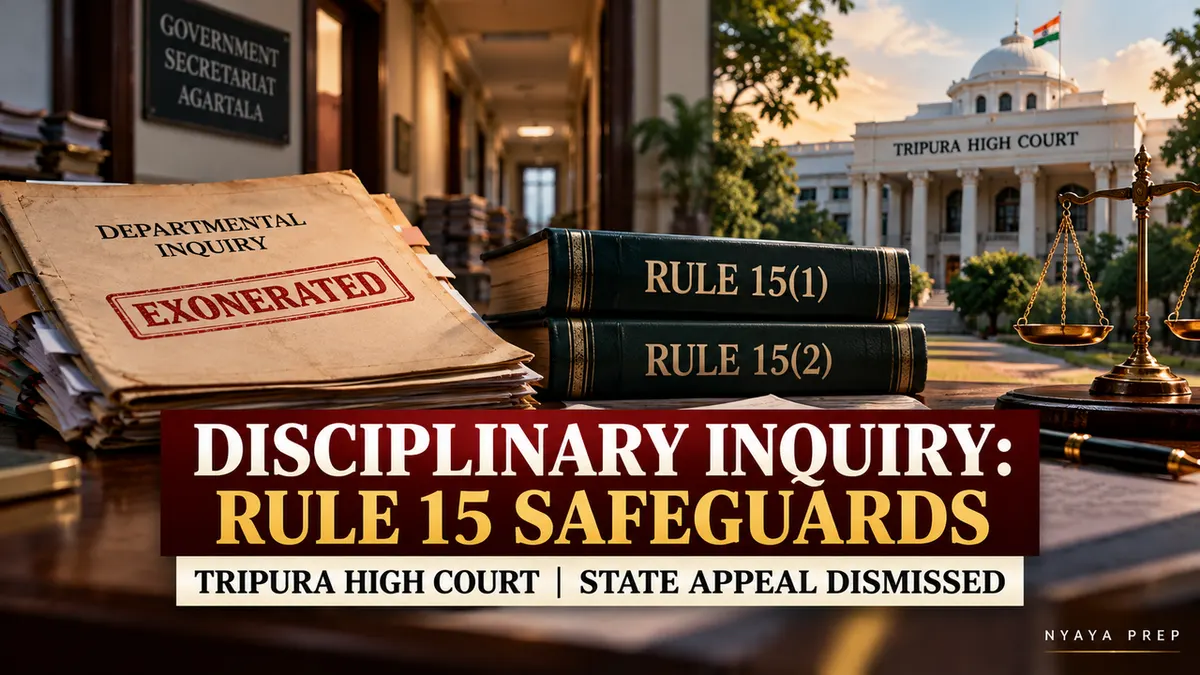
State appeal dismissed on procedural grounds
The Tripura High Court has dismissed a State Government appeal arising from repeated attempts to conduct a further departmental inquiry against Goutam Choudhury, an employee whom the original inquiry authority had exonerated. The Division Bench of Chief Justice M S Ramachandra Rao and Justice S Datta Purkayastha held that the disciplinary authority could not bypass an earlier binding judicial direction requiring compliance with Rule 15(2) of the Central Civil Services (Classification, Control and Appeal) Rules, 1965.
The judgment, delivered on 29 September 2026 in WA No. 12 of 2026, concerns the sequence that must be followed when an authority disagrees with an inquiry report. It does not decide that a disciplinary authority can never disagree with an exoneration. Rather, it insists that any disagreement must proceed through the legally prescribed procedure.
How the dispute developed
A show-cause notice was issued in September 2018 and a departmental inquiry was conducted under Rule 14 of the CCS (CCA) Rules. On 10 May 2021 the inquiry authority submitted a report exonerating Choudhury of all charges. The disciplinary authority nevertheless directed a fresh inquiry in July 2021 and subsequently issued further orders appointing or changing the inquiry officer.
Choudhury challenged those orders. In December 2023, a Single Judge set aside the original direction and required the authority to act in accordance with Rule 15(2). Neither side appealed, so that ruling attained finality. The authority later issued another order in March 2024, this time invoking Rule 15(1), to conduct further inquiry.
Why the second order failed
The employee challenged the March 2024 order and succeeded before a Single Judge in September 2025. The State appealed. The Division Bench examined whether the authority could rely on Rule 15(1), which deals with remitting a case for further inquiry, after a binding earlier judgment had specifically required the Rule 15(2) procedure.
The Bench concluded that it could not. The authority was not free to sidestep the earlier ruling by relabelling the exercise. The original judicial direction had become final, and the procedural obligation it imposed remained binding. The appeal was therefore dismissed.
The protection contained in Rule 15(2)
Rule 15(2) requires the disciplinary authority to forward the inquiry report to the government servant together with its tentative reasons for disagreement, if any. The employee must be allowed to make a written representation before a final decision is taken. This safeguard is particularly important when the inquiry officer has found the charges unproved.
The requirement is not a ceremonial formality. A person facing adverse disciplinary action must know the proposed basis for disagreement and have a meaningful opportunity to answer it. A fresh inquiry order cannot be used as an alternative route when the law and a binding court judgment require the authority to disclose its tentative disagreement.
Operative directions and timeline
The Division Bench directed the disciplinary authority to communicate its tentative reasons for disagreement with the inquiry report within four weeks. The employee was then to have a further four weeks to submit objections. A final order must follow in accordance with law after the response has been considered.
The directions preserve the authority’s power to reach a lawful decision through the correct procedure. They do not automatically convert the inquiry officer’s exoneration into an irreversible final disciplinary order. The crucial distinction is between the power to disagree and the manner in which that power may be exercised.
Significance for public-service discipline
The judgment offers a clear warning against procedural workarounds in departmental cases. An authority cannot repeatedly restart a process while ignoring an earlier order that has settled the required course. Finality of judicial decisions and the right to be heard operate together to prevent uncertainty and arbitrary treatment.
Government departments should therefore record reasons carefully, communicate tentative disagreement when required and provide a genuine opportunity for representation. Employees should distinguish an inquiry officer’s favourable report from the disciplinary authority’s eventual order, while insisting on the safeguards governing any proposed departure from that report.
Case Details
Case: State of Tripura v. Sri Goutam Choudhury
Citation: 2026:THC:1360-DB; WA No. 12 of 2026
Bench: Chief Justice M S Ramachandra Rao and Justice S Datta Purkayastha
Advocates: Dipankar Sarma; Somik Deb; S Tripura; Jishan Samed
Relevant Bare Act
Act: Central Civil Services (Classification, Control and Appeal) Rules, 1965
Relevant provisions: Rules 14, 15(1) and 15(2)
- Tripura High Court
- CCS CCA Rules
- Departmental Inquiry
- Rule 15
- Natural Justice