SC
Supreme Court Stays High Court Restriction on Rohtak Judges Hearing Bail Pleas in Real Estate Fraud Case
Nyaya Prep • Published • 5 min read
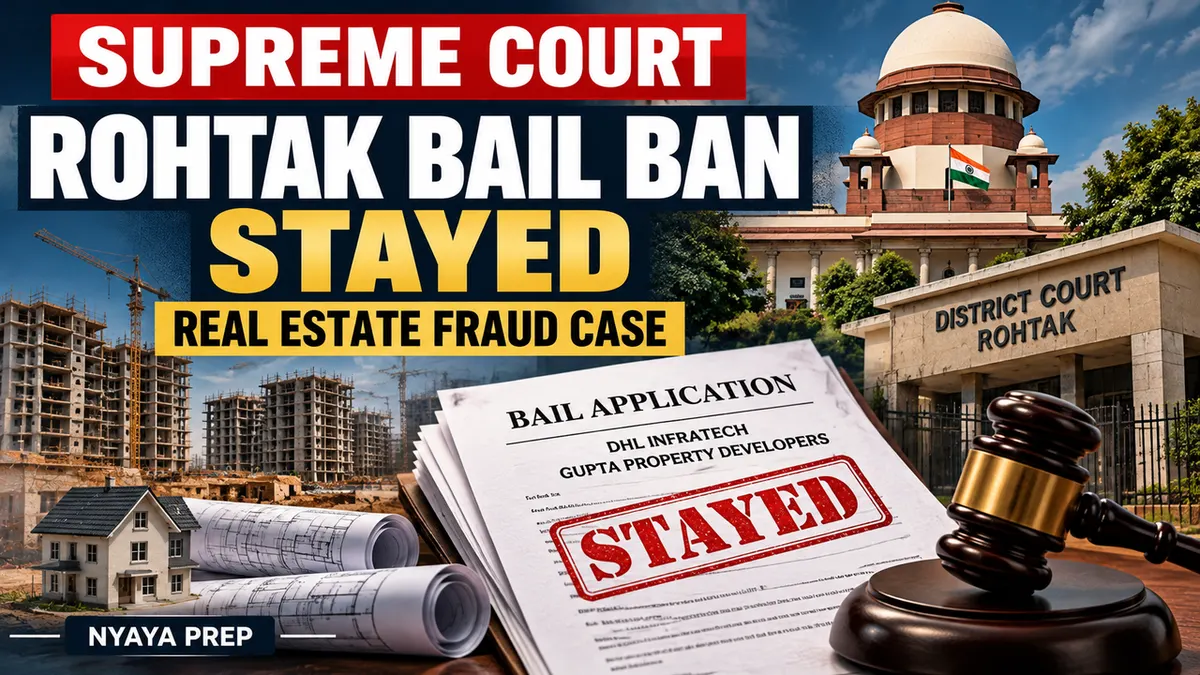
What the Supreme Court stayed
The Supreme Court on 27 October 2026 stayed a direction of the Punjab and Haryana High Court that had prevented judicial officers posted in the Rohtak Sessions Division from entertaining bail applications connected with a particular real estate fraud case. The development concerns the allocation and handling of bail matters in a pending criminal investigation, not a final decision on the alleged property transactions.
The matter is identified in the Supreme Court’s official latest-orders listing as Sidhant Ohlan v. State of Haryana, Diary No. 64731 of 2026. The reported interim intervention concerns a High Court restriction issued during proceedings involving DHL Infratech Private Limited and Gupta Property Developers. The signed text of the Supreme Court’s interim order was not independently accessible during preparation of this update, so any unreported conditions or further directions should not be assumed.
How the restriction arose
The dispute stems from complaints by purchasers who alleged that money had been collected for a residential project on representations about approvals, possession and execution of sale documents. The alleged transactions became the subject of a criminal investigation in Rohtak. These remain allegations; the present Supreme Court order does not establish that the developers or other named individuals committed the offences under investigation.
In proceedings before the Punjab and Haryana High Court, Justice N.S. Shekhawat expressed serious concern about the conduct of the local investigation and the differing treatment of bail requests made by persons connected with the case. The High Court’s earlier order, dated 30 September 2026, was made in proceedings titled Subhash Gupta v. State of Haryana, CRM-M-42815 of 2026.
The High Court noted information about the grant of interim bail to some co-accused and the refusal of relief to another person. It also criticised perceived deficiencies in police action. Against that background, it directed that judicial officers in the Rohtak Sessions Division should not entertain bail applications in the particular criminal case. The High Court expected the State to place the investigation under a senior police officer and sought a status report.
The immediate procedural consequence
The Supreme Court’s reported order puts the High Court’s restriction on hold. The essential distinction is between staying a direction about which judges may hear bail applications and deciding whether any accused person should actually receive bail. The reported stay does not, by itself, amount to an order granting bail, cancelling an FIR, ending the investigation or clearing any person of the allegations.
Bail applications are ordinarily determined through a judicial assessment of the governing law and the circumstances of the individual applicant. The restriction imposed by the High Court was unusual because it addressed a group of judicial officers rather than only the merits of a particular bail request. The Supreme Court’s intervention therefore has an immediate administrative and procedural significance, even though the substantive allegations remain to be examined separately.
Because the complete Supreme Court order was not retrieved, the precise reach of the stay and whether it contains any further qualifications require confirmation from the signed order. It would be premature to claim that the Supreme Court has decided the correctness of every observation made by the High Court about the investigation.
What remains unresolved
The property purchasers’ allegations and the progress of the investigation are separate from the question of which court may entertain bail applications. The High Court had sought further information about investigative steps, including the role of a senior officer. Whether the Supreme Court’s interim order affects any direction other than the reported restraint on Rohtak judges cannot be stated without examining its full terms.
The earlier High Court proceedings had a further hearing scheduled for 28 October 2026. The existence of that date in the earlier record does not establish how the later Supreme Court stay will affect the High Court’s subsequent proceedings. Any changed listing, modification of the restriction or further order must be verified independently.
For judiciary-examination candidates, the development is a reminder to distinguish interim relief, jurisdictional or administrative directions, and a final adjudication on merits. An interim stay preserves or alters the procedural position pending further consideration; it is not necessarily a declaration of a general legal rule. That distinction is especially important when reporting sensitive criminal allegations involving several parties.
Practical significance for litigants and lawyers
The case raises a difficult institutional question: how a constitutional court should respond when it has concerns about the handling of a particular criminal case by the police or lower judiciary, while preserving the ordinary process for judicial consideration of bail. The Supreme Court’s intervention is significant because the earlier restraint applied to all judges posted in a sessions division for one specified case.
For affected applicants, the immediate concern is identifying the competent forum and obtaining an individual judicial decision under the applicable bail provisions. For complainants and purchasers, the investigation and the legal remedies relating to the alleged financial loss remain distinct matters. The next dependable update will be the publication of the signed Supreme Court order or a subsequent hearing clarifying its scope.
Case Details
Case name: Sidhant Ohlan v. State of Haryana
Court: Supreme Court of India
Date of reported interim order: 27 October 2026
Supreme Court diary number: 64731 of 2026
Related High Court proceeding: Subhash Gupta v. State of Haryana, CRM-M-42815 of 2026
- Supreme Court
- Punjab and Haryana High Court
- Rohtak
- Bail Proceedings
- Judicial Administration
- Real Estate Fraud
- Sidhant Ohlan