SC
Supreme Court Says Arbitrators Cannot Rewrite Development Contract, Orders Refund with Nine Percent Interest
Nyaya Prep • Published • 4 min read
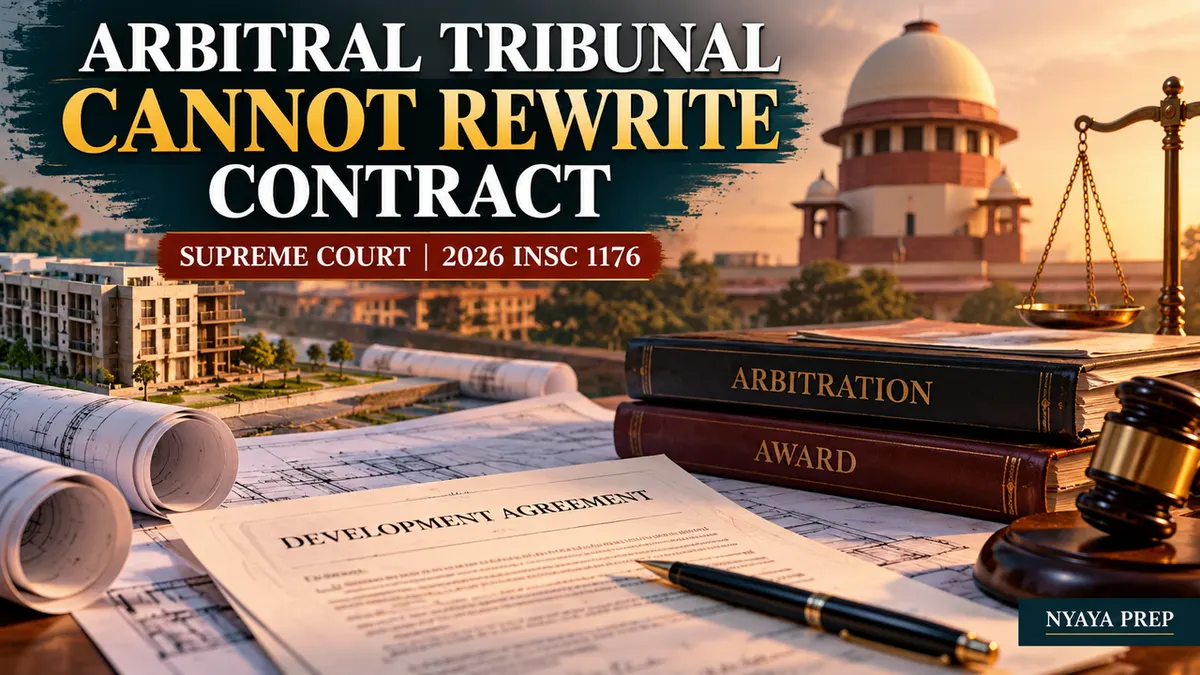
The judgment and its two-part outcome
A Bench of Justices Sanjay Kumar and Sanjeev Sachdeva delivered judgment on 29 October 2026 in Shreeram Builders v. Upendra Kantilal Thanawala and others, 2026 INSC 1176. The Court upheld the High Court’s intervention against the majority arbitral award because the tribunal had replaced essential contractual terms with different obligations.
At the same time, the Court exercised its power under Article 142 of the Constitution to direct the respondents to return consideration received under the agreement, with simple interest at nine percent per annum from each payment date until refund. The appeals were disposed of on those terms, with each side bearing its own costs. This restitutionary relief must not be confused with reinstatement of the invalid arbitral award.
The underlying development agreement
The dispute arose from an August 2003 agreement between property owners and Shreeram Builders for a development transaction. The agreement contained detailed conditions linking consideration to floor-space index, possible regularisation of additional land, construction of basements and subsequent steps needed before a conveyance could be executed.
After the owners terminated the arrangement in April 2008, the parties invoked arbitration. A majority of the tribunal delivered an award in December 2011 in favour of the developer, declaring termination invalid and directing specific performance upon deposit of a sum specified in the award. A dissenting arbitrator rejected the claims and counterclaims.
The majority award was first upheld in proceedings under Section 34 of the Arbitration and Conciliation Act, 1996. The High Court later set it aside under Section 37. The developer then approached the Supreme Court, which examined the actual bargain and the tribunal’s authority to grant the relief awarded.
Why the award exceeded contractual limits
The Supreme Court emphasised Section 28(3), which requires an arbitral tribunal to take account of the terms of the contract. The Court found that the majority arbitrators ignored the agreed sequence of payments and conveyance, treated variable consideration as if it could be settled on new terms, and included property that the agreement had expressly excluded.
The judgment also identified adjustments based on an earlier memorandum that the later agreement had superseded. It criticised the adoption of a rate not derived from the contractual formula and the grant of damages without the necessary contractual foundation. The cumulative result was not merely an arguable interpretation of ambiguous wording but a substitution of the tribunal’s preferred arrangement for the parties’ agreement.
The Court stressed that arbitrators derive their authority from consent and cannot grant specific performance by rewriting the consideration, subject matter or timing chosen by the parties. That principle remains important even where a tribunal considers a different result commercially fair.
Which version of arbitration law applied
The Section 34 challenge had been filed in 2012, before the 2015 amendments to the Arbitration and Conciliation Act. The Supreme Court therefore considered the challenge under the pre-amendment public-policy framework, while discussing the later statutory changes and the decision in Ssangyong Engineering on their temporal application.
This distinction matters because the modern Section 34(2A) ground of patent illegality was not simply transplanted backwards into the dispute. The Court nevertheless held that an award contradicting the underlying bargain in the manner demonstrated here could not be sustained under the applicable earlier law.
The Court did not announce that every incorrect contractual interpretation automatically justifies judicial interference. The defect was the tribunal’s disregard of express terms and its creation of obligations that the contracting parties had not accepted.
Restitution without reviving the award
The judges also examined a contractual clause requiring repayment of consideration if the arrangement ended before construction on the owners’ share. The owners had retained payments after termination. The Court considered that it would be unjust to permit retention while denying the developer the contractually promised conveyance.
Rather than direct another round of litigation, it ordered repayment with nine percent simple annual interest. It also permitted return of sums deposited in court, together with accrued interest if any. This direction was framed as complete justice under Article 142, not as approval of the arbitral majority’s damages or specific-performance directions.
For drafting and arbitration practice, the ruling reinforces the need for precise contractual payment triggers and exclusions. Arbitrators must respect those terms, and courts may still address restitution separately when setting aside an award leaves one party holding money that should be returned.
Case Details
Case: Shreeram Builders v. Upendra Kantilal Thanawala & Ors.
Citation: 2026 INSC 1176
Bench: Justices Sanjay Kumar and Sanjeev Sachdeva
Advocates: Darius Khambata for appellant; Shyam Divan and Aniruddha Joshi for respondents, with respective appearing counsel.
Relevant Bare Act
Arbitration and Conciliation Act, 1996: Sections 28(3), 34 and 37
Constitution of India: Article 142
- Supreme Court
- Arbitration
- Contract
- Section 28(3)
- Section 34
- Section 37
- Article 142