SC
Supreme Court Restores DVC Tariff Ruling, Sets Aside APTEL Review and Imposes ₹3.5 Lakh Costs
Nyaya Prep • Published • Updated • 5 min read
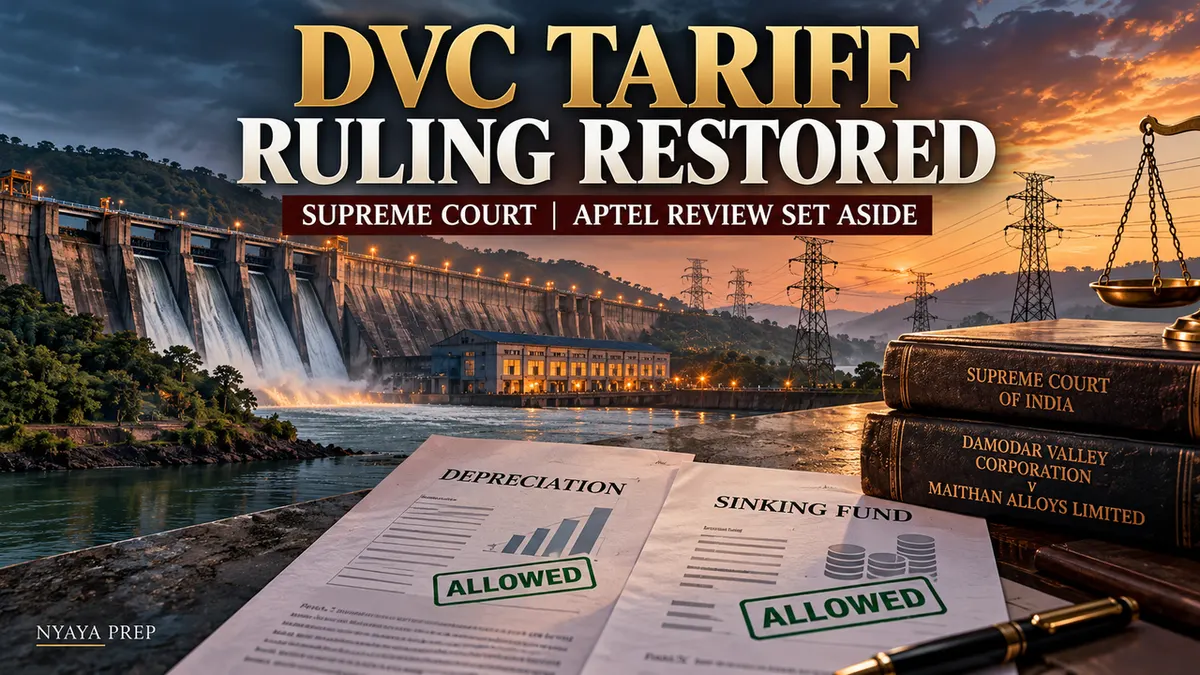
The Supreme Court restores the original tariff ruling
The Supreme Court of India has set aside a review order of the Appellate Tribunal for Electricity (APTEL) that prevented Damodar Valley Corporation (DVC) from recovering both depreciation and contributions to its sinking fund through electricity tariffs. A Bench of Justices J.B. Pardiwala and K. Vinod Chandran restored APTEL’s original order dated 17 May 2019 and held that the later review violated the discipline required by binding Supreme Court precedent.
In its reportable judgment dated 30 October 2026, the Court allowed DVC’s appeal and imposed separate costs on Maithan Alloys Limited and Steel Authority of India Limited (SAIL). The decision concerns the 2009–2014 tariff period and the applicable statutory framework.
How the dispute developed
DVC is a statutory corporation with responsibilities extending beyond power generation to flood control, irrigation and regional development. Its financial arrangements include a sinking fund intended to redeem bonds issued for capital expenditure. Depreciation, by contrast, accounts for the use and eventual replacement of capital assets. Whether both amounts could be reflected in tariff calculations became the central controversy.
The Central Electricity Regulatory Commission (CERC) had permitted the sinking fund contribution to be treated as an expenditure recoverable through tariff. APTEL upheld that treatment in 2019, relying on the Supreme Court’s earlier decision in Bhaskar Shrachi Alloys Limited v. Damodar Valley Corporation, reported in (2018) 8 SCC 281. No appeal was brought against the 2019 tribunal order.
Maithan Alloys instead pursued a review. In 2024, more than five years after the original order, APTEL reversed its position. It reasoned that depreciation on assets created with bond proceeds and contributions towards redeeming those bonds would confer an impermissible double benefit. DVC challenged that reversal before the Supreme Court.
Arguments and the legal issue
The contest was not whether a sinking fund exists, but whether its inclusion in recoverable tariff expenditure must exclude depreciation on the related assets. The respondents advanced the concern that consumers would effectively finance the same capital investment twice. The Court treated that submission as a party position requiring examination against the statutory scheme and the prior binding decision, rather than as an established defect in DVC’s accounting.
The further and decisive question was procedural: could APTEL revisit the issue in review after its original order had followed a Supreme Court judgment? The Court examined both the statutory treatment of DVC’s funds and the narrow boundaries of review jurisdiction.
Why the review order could not stand
The Bench held that APTEL could not use review proceedings to reach a different interpretation of an issue already considered by the Supreme Court. Article 141 of the Constitution makes the law declared by the Supreme Court binding on all courts within India. A tribunal cannot avoid that obligation by suggesting that an earlier Supreme Court Bench overlooked an argument which ought to have been pursued through a properly constituted appeal.
The judgment referred to State of West Bengal v. Kamal Sengupta, (2008) 8 SCC 612, on the meaning of an error apparent on the face of the record. A mistake requiring extended debate or detailed reasoning is not ordinarily such an error. The review power under Section 122(f) of the Electricity Act is not a substitute for an appeal on the merits.
The Supreme Court found that APTEL’s 2024 decision fell outside the recognised grounds of review. Its criticism was directed at the tribunal’s departure from settled law and at the use of review to reopen a controversy that had attained finality.
Why both tariff components were permissible
On the substantive question, the Court read the fourth proviso to Section 14 of the Electricity Act together with the special provisions governing DVC. Section 40 of the Damodar Valley Corporation Act authorises provision for depreciation and reserve or other funds. Regulation 43 of the CERC Tariff Regulations, 2009 specifically recognises depreciation and the funds established under Section 40 in the tariff framework applicable to DVC.
The Court found that the earlier Bhaskar Shrachi Alloys ruling had already addressed the relevant statutory treatment. It rejected the suggestion that the sinking fund and depreciation were mutually exclusive simply because both related to bond-financed assets. The ruling should not be read as a general licence for duplicate recovery under every electricity tariff regime; it rests on DVC’s specific statutory provisions and the binding precedent interpreting them.
Costs, compliance and wider significance
The Supreme Court restored APTEL’s order of 17 May 2019. It imposed costs of ₹2 lakh on Maithan Alloys for pursuing the belated review and ₹1.5 lakh on SAIL for supporting the challenged position. Both sums must be paid to DVC within one month of the judgment. If payment is delayed, interest at 18 percent per annum will apply. The appeal was allowed and pending applications were rejected.
The broader importance lies in distinguishing an obvious error from reopening settled legal questions. Electricity regulators, specialist tribunals and litigants must account for binding precedent when assessing whether review is available. It also illustrates why finality in adjudication matters when tariffs and public-sector financing have already been considered through multiple stages of litigation.
Case details and applicable law
Case: Damodar Valley Corporation v. Maithan Alloys Limited & Others
Citation: 2026 INSC 1178; Civil Appeal No. 11106 of 2024
Bench: Justices J.B. Pardiwala and K. Vinod Chandran
Advocates: Senior Advocates Abhishek Manu Singhvi and Vikas Singh appeared for DVC; Advocate Rajiv Yadav appeared for Maithan Alloys; Senior Advocate Rajiv Shakdher appeared for SAIL.
Constitution of India: Article 141.
Electricity Act, 2003: Section 14 (fourth proviso) and Section 122(f).
Damodar Valley Corporation Act, 1948: Section 40.
CERC (Terms and Conditions of Tariff) Regulations, 2009: Regulation 43.
- Supreme Court
- APTEL
- Electricity Tariff
- Damodar Valley Corporation
- Article 141
- Review Jurisdiction
- Sinking Fund