SC
Supreme Court Reserves Order on ED Request for CBI Investigation into Alleged Obstruction of I-PAC Search
Nyaya Prep • Published • 4 min read
What the Court decided today
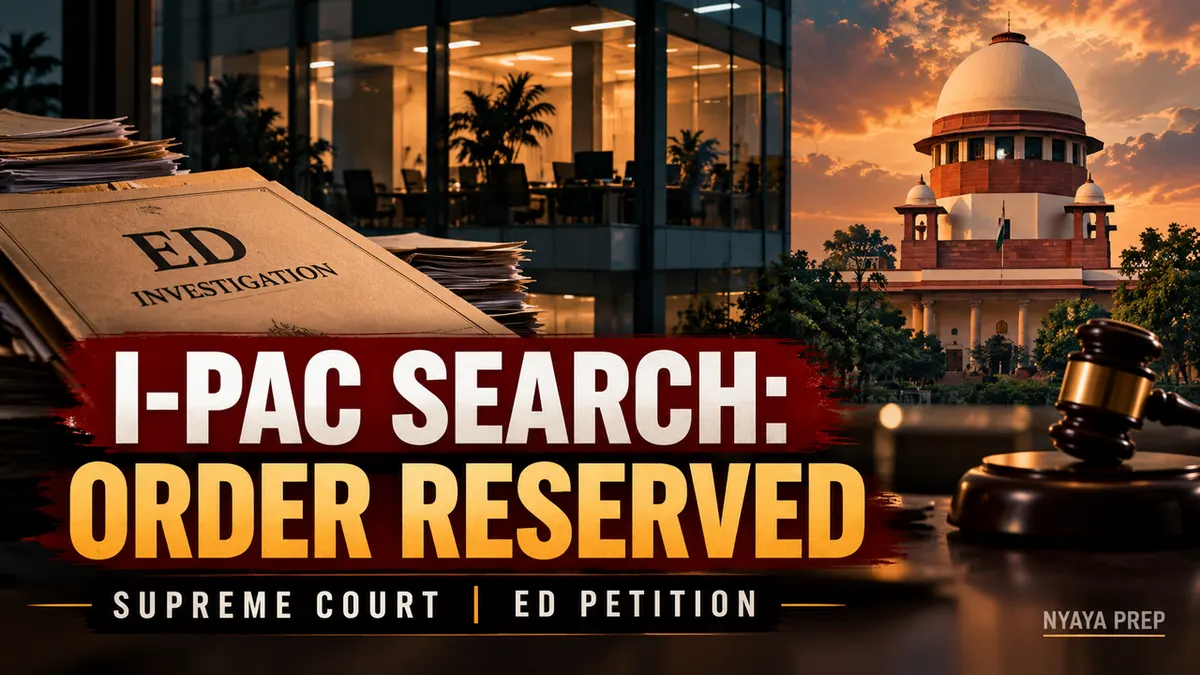
A bench of Justices Prashant Kumar Mishra and N V Anjaria concluded hearing on a writ petition by the Enforcement Directorate and its officers. The immediate question before the bench was the appropriate investigating agency for allegations arising from a search operation at the Kolkata offices of political consultancy I-PAC. The bench reserved its order on that limited issue. It did not announce a finding that any respondent had obstructed investigators, nor did it direct the CBI to register a case at this stage.
The distinction matters because reserving an order closes oral submissions on the issue under consideration but does not determine the merits. Any final direction concerning investigation, agency selection or the status of the allegations must await the Court’s eventual order. The report of the hearing does not identify a date on which that order will be pronounced.
Background to the ED petition
The dispute followed searches by ED personnel at I-PAC premises in Kolkata in connection with a money-laundering investigation linked to an alleged coal scam. The agency alleges that Mamata Banerjee, then Chief Minister of West Bengal, arrived at the office with political leaders, confronted officers and removed certain files. Those assertions are allegations advanced by the investigating agency and must not be presented as judicially established facts.
The ED petition also names the then Director General of Police Rajeev Kumar, the then Kolkata Police Commissioner Manoj Kumar Verma and the then South Kolkata Deputy Commissioner Priyabatra Roy among the respondents. The precise criminal liability of any individual was not decided at this hearing. The procedural controversy instead concerned who should examine the allegations and whether a court-directed referral was necessary.
Arguments on the choice of investigating agency
Senior Advocate Kapil Sibal, appearing for the former Chief Minister, submitted that the political position in West Bengal had changed and that the present State government was capable of considering an investigation or referral. He argued that a judicial direction was unnecessary because the State itself could refer a matter to the CBI if the circumstances warranted it. This was a party submission, not a determination that the State had already ordered such a referral.
Additional Solicitor General S V Raju raised the opposing concern that a referral initiated by the State might later attract allegations of political motivation. He also pointed to the position of senior police officers named in the petition and argued that they could influence a State-level investigation. The bench heard the competing positions on institutional independence and the perception of neutrality before reserving its decision.
Legal issue and procedural significance
The hearing illustrates the difference between deciding whether allegations merit investigation and deciding which authority should investigate them. A court may have to consider the existing investigative framework, the nature of the allegations, possible conflicts of interest and whether exceptional judicial intervention is justified. None of those considerations should be converted into a conclusion that the ED’s account has been proved.
The CBI is a central investigative agency, while State police ordinarily investigate offences within their jurisdiction. The availability and conditions of a central-agency investigation depend on the applicable law and any judicial order. The present report does not disclose a final ruling on consent, statutory jurisdiction or the evidentiary threshold for transferring the case.
For readers following the litigation, the critical distinction is between a request for a CBI investigation and an actual direction ordering one. The former remains pending. No FIR or finding of guilt should be inferred from the Court’s decision to reserve an order.
What happens next
The next operative step is pronouncement of the reserved order. It may clarify whether the Court considers a CBI referral necessary or regards the State government as an appropriate forum to decide the matter. Until that order is available, the parties’ arguments remain competing positions and the alleged obstruction remains unadjudicated.
Any subsequent report should reproduce the actual directions from the signed order rather than assume that the oral discussion amounts to a binding instruction. That is particularly important where a politically sensitive investigation may affect several officials and where public accounts of a hearing can easily blur the line between accusation, advocacy and judicial conclusion.
Case Details
Case: Enforcement Directorate v. State of West Bengal & Others (I-PAC search proceedings)
Citation: Citation not yet available
Bench: Justices Prashant Kumar Mishra and N. V. Anjaria
Advocates: Senior Advocate Kapil Sibal for Mamata Banerjee; Additional Solicitor General S. V. Raju for the Enforcement Directorate
Relevant Bare Act
Constitution of India: Article 32
- Supreme Court
- Enforcement Directorate
- CBI
- West Bengal
- I-PAC