SC
Supreme Court Requests Law Commission Study After 24-Year Delay in Enforcing Arbitral Award
Nyaya Prep • Published • Updated • 4 min read
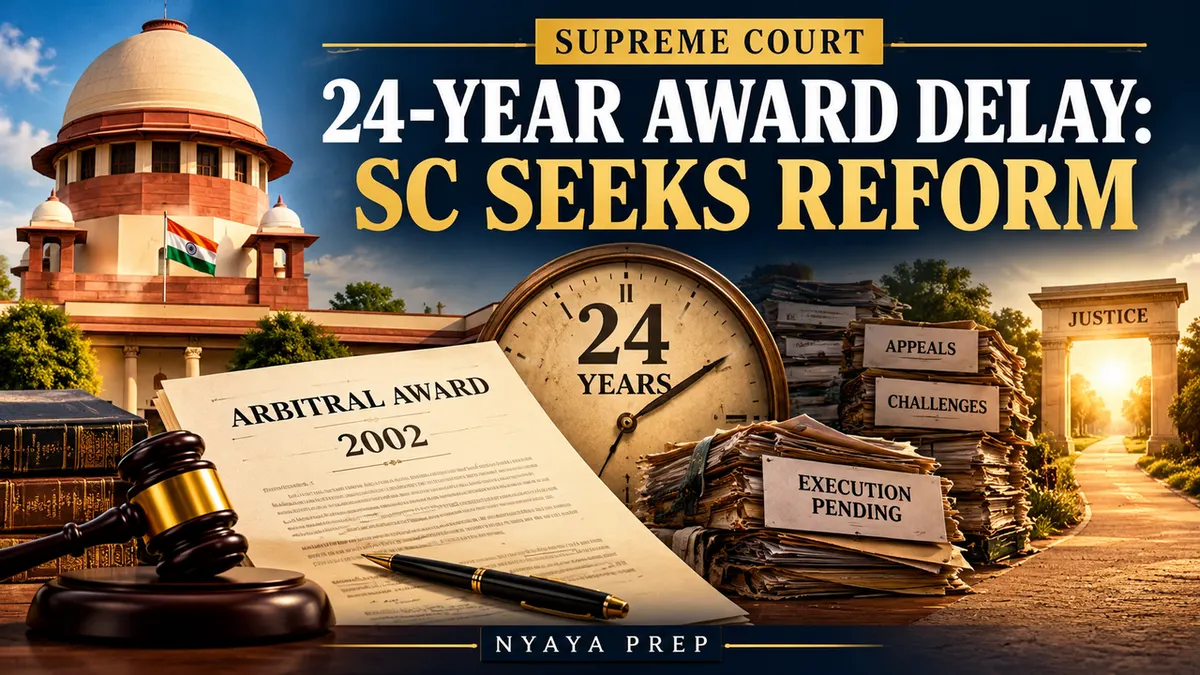
A dispute that outlived the arbitration
The case arose from an international commercial arbitration involving Royal Construction Company Private Limited and National Projects Construction Corporation. The award was rendered in 2002, but the parties continued to litigate questions connected with payment and enforcement for more than twenty-four years. Earlier proceedings had addressed the currency in which the award was payable and how payments and interest were to be treated. The present intervention therefore emerged from a concrete and unusually prolonged enforcement history, not from an abstract consultation about arbitration policy.
The Court drew attention to the gap between obtaining an arbitral award and actually receiving the amount awarded. A claimant may succeed before the tribunal, survive challenges to the award and still face substantial delay when attempting to execute it. That gap can undermine the commercial value of arbitration as an alternative to ordinary litigation. The Bench treated the length of this dispute as evidence that procedural finality alone does not necessarily deliver practical relief.
What Section 36 provides
Section 36 of the Arbitration and Conciliation Act, 1996 generally permits enforcement of an arbitral award in the same manner as a court decree, subject to the applicable statutory conditions. That approach makes ordinary civil execution machinery relevant to arbitration. The Supreme Court did not suggest that every procedural safeguard should disappear. Rather, it identified the need to test whether the existing machinery deals effectively with enforcement once the grounds for resisting an award have been exhausted.
The central distinction is between a legitimate objection permitted by law and repetitive or dilatory steps that prevent an award-holder from obtaining its benefit. A system may have rules that recognise an award but still lack efficient processes to identify assets, coordinate recovery and dispose of objections. The Court's request asks the Commission to consider these practical problems as well as the wording of the governing statutes.
Questions referred for examination
The Commission has been invited to examine practical obstacles to timely recovery, including identifying and disclosing the award-debtor's assets and coordinating different methods of execution. The Court also pointed to repetitive objections and the overall time taken to complete enforcement proceedings. These are subjects for study, not findings that a particular party in every arbitration has acted improperly.
Another question is whether enforcement of domestic and foreign awards should follow separate procedures or a common framework containing suitable safeguards. The Commission may study comparative approaches used elsewhere and assess whether changes to legislation or court procedure would improve outcomes. The language of the request leaves room for a considered policy response rather than dictating a predetermined statutory solution.
Why the intervention matters
For businesses, delayed recovery can change the economic value of a successful claim. Interest, legal expenses, currency questions and the availability of debtor assets can all complicate enforcement. For lawyers and courts, the decision highlights that the effectiveness of arbitration should be measured beyond the time needed to obtain an award. The execution stage deserves independent institutional attention.
The judgment should not be read as creating an automatic right to immediate payment or eliminating statutory defences available to judgment-debtors. Nor does it itself settle every outstanding issue in the parties' long-running dispute. Its broader significance is institutional: the Supreme Court has formally asked the body responsible for legal reform to consider how the enforcement system can be made more predictable and timely.
Operative next step
The immediate operative direction is for the Supreme Court Registry to forward the judgment to the Chairman of the Law Commission. The Commission may thereafter undertake the requested study and recommend legislative or procedural measures. Whether any proposal becomes binding law will depend on subsequent decisions by the competent authorities. Until then, existing statutory provisions and judicial directions continue to govern individual execution proceedings.
- Arbitration
- Law Commission
- Execution of Awards
- Section 36