SC
Supreme Court Refers Reliance–Government KG Basin Gas Dispute to Justice Ranjana Prakash Desai for Mediation
Nyaya Prep • Published • 4 min read
The Court’s immediate decision
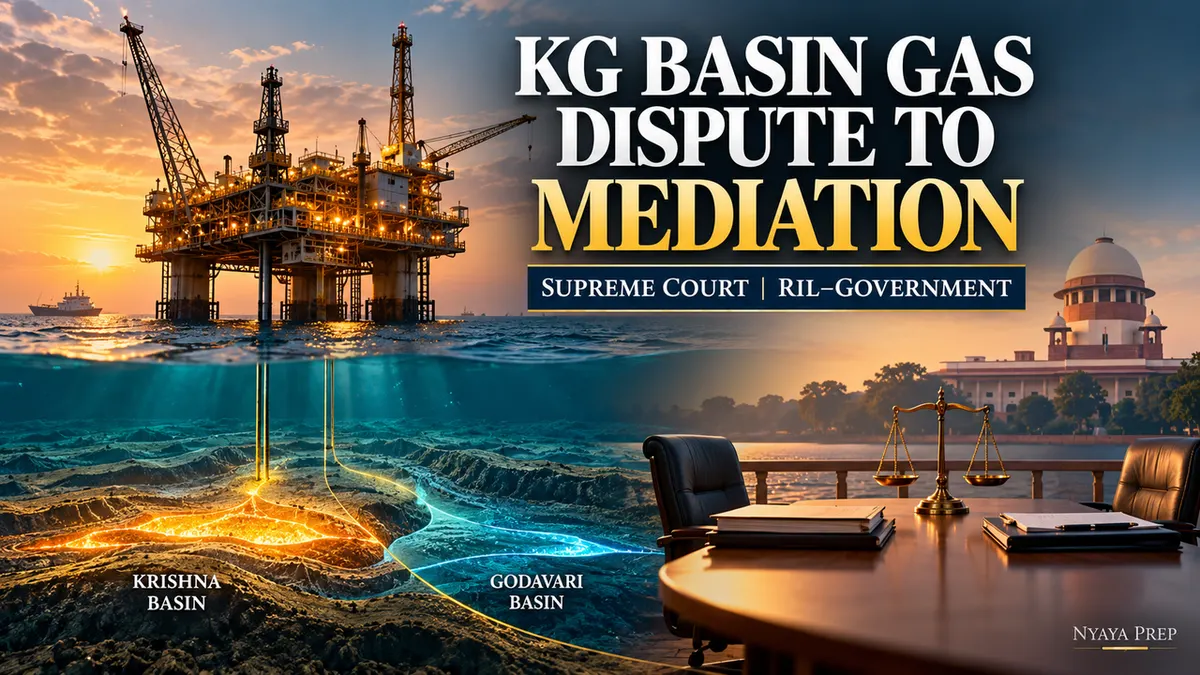
A Bench led by Chief Justice Surya Kant, with Justices Joymalya Bagchi and V. Mohana, asked former Supreme Court judge Justice Ranjana Prakash Desai to serve as mediator in a dispute over gas allegedly migrating between adjoining offshore production blocks. The Court also contemplated two subject specialists, whose names would come from the parties. This is a procedural referral designed to explore settlement, not a final determination of liability, contractual breach, ownership of migrated gas or the amount recoverable from the private operator.
Why mediation was ordered
The parties had sought adjournments while attempting to negotiate a settlement themselves. Attorney General R. Venkataramani and Senior Advocate Kapil Sibal informed the Court that the discussions had not produced a workable resolution. The Bench responded by appointing an independent mediator and suggesting technical assistance. Given the highly specialised nature of offshore reservoirs and production-sharing arrangements, expertise concerning subsurface connectivity and extraction may help the parties evaluate disputed factual assumptions. No public report establishes a binding settlement, payment direction or fixed conclusion of the mediation process.
Background to the contested extraction
The underlying disagreement concerns allegations that natural gas from an adjoining block operated by the Oil and Natural Gas Corporation migrated into a block operated by Reliance Industries. ONGC asserted that the reservoirs were connected and that gas belonging to its block had been produced from the neighbouring field. A technical study by DeGolyer and MacNaughton indicated reservoir connectivity. The Union government subsequently established a committee chaired by former Supreme Court judge Justice A. P. Shah to examine the controversy. These matters explain the origins of the dispute but do not themselves establish the final civil liability now before the Court.
Arbitration and the Delhi High Court stage
Following the committee process, the government demanded approximately US$1.74 billion plus interest from Reliance Industries in relation to the alleged migrated-gas extraction. Reliance challenged that demand through arbitration under the relevant Production Sharing Contract. A majority of the arbitral tribunal concluded that although certain contractual obligations had been breached, the breaches were not material in the sense asserted by the government. In February 2025, the Delhi High Court set aside the award, finding patent illegality and stressing the State’s trustee role in relation to natural resources. The Supreme Court proceedings followed that ruling.
Legal and commercial issues still unresolved
At the centre of the controversy are the interaction between contractual rights to produce gas, geological migration between blocks, the State’s obligations concerning public natural resources and the standard for reviewing arbitral awards. Those are separate from the question whether the parties can voluntarily agree on a commercial resolution. The referral does not reverse the Delhi High Court’s judgment by itself, nor does it restore the arbitral award. It creates a supervised opportunity for negotiation while the underlying legal controversy remains unresolved.
What the referral means in practice
A mediator facilitates communication and proposals; the mediator does not ordinarily impose a binding adjudicated outcome simply by accepting the appointment. The parties may use technical input to test competing accounts of reservoir connectivity, production volumes, contract interpretation and any proposed financial adjustment. Any agreement would require appropriate legal implementation, and any unresolved issues would remain subject to further judicial process. The reported direction identifies the proposed mediator and expert-assistance framework, but does not disclose a concluded timetable, confidentiality protocol or final financial terms.
Next procedural step
The parties must now engage with the proposed mediation arrangement and suggest suitable domain experts if they wish to use that assistance. The Court’s further action will depend on whether mediation yields an acceptable settlement or the appeal requires adjudication. The immediate news is therefore a shift from unsuccessful bilateral negotiations to court-facilitated mediation, not a judicial verdict that either Reliance Industries or the Union government has won the gas dispute.
Case Details
Case: Reliance Industries Limited v. Union of India and Others
Citation: SLP(C) No. 17584/2025
Bench: CJI Surya Kant, Justices Joymalya Bagchi and V. Mohana
Advocates: Attorney General R. Venkataramani; Senior Advocate Kapil Sibal
Relevant Bare Act
No direct bare-act section is independently verified as the operative basis of this development.
- KG Basin
- Natural Gas
- Arbitration
- Mediation
- Reliance Industries
- ONGC