SC
Supreme Court Questions Rajasthan Over Mining Leases Along Polluted River System
Nyaya Prep • Published • 3 min read
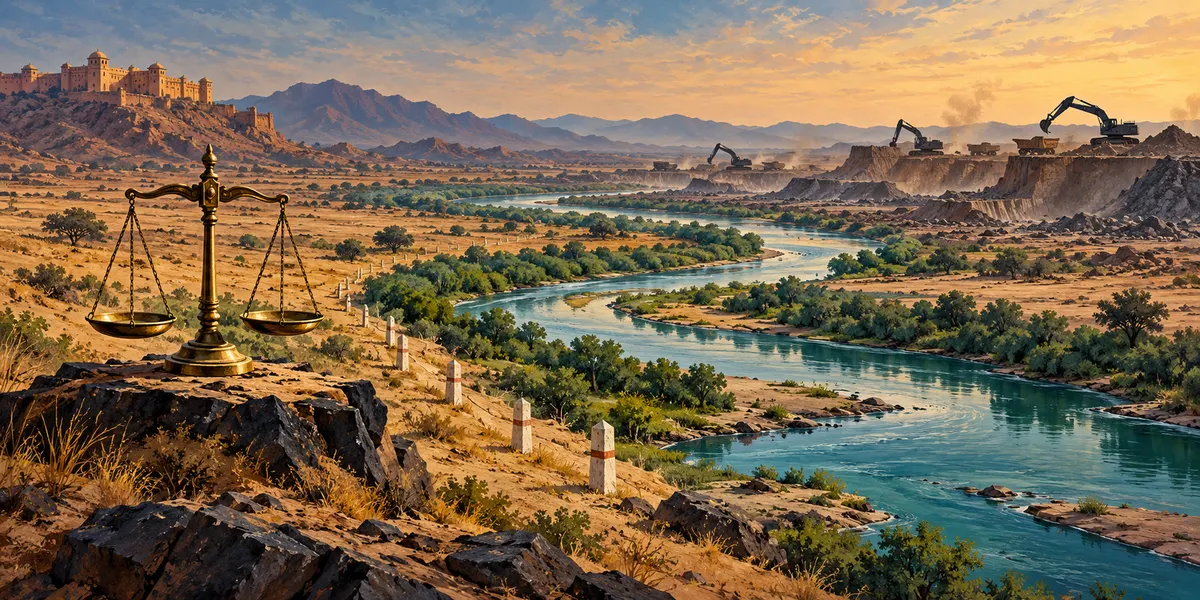
Questions in a continuing river case
The Supreme Court has pressed Rajasthan to explain why mining areas along the Jojari-Luni-Bandi river system were leased or regularised after illegal mining had been identified. Justices Vikram Nath and Sandeep Mehta raised the issue on October 26 in the Court’s continuing proceedings on river pollution. The Bench warned that a Central Bureau of Investigation inquiry could follow if the State did not correct its approach. No CBI investigation was ordered in the reported hearing, and the comments did not determine any officer’s criminal responsibility.
The concern arises in a larger environmental case involving polluted waterways, river corridors and the effect of industrial discharge on nearby communities. Earlier court directions had restricted construction and development within 100 metres of the river edge until a scientific exercise identified the High Flood Line and ecological buffers. The latest hearing examined whether State action was consistent with that protection.
Mining leases under scrutiny
Rajasthan told the Bench that cases had been registered concerning illegal mining. The judges questioned whether filing cases addressed a separate problem: areas previously identified as sites of unauthorised mining had later received leases. The Court asked how contiguous leased stretches could preserve the natural course of the rivers. State counsel said the allotments followed prescribed procedure and undertook to examine the Bench’s concern about regularisation.
The exchange should be read accurately. The Court voiced a serious warning and sought explanations. It did not rule that every lease was unlawful, order cancellation of particular leases or direct a criminal probe that day. The State’s next account of the records and corrective action will matter. Still, the questions are substantive because they concern whether administrative decisions are undermining orders made to protect an already damaged river ecosystem.
Flood boundaries and the recorded corridor
The Bench also examined a Water Resources Department communication said to rely on an earlier Supreme Court order while using a dry-season flow as the basis for the Luni River’s High Flood Line. The judges questioned how a narrow seasonal channel could define a river that periodically floods. The report noted a striking contrast between the State’s narrow flow figure and the width of a bridge over the river at Balotra. The Court was concerned that a cramped definition could leave floodplain and ecological space unprotected.
The Bench accepted the oversight committee’s recommendation that the State protect the entire recorded river corridor by using whichever boundary was wider in Revenue Department and Water Resources Department records. Rajasthan’s counsel acknowledged that fresh permissions for industries would not be granted until scientifically determined flood lines were available. That undertaking is distinct from a final judicial determination of the ultimate boundary; the scientific exercise remains necessary.
The hearing illustrates why river protection cannot depend only on the water visible in a dry season. A flood line and buffer must account for the river’s actual hydrology and recorded corridor, or development and mining decisions may encroach upon the system the Court is trying to restore.
Pollution treatment and the next response
The Court asked Rajasthan to return with a concrete financial proposal supporting common effluent treatment plants equipped with zero-liquid-discharge technology. The judges indicated that the State could not assign the entire burden of restoration to industries and municipalities while its own authorities were alleged to have failed in their regulatory duties. The precise funding split has not been fixed.
At the next hearing, the important questions will be whether Rajasthan provides a credible account of the mining leases, corrects any misuse of prior court directions, protects the broader recorded corridor and offers realistic funding for treatment facilities. For now, the proceeding is a monitoring and compliance matter. Its reported developments should not be described as a conviction, a final finding of illegal mining by identified persons or an order already transferring investigation to the CBI.
Case Details
Proceeding: Supreme Court suo motu proceedings on pollution of the Jojari-Luni-Bandi river system
Bench: Justices Vikram Nath and Sandeep Mehta
Advocate: Additional Solicitor General S.V. Raju appeared for Rajasthan
- Supreme Court
- Rajasthan
- River Pollution
- Illegal Mining
- Flood Line
- Environmental Protection