Constitutional Law
Supreme Court Questions Form 6 Requirement for Previously Enrolled Delhi Voters, ECI Agrees to Examine Alternatives
Nyaya Prep • Published • 3 min read
The hearing and the immediate development
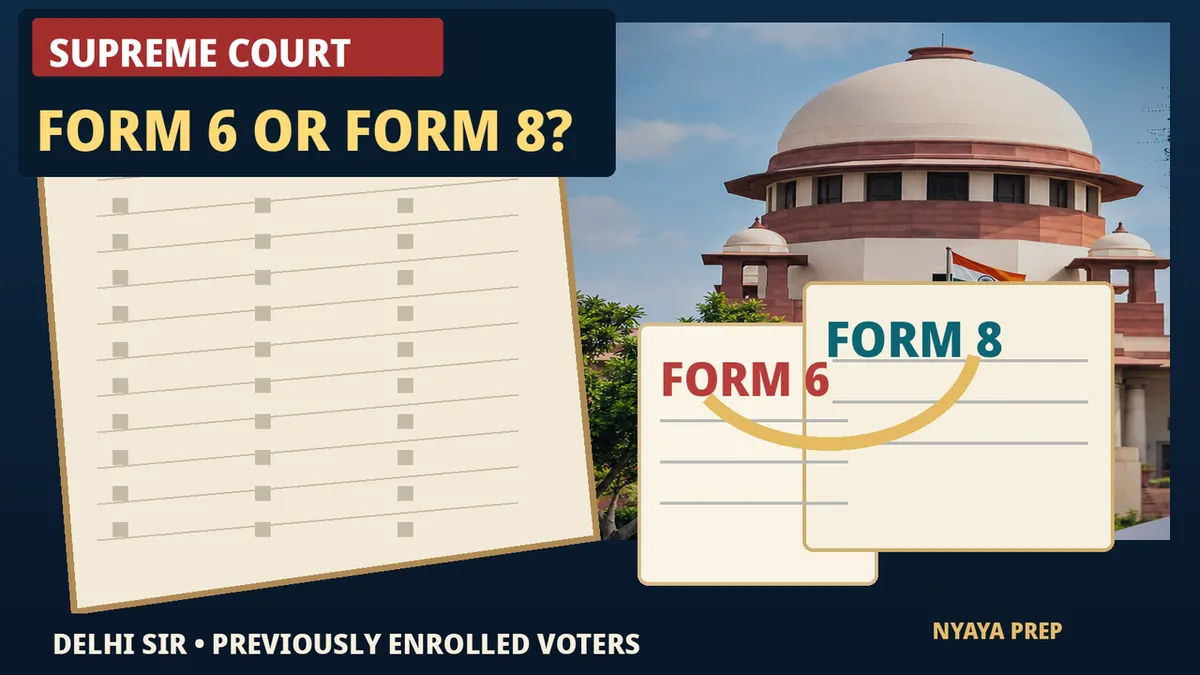
A Bench of Chief Justice Surya Kant and Justices Joymalya Bagchi and V. Mohana heard a petition concerning transparency and remedies during Delhi’s Special Intensive Revision of electoral rolls. The judges focused on a mismatch between the position of someone who was previously registered and the declaration ordinarily associated with Form 6, which is designed for fresh enrolment.
The Court asked whether such electors could instead submit delayed enumeration forms or use Form 8 to reflect a change of residence. Senior Advocate Dama Seshadri Naidu, appearing for the Election Commission, said the authority would examine the concerns and consider remedial steps. He also indicated that an approaching deadline could be extended if necessary. No final order invalidating Form 6 or the revision process was reported at this hearing.
Why Form 6 became controversial
The petitioners argued that a person included in an earlier electoral roll should not be required to represent themselves as a first-time voter merely because they failed to respond during the revision exercise. Advocate Prashant Bhushan said that some voters had moved, were temporarily absent or had not received enumeration forms at their earlier addresses.
According to submissions before the Court, millions of names were omitted from the draft list, with a substantial share classified as shifted or absent. These figures were advanced in the litigation and should not be confused with a final judicial finding that every omission was unlawful. The petitioners contended that the procedure could pressure previously registered electors to make an inaccurate declaration.
The Bench observed that Delhi has a mobile population and that a voter who changes residence may already have an electoral number and identifiable details in the earlier roll. It questioned the administrative logic of making that person begin the process as though they had never been enrolled.
Possible solutions discussed in Court
The judges discussed accepting enumeration forms after the initial cut-off and allowing Form 8 where a change of address was involved. They also suggested a residual category for people who did not submit forms for reasons other than the classifications already used, including non-service or temporary absence.
The Court urged clear public communication and accessible lists so affected people could identify their status and respond. These were concerns and suggestions raised in the hearing; the precise enforceable obligations, if any, must be assessed against the signed judicial order when available.
The Election Commission maintained that the revision is an evolving process and that inclusion remedies remain available. Its counsel explained that references to fresh inclusion related to the new roll being prepared through the exercise, rather than necessarily asserting that a person had never voted before.
A separate legal question remains unresolved
During the same proceedings, the Court also clarified orally that it had not finally decided the legality of using a “logical discrepancy” category in electoral-roll verification. The Bench distinguished an interim arrangement permitted in West Bengal from a conclusive ruling on that practice.
That clarification matters because statements about earlier SIR litigation should not be overstated as resolving every subsequent procedural issue. A temporary arrangement and a final merits decision have different legal effects. The judges cautioned against treating oral observations as definitive holdings.
What happens next
The matter is expected to return to the Supreme Court after approximately two weeks. The Election Commission’s response to the suggested alternatives, any extension of the relevant deadline and the eventual written directions will determine what practical route excluded voters can use.
For now, the development is a judicial examination of the form and notice procedure, accompanied by an assurance that the concerns will be considered. It is not a declaration that the entire Delhi SIR is invalid, nor a blanket restoration of names to the electoral roll.
- Supreme Court
- Delhi SIR
- Electoral Rolls
- Election Commission
- Form 6
- Form 8