SC
Supreme Court Questions Effectiveness of Acid-Sale Guidelines and Urges Centre to Revisit Policy
Nyaya Prep • Published • 4 min read
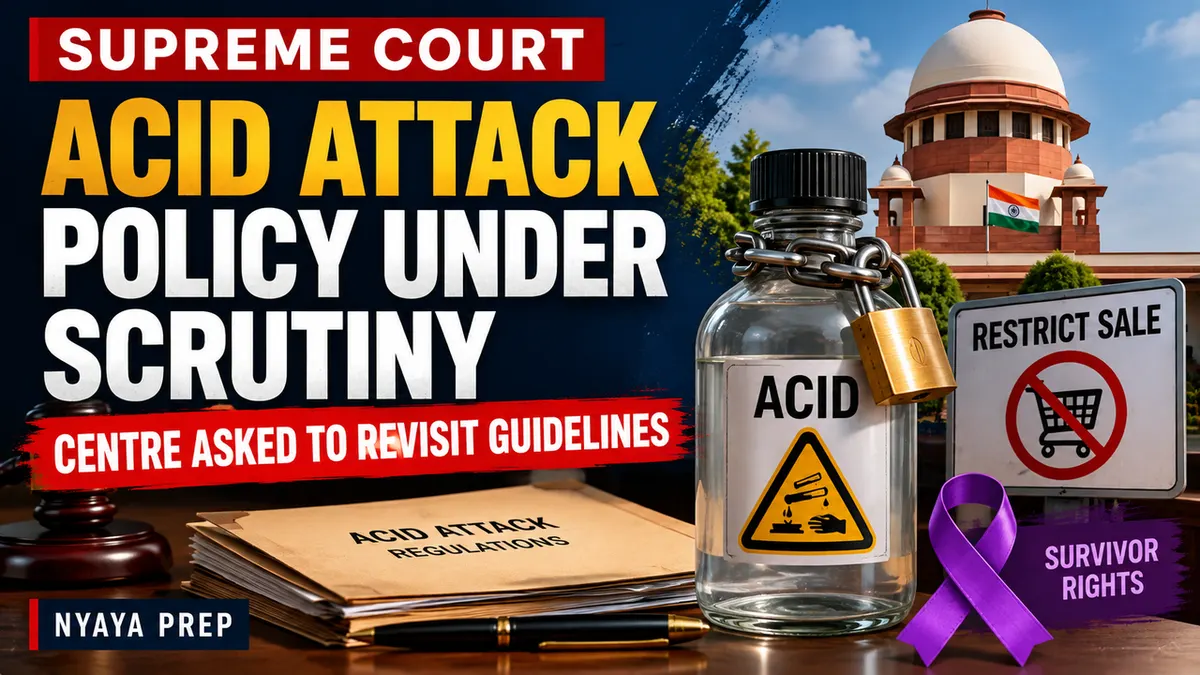
Court raises concerns over implementation
The Supreme Court questioned whether existing restrictions on retail acid sales were achieving their purpose and urged the Union Government to revisit its policy in light of continuing acid attacks. A bench comprising Chief Justice Surya Kant and Justices Joymalya Bagchi and V. Mohana discussed enforcement gaps, accountability and survivor rehabilitation during proceedings in Shaheen Malik v. Union of India. The Court’s observations were reported on 27 October 2026. The hearing should not be mistaken for a final judgment striking down existing guidelines or imposing a complete prohibition on acid sales. The immediate development was judicial scrutiny of how policy works in practice and a request for the Centre to reconsider its approach.
Why existing guidance was questioned
The Union’s representative, Additional Solicitor General Archana Pathak Dave, explained that guidelines restricting acid sales had been issued and circulated to states and Union territories, and that implementation remained difficult. The bench questioned whether issuing instructions was sufficient when attacks continued. It emphasised the need for coordination between central and state authorities and for an examination of data on the incidence of attacks. The discussion focused on whether loopholes in retail availability and enforcement could be identified and addressed. The Court did not announce a factual finding that a particular state officer had violated a duty; it pressed for better accountability mechanisms and meaningful policy review.
Possible regulatory alternatives discussed
The judges considered whether acid should remain widely available for household purposes when substitutes may exist. They suggested examining which uses genuinely require acid and whether stricter control of sales could be designed around those needs. Justice Bagchi referred to legislative approaches in another jurisdiction during the discussion, while the bench explored whether expert input could identify necessary uses and workable alternatives. These remarks were exploratory. They did not themselves create a new licensing system or prohibit all transactions. The Union’s counsel said she would obtain instructions concerning regulated sale. The policy question is how to balance legitimate industrial or household uses with the foreseeable danger of misuse and the need to protect vulnerable people.
Survivor treatment and intervention requests
The hearing also addressed individual survivor needs. Counsel informed the Court about a survivor receiving treatment at Sir Ganga Ram Hospital, and the bench encouraged consideration of accommodation that would allow her mother to assist during a prolonged recovery. The Union’s counsel reported steps taken in relation to medical treatment and the status of accused persons in that matter. The Court also indicated that it would entertain an application involving a woman lawyer who had suffered an acid attack in an earlier incident. These aspects show that the proceeding was not confined to retail regulation: treatment, accessibility, compensation and long-term rehabilitation were central concerns.
Disability recognition and proposed procedures
The bench allowed an intervention application by National Justice and Social Change, an organisation that had placed a proposed standard operating procedure before the Court. The Union and the National Legal Services Authority were asked to examine the proposal and seek input from stakeholders, including survivors. Counsel also discussed the position of survivors with internal injuries caused by forced acid ingestion and the revision of disability-assessment guidelines. These matters affect access to benefits and official recognition of disability. The Court did not finally settle the criteria during this hearing. Its approach indicated that survivor protection requires coordinated action extending beyond the criminal prosecution of perpetrators.
Practical significance and next steps
The development is relevant to constitutional rights, public administration and victim protection. It illustrates the difference between promulgating a rule and showing that the rule is enforced effectively. For students, the important issues are the State’s duty to protect bodily integrity, the design of enforceable controls, coordination across levels of government and rehabilitation after serious violence. The next steps depend on the Union’s instructions, examination of proposed procedures and further judicial consideration. Until a formal order or notification changes the position, existing law and valid guidelines remain applicable. The reported hearing supports a policy-review story, not a claim that the Court has already rewritten the regulatory regime.
Case Details
Case name: Shaheen Malik v. Union of India
Citation: W.P.(C) No. 1112 of 2025
Court: Supreme Court of India
Bench: CJI Surya Kant; Justices Joymalya Bagchi and V. Mohana
Case number: W.P.(C) No. 1112 of 2025
- Supreme Court
- Acid Attacks
- Victim Compensation
- Disability Assessment
- NALSA
- Policy Guidelines
- Article 21