SC
Supreme Court Orders ₹6 Lakh Compensation for Man Acquitted After Six Years in Jail, Calls Case a 'Travesty of Justice'
Nyaya Prep • Published • Updated • 4 min read
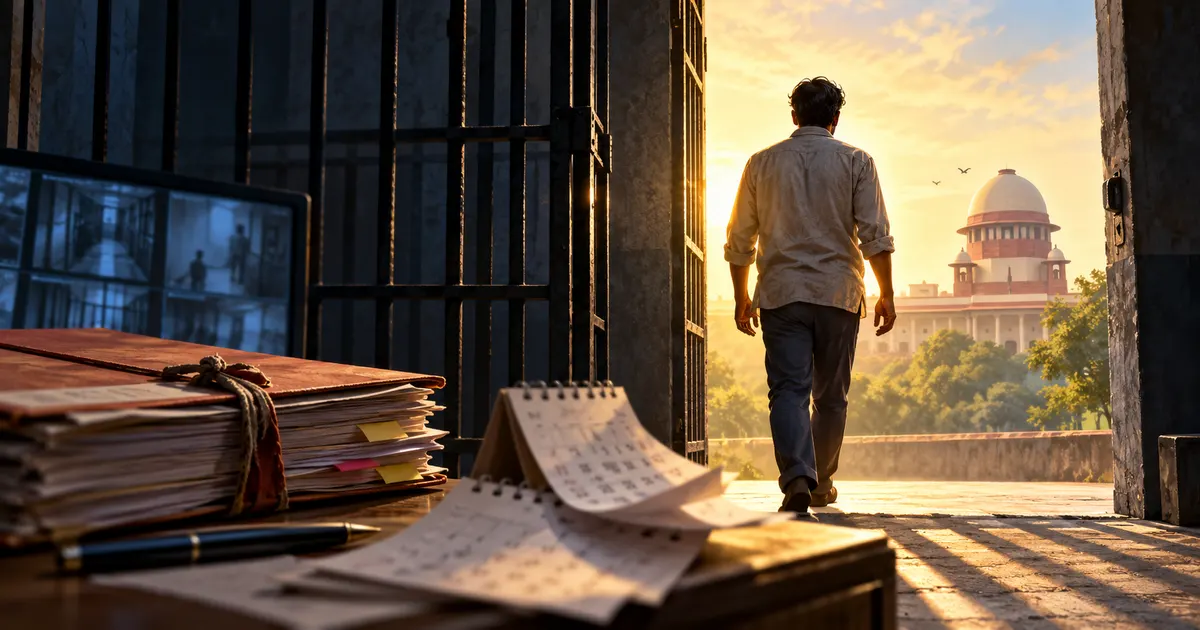
The Supreme Court has directed the State of Uttar Pradesh to pay ₹6 lakh as compensation to a man who spent six years in jail in a murder case and was eventually acquitted by the trial court. In Arun @ Deepak v. State of U.P., reported as 2026 LiveLaw (SC) 1083, a Bench of Justices J.B. Pardiwala and K. Vinod Chandran described the case as a "travesty of justice" and criticised what it called a slipshod investigation and haphazard prosecution. Justice Chandran authored the judgment, which was reported on 26 October 2026.
How the case reached the Court
The petitioner was arrested in connection with an FIR registered in October 2019 in Agra district. The offences invoked were Sections 364 (kidnapping or abduction in order to murder), 302 (murder) and 201 (causing disappearance of evidence) of the Indian Penal Code. He was not named in the FIR or in the complainant's statement under Section 161 of the Code of Criminal Procedure. He was implicated later, on the basis of CCTV footage and the alleged confession of a co-accused. He had been in custody since 14 November 2019.
The matter came before the Supreme Court as a bail application. In March 2026, the Court directed the trial court to conclude the trial within three months, noting his long incarceration and that the prosecution case rested entirely on circumstantial evidence. During the trial, the co-accused died. Another accused, the co-accused's mother, remained absconding, so the petitioner was the only person tried. The trial ended in his acquittal.
The Supreme Court then called for the trial court's judgment to examine how the prosecution had been conducted.
Failings identified in the prosecution
The Bench recorded several weaknesses in the evidence that had kept the petitioner in custody for years:
The CCTV footage was unclear, and it was not supported by a certificate under Section 65B of the Indian Evidence Act, which is required for electronic records to be admissible. Call detail records also lacked this certificate.
The sub-inspector examined as PW4 did not testify that the complainant (PW1) had identified the accused from the footage, or as one of the men who approached him that day.
The alleged ransom demand was never reported to the police.
It remained unclear how the three persons were identified and arrested, particularly because the CCTV footage from Kiraoli Tehsil was not proved.
The Court's observations
The Bench said that the petitioner had been imprisoned for six years without any evidence against him. It stressed that the State cannot avoid its duty to protect citizens, and that investigating and prosecuting agencies are stakeholders in securing justice for the accused as well as for the victim and the complainant. In this case, the Court said, the accused was himself a victim of the system.
The Court explained that it had initially been concerned only with a bail plea, but spent time studying the trial judgment in order to caution the State about how investigations are carried out.
Directions issued
The Court directed the State of Uttar Pradesh to pay ₹6 lakh to the petitioner within one month. If payment is delayed, interest at 18 percent per annum will apply. A copy of the order is to be sent to the Director General of Police and the Home Secretary of Uttar Pradesh, with a suggestion that police officers be trained in proper investigation procedure.
The petitioner was represented by Mr. Kartikeya Bhargava, Advocate-on-Record. The State was represented by Mr. Sarvesh Singh Baghel, Advocate-on-Record, with Mr. Ramesh Thakur, Mr. Shaurya Krishna and Ms. Shivranjani Ralawata.
Significance for exam preparation
The judgment is a useful illustration of several points that frequently appear in criminal law papers. First, the weight of electronic evidence depends on compliance with Section 65B of the Indian Evidence Act (now found in Section 63 of the Bharatiya Sakshya Adhiniyam for proceedings under the new law); an uncertified recording is easily discounted. Second, a case built wholly on circumstantial evidence requires a complete chain of proof, and unexplained gaps in identification and arrest favour the accused. Third, the order is part of a line of decisions in which the Supreme Court has used Article 21 and its powers under Article 142 to grant monetary relief to persons wrongfully prosecuted.
Although the facts arose under the IPC and CrPC, the lessons carry over to investigations under the Bharatiya Nyaya Sanhita and the Bharatiya Nagarik Suraksha Sanhita. The Court's suggestion that police be trained in investigation procedure signals that improving the quality of evidence collection, rather than merely punishing its failure, is the long-term remedy it has in mind.
- Supreme Court
- Compensation for Wrongful Prosecution
- Section 65B Evidence Act
- Circumstantial Evidence
- Uttar Pradesh Police