SC
Supreme Court Holds Foreign Nationality Alone Cannot Trigger UAPA Bail Bar Without Proof of Illegal Entry
Nyaya Prep • Published • Updated • 4 min read
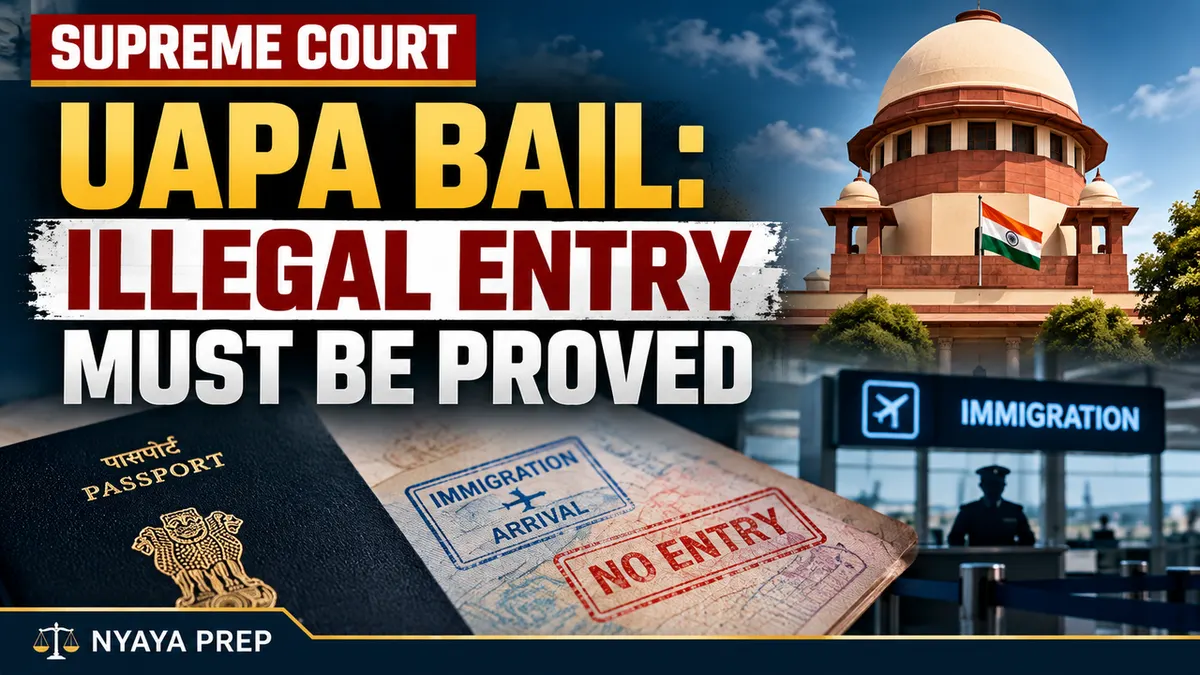
What the Supreme Court decided
The Supreme Court dismissed the Union of India’s appeal against a Madras High Court order restoring bail to Mohamed Rifas, also referred to in the proceedings as Mohamed Rigbas. In a reportable judgment authored by Justice Aravind Kumar, the Court explained that Section 43D(7) of the Unlawful Activities (Prevention) Act does not automatically prohibit bail merely because an accused is a foreign citizen. The prosecution must also establish that the accused entered India without authorisation or illegally. The judgment is reported as 2026 INSC 1160. The bench comprised Justices Aravind Kumar and Vipul M. Pancholi. Its decision concerns the conditions for activating a statutory restriction, not a general exemption from terrorism-law bail safeguards.
Background and litigation history
The case began with an FIR registered in Tamil Nadu in April 2018 alleging offences under the UAPA, the Indian Penal Code and the Arms Act. Rifas received default bail in July 2018 because the investigating agency had not filed its chargesheet within the applicable period. The National Investigation Agency subsequently took over the investigation. A separate FIR in November 2019 alleged that he was a Sri Lankan national who had entered India in 2009, overstayed a visa and obtained Indian identity documents. These remained allegations requiring proof; they were not themselves a final judicial determination of nationality or unlawful entry. The Union sought cancellation of the earlier bail in 2022. A special court cancelled it, but the Madras High Court reversed that decision in December 2023.
The statutory test under Section 43D(7)
Section 43D(7) uses two linked requirements concerning citizenship and entry. The person must not be an Indian citizen and must have entered India unauthorisedly or illegally. The Supreme Court read the conjunction between those requirements as meaningful. A subsequent expiry of a visa or later unlawful stay does not retrospectively transform an initially lawful entry into an unlawful one for this particular provision. The distinction matters because immigration status can change over time. The Court did not hold that immigration offences become irrelevant, nor that a foreign national is entitled to release as of right. It held that the specific exceptional bail restriction cannot be applied unless its statutory factual predicates are shown.
Default bail and the competing submissions
The Union argued that suppression of Sri Lankan nationality and newly discovered material justified cancellation of bail. It also maintained that the court which granted bail could cancel it when new circumstances emerged. Rifas disputed the evidence of his nationality and unlawful entry, and relied on the statutory right to default bail after the prosecution missed its filing deadline. The judgment examined Section 43D(2), which modifies investigation periods in UAPA cases while retaining the framework of default bail. It distinguished the possibility of cancelling bail on recognised legal grounds from an attempt to impose Section 43D(7) without showing its necessary elements. The Court found that the material relied on did not prima facie establish that Rifas had originally entered India illegally.
Limits of the ruling and practical significance
The Court also explained that where Section 43D(7) genuinely applies, bail remains possible only in very exceptional circumstances supported by recorded reasons. That is a demanding exception, and the burden of demonstrating the exceptional circumstances rests on the accused once the prosecution establishes the section’s threshold conditions. The ruling therefore protects both sides of the statutory design: it refuses to dilute a stringent restriction when properly triggered, but prevents authorities from applying it through an assumption about nationality alone. For judiciary-examination preparation, the important distinction is between proof of foreign citizenship, proof of illegal entry at the time of entry, and a later immigration violation. They are not interchangeable concepts.
Operative result and what follows
The Union’s appeal was dismissed and the Madras High Court order setting aside cancellation of bail was left undisturbed. The judgment does not determine the ultimate truth of the underlying terrorism allegations, and the criminal prosecution remains a separate process governed by evidence and the applicable law. It also does not decide every possible ground on which bail might be cancelled in a different factual setting. The immediate legal consequence is that the government could not rely on the special foreign-national restriction without establishing the conditions written into Section 43D(7). The ruling offers a useful illustration of close textual interpretation in criminal statutes that affect personal liberty.
Case Details
Case name: Union of India v. Mohamed Rifas @ Mohamed Rigbas
Citation: 2026 INSC 1160; 2026 LiveLaw (SC) 1091
Court: Supreme Court of India
Bench: Justices Aravind Kumar and Vipul M. Pancholi
Case number: SLP (Criminal) No. 7177 of 2024
Relevant Bare Act
Act: Unlawful Activities (Prevention) Act, 1967
Relevant provisions: 43D(7); 43D(2)
- Supreme Court
- UAPA
- Section 43D(7)
- Section 43D(2)
- Default Bail
- Foreign Nationals
- 2026 INSC 1160