SC
Supreme Court Hears Challenge to Exclusions from 'Industry' Definition Under Industrial Relations Code
Nyaya Prep • Published • Updated • 4 min read
What happened before the Court
A petition brought by the Tamil Nadu unit of the All India Trade Union Congress came before a Bench comprising Chief Justice Surya Kant and Justices Joymalya Bagchi and V. Mohana on 28 October 2026. The challenge concerns the statutory definition of 'industry' in the Industrial Relations Code, 2020, and particularly the activities which Parliament has excluded from that definition. Senior Advocate Gopal Sankaranarayanan addressed the Bench for the petitioner and urged judicial examination of the new provision.
The hearing did not produce a reported ruling invalidating any part of the Code. The Chief Justice asked about the difficulty with the definition and indicated that he wished to go through the issue. That procedural position matters: the petition raises substantial questions, but a party's description of a statutory defect is not a judicial finding. The constitutional validity of the disputed exclusions remains to be decided.
Which statutory exclusions are challenged
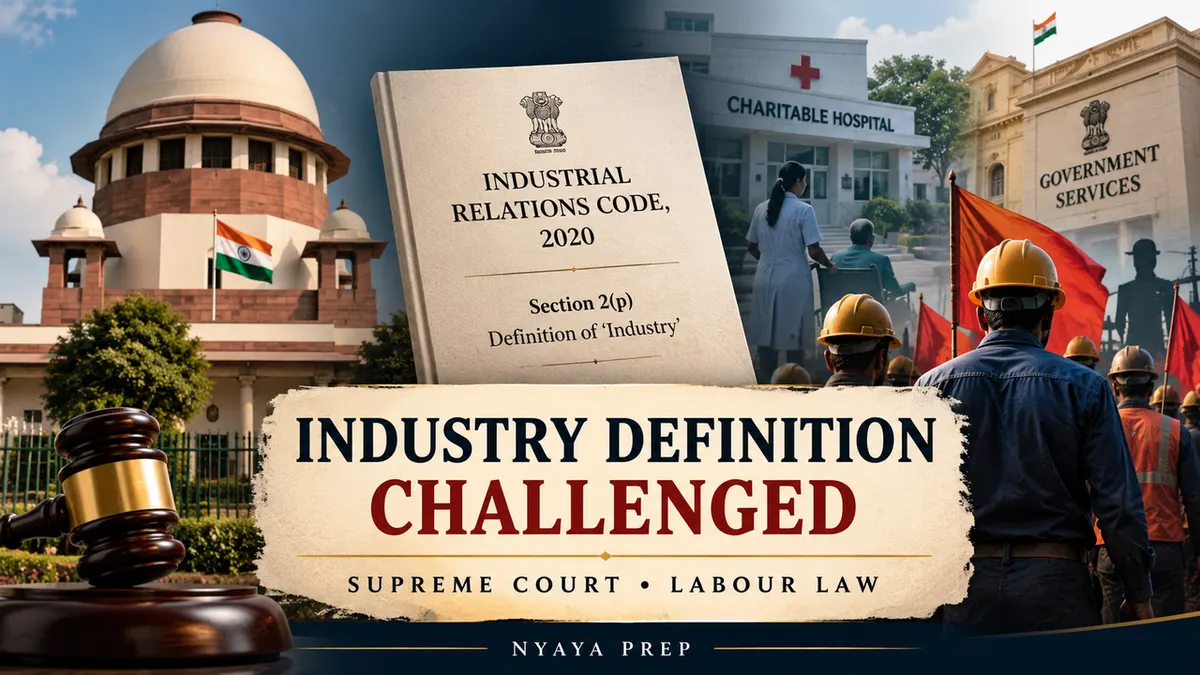
Section 2(p) contains a definition of 'industry' for the new industrial relations regime. The petitioner objects to the exclusion of institutions engaged in charitable, social or philanthropic services, activities relatable to sovereign functions, and other activities that the Central Government may notify. Domestic service is also excluded by the provision, but the reported challenge does not target that exclusion. The petition therefore raises a focused issue about the boundaries of statutory employment protections.
The union's concern is that the character or declared purpose of an institution might be used to remove workers from the industrial relations framework even where the actual activity resembles an organised service undertaking. It also questions the breadth of the residual power to notify further excluded activities. Whether those objections succeed will depend on the statutory language, the legislative scheme and the constitutional standards applied by the Court.
Constitutional and precedential arguments
The petition relies on the functional approach associated with Bangalore Water Supply and Sewerage Board v. A. Rajappa. In that landmark decision, the Supreme Court articulated a test for identifying an industry by reference to the nature of the activity rather than simply the institutional label. Counsel argued that the newer Code departs from that approach by creating categories of excluded establishments and by permitting additional exclusions through notification.
The petitioner invokes Articles 14, 19(1)(c) and 21 of the Constitution. Its case is that broad categorical exclusions could affect equality, the freedom to form associations and the protection of livelihood-related interests. These are the petitioner's contentions, not conclusions already accepted by the Bench. The Union and other respondents must have an opportunity to present the statutory and policy justification for the legislative choices before any final constitutional determination.
Why an earlier Constitution Bench decision matters
Counsel referred to a nine-judge Constitution Bench judgment delivered on 20 August 2026 concerning the earlier industrial disputes framework. According to the submission, that judgment did not decide the validity or interpretation of Section 2(p) of the Industrial Relations Code. The petitioner therefore argues that the new challenge remains open notwithstanding the earlier discussion of the meaning of 'industry'.
This distinction between the repealed framework and the current Code is central to the litigation. A precedent explaining an earlier statutory definition does not automatically decide the validity of a differently worded successor provision. Equally, the existence of the older functional test does not itself establish that Parliament was constitutionally prohibited from enacting express exclusions. Those competing positions require a reasoned examination of the new text.
Practical significance and next step
The outcome could matter to employees and employers in charitable organisations, public-service bodies and establishments that might be placed within future notified exclusions. Classification as an 'industry' can influence the availability and operation of mechanisms for industrial disputes and collective employment relations. The immediate development, however, is only the Court's consideration of a petition, not a change in the governing statutory definition.
For now, the Code continues to operate according to its existing terms. The reported hearing did not confirm a stay, a formal notice order or a final adjudication. Further orders and any responses from the Union will need to be checked before the next procedural step can be stated with certainty. Readers should distinguish the questions raised in court from the legal position that presently governs affected establishments.
Relevant Bare Act
Industrial Relations Code, 2020, Section 2(p).
- Industrial Relations Code
- Labour Law
- Trade Unions
- Constitutional Challenge