SC
Supreme Court Excludes Related Lender and Debenture Trustee from Insolvency Committee of Creditors
Nyaya Prep • Published • Updated • 4 min read
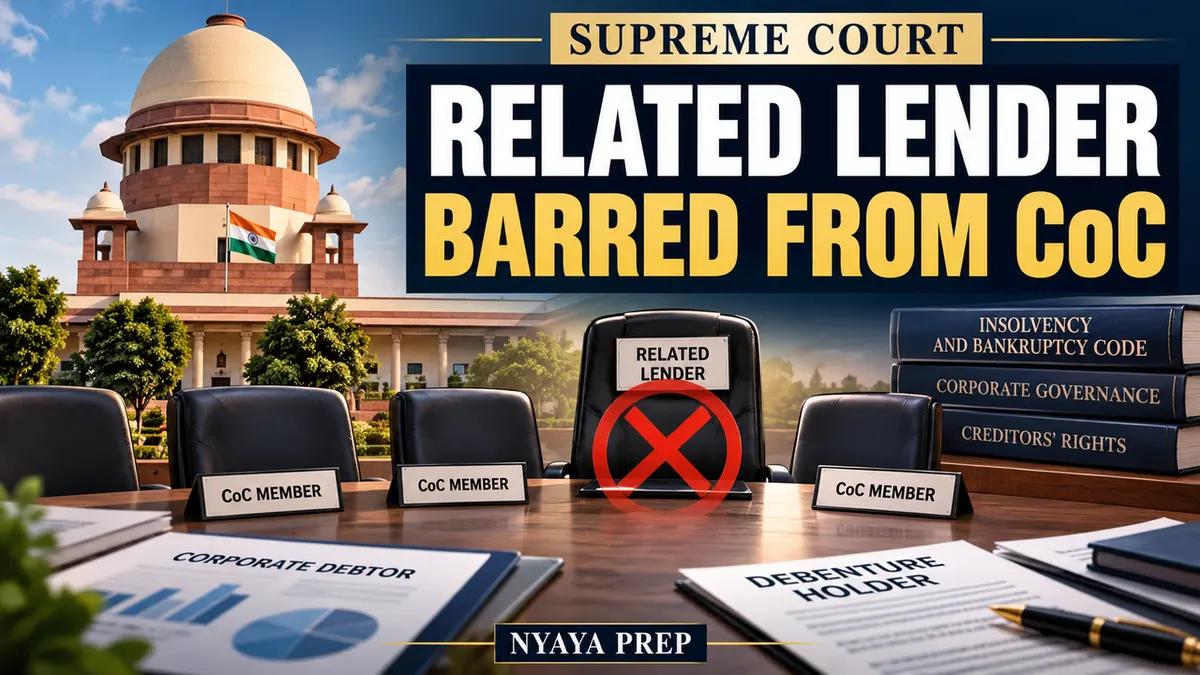
Appeals arising from the financing structure
The Supreme Court, in ECL Finance Ltd. and another v Abhinav Mukherjee and others, delivered a reportable judgment dated 27 October 2026 in Civil Appeal Nos. 6268 and 6273 of 2022. Justices J.B. Pardiwala and K. Vinod Chandran upheld the insolvency appellate tribunal’s conclusion that the appellants were related parties of Palm Developers Private Limited, the corporate debtor. The immediate consequence is exclusion from participation in its committee of creditors, rather than cancellation of the underlying debt claims.
The financing concerned Saha Infratech Private Limited, which issued non-convertible debentures and obtained a separate revolving credit facility. Palm Developers guaranteed obligations arising from those arrangements. IDBI Trusteeship Services was the debenture trustee; ECL Finance held the debentures and was also a lender. These different contractual capacities mattered because the Court examined the powers flowing from each arrangement rather than accepting the parties’ labels as conclusive.
How related-party status was assessed
Section 5(24)(m)(i) of the Insolvency and Bankruptcy Code treats a person as related to the corporate debtor when association exists through participation in its policy-making processes. The judgment distinguishes influence over policy from merely protecting a creditor against non-payment. A financier need not occupy the management’s chair to participate meaningfully in the company’s policy choices. Contractual rights to shape implementation and commercial direction can be legally significant.
The Court reviewed the debenture trust deed, facility agreement and the corporate debtor’s articles of association. The rights extended to supervision of project implementation, revenues and commercial arrangements. The bench found the degree of control all-pervasive in the relevant projects, and rejected the proposition that these were only negative or restrictive safeguards ordinarily available to lenders.
Committee participation and the trustee
The first proviso to Section 21(2) ordinarily removes a related-party financial creditor’s right of representation, participation and voting in the committee of creditors. Here, the Court held that ECL’s status as debenture holder and lender brought it within the related-party restriction. The trustee could not independently secure committee participation for the very debenture interests that were disqualified through the holder’s relationship.
The Court also considered the assignment of certain rights after commencement of the insolvency process. It found that the timing and surrounding record did not establish a bona fide assignment capable of avoiding the statutory exclusion. The conclusion concerned these arrangements and did not announce that all debt assignees, trustees or secured creditors are necessarily related parties.
Reasons and practical significance
The judgment emphasises the difference between a creditor’s economic exposure and the governance powers embedded in financing documents. A creditor can have a valid claim and yet lack a vote in decisions about the resolution process. This separation protects the committee’s independence where a financier has already participated in shaping the debtor’s affairs.
For resolution professionals, the decision underlines the need to inspect debenture documents, corporate articles, escrow controls and actual rights over projects when preparing committee composition. For banks and non-banking lenders, it shows why drafting broad project-control provisions can have consequences during insolvency even if those provisions were designed initially as credit protection.
Operative outcome
The Supreme Court dismissed the appeals, closed the connected contempt petitions and rejected pending applications. The NCLT and NCLAT findings on exclusion therefore remain undisturbed in these proceedings. The Court did not decide the commercial recoverability of the debt or prescribe a general prohibition on creditors monitoring their security.
The ruling is a significant interpretation of related-party status under the Code. Its application in other insolvencies will depend on the actual contractual rights and relationship between the creditor and the corporate debtor, not simply on the existence of a loan, a debenture or a trustee.
The judgment also highlights why an insolvency resolution professional should not treat a debenture trustee as a neutral substitute for a disqualified holder without examining whom the trustee represents. Where the same creditor controls the relevant economic interest, formal separation of titles does not answer the question of influence. The Court's findings are rooted in the documents and the timing of the assignment in this particular insolvency.
- IBC
- Related Party
- Committee of Creditors
- ECL Finance
- Insolvency