SC
Supreme Court Directs States and High Courts to Provide Exclusive Bar Rooms and Washrooms for Women Lawyers in All District Courts
Nyaya Prep • Published • Updated • 4 min read
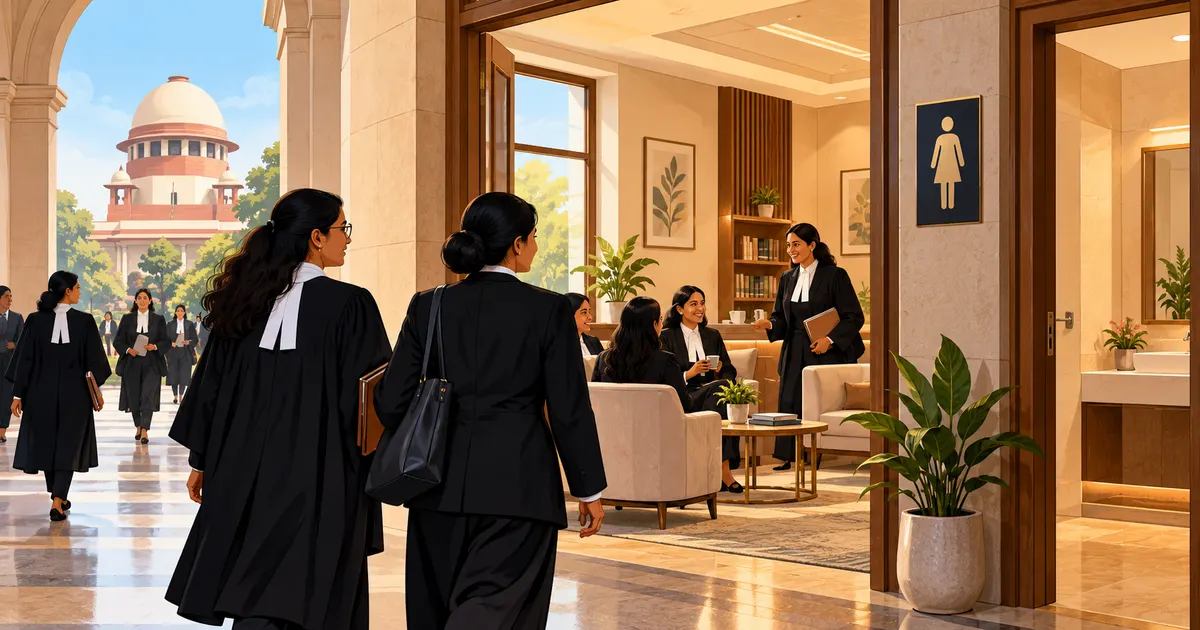
The Supreme Court on Monday, 26 October 2026, directed all State governments and High Courts to ensure that women advocates have exclusive bar rooms, washrooms and other basic amenities in district, sub-divisional and taluka courts wherever they practise. A Bench of Chief Justice of India Surya Kant and Justices Joymalya Bagchi and V. Mohana passed the order in Sarika Tyagi v. Union of India, a public interest litigation filed by women advocates over the absence of adequate facilities in court complexes across the country.
The Court made clear that the entitlement does not depend on numbers. The facilities must be provided regardless of how many women lawyers practise at a particular court, though the size of the bar room should be proportionate to their strength.
Key directions
The Bench issued a set of directions aimed at moving the case from principle to implementation:
State governments and High Courts must ensure exclusive bar rooms, washrooms and other basic amenities for women advocates in district, sub-divisional and taluka courts.
The facilities must be created even where additional funds or land are required. State governments must allocate the necessary funds if they have not already done so.
High Court infrastructure committees must give priority to creating these facilities in district and taluka courts.
The pattern of amenities should preferably be uniform across States.
The Attorney General for India, R. Venkataramani, is the nodal authority to coordinate compliance by States and Union Territories and to consolidate their progress reports. All Advocates General and standing counsel for Union Territories must submit progress reports to him.
The petitioners, their counsel and the intervenors may send suggestions through the Attorney General for consideration by State governments.
What emerged at the hearing
The amicus curiae informed the Court that only 21 of the 69 respondents had filed status reports, a figure that underlined how unevenly the earlier directions have been followed.
Senior Advocate Monika Gusain, appearing for the petitioners, said several States had themselves acknowledged gaps in basic facilities. She pointed out that Punjab had reported washrooms in only nine of its 67 court complexes and that Haryana had not conducted an inspection. She also drew attention to the Calcutta High Court's affidavit, which acknowledged that there is no women's bar room in the Calcutta City Courts.
The Chief Justice observed that the Court was now at the execution stage of its earlier directions. On the Calcutta position, he said a bar room must be created if none exists.
The amicus suggested that washrooms be built into the designs of all new court complexes and that adequate space be set aside for women's bar rooms from the planning stage. The Court asked the amicus to compile the information received from the States and High Courts.
The Attorney General told the Court that he had convened a meeting of all Advocates General on 17 September and proposed another round by the end of October to speed up implementation.
Why this matters
Access to a safe, usable workplace is a precondition for effective practice at the Bar. For women advocates, the lack of a separate bar room or a functioning washroom in a court complex is not a matter of convenience alone; it affects how long they can stay at court, whether they can practise in smaller towns, and whether the profession is open to them on equal terms. The Court's approach in this case treats infrastructure as part of the guarantee of equality and the working conditions of those who serve the justice system, a theme that law students may connect with Articles 14 and 15 of the Constitution and with the Court's wider supervision of judicial infrastructure through continuing mandamus.
The order is also an example of the Court's growing use of monitoring mechanisms. Rather than leaving each State to act on its own, it has appointed a single nodal officer, required periodic progress reports, and asked an amicus to collate the data. This allows the Bench to see which States are lagging and to hold them to account at each hearing.
What happens next
The matter will next be heard on 2 December. By then, States and Union Territories are expected to have reported their progress to the Attorney General, who will consolidate the position for the Court. Bar associations and women advocates' groups can route their suggestions through the Attorney General in the meantime. For courts that currently have no exclusive facilities for women lawyers, the direction means that the question is no longer whether such facilities will be built, but how soon and at what standard.
- Supreme Court
- Women Advocates
- Court Infrastructure
- Public Interest Litigation
- Attorney General