SC
Supreme Court Directs Sanjay Raut to Appear in Person and Nikhil Wagle Virtually in Contempt Proceedings
Nyaya Prep • Published • Updated • 4 min read
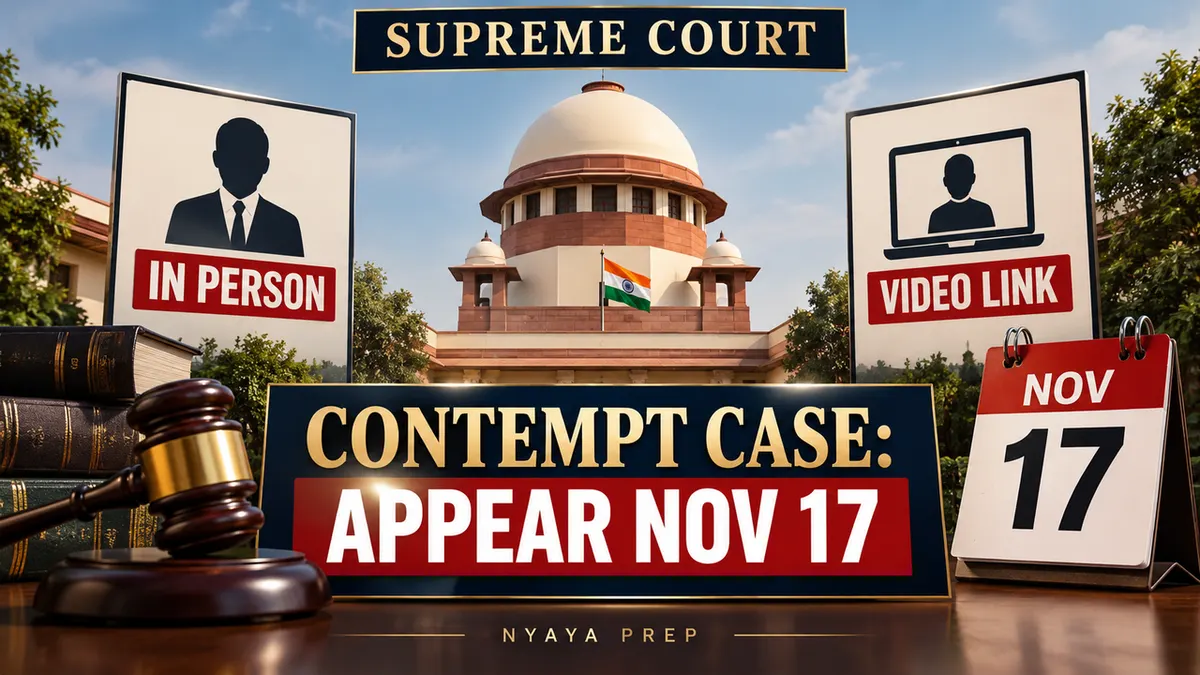
Court issues distinct appearance directions
A Bench of Justices Aravind Kumar and Vipul M. Pancholi considered the criminal contempt petition filed by the Supreme Court Bar Association. The Bench directed Rajya Sabha member Sanjay Raut to attend the next hearing in person. It permitted journalist Nikhil Wagle to appear through video conferencing for the time being. The hearing is fixed for 17 November 2026 at 2 PM. The directions concern participation in the proceedings and do not amount to a conviction for contempt or a final ruling on whether either respondent committed the alleged misconduct.
Background of the contempt petition
The association approached the Court following public statements and social-media posts criticising Chief Justice of India Surya Kant and the judiciary. The petition was initiated after obtaining the Attorney General's consent under Section 15(1)(b) of the Contempt of Courts Act, 1971. At an earlier hearing on 16 October, the Supreme Court issued show-cause notices. The controversy includes a social-media post attributed to Wagle and allegations concerning remarks made by Raut. These are allegations advanced in contempt proceedings, not facts established by a final judgment.
Apology and submissions for the journalist
Senior Advocate Indira Jaising informed the Court that Wagle had submitted a reply affidavit tendering an unconditional apology. She said the journalist had deleted the relevant post, did not seek to justify the language used and wished to be discharged from the notice. Counsel also referred to his long professional career and asked that he be allowed to join remotely because he resides in Mumbai. The petitioning association questioned the timing of the deletion and maintained that the language directed at the highest judicial office was serious. The Bench recorded the apology but required Wagle's appearance at the next hearing.
Position concerning the parliamentarian
The Court was informed that an advocate-on-record had filed a vakalatnama on behalf of Raut, but the registry's office report did not show an entered appearance. The judges also noted that a reply affidavit referred to by counsel was not yet on the record and directed the registry to place the relevant material before the Bench. In that procedural setting, Raut was directed to appear personally. No inference of guilt should be drawn from the absence of an appearance or the direction to attend. The parties will have an opportunity to address the case in accordance with law.
Legal question and institutional context
Criminal contempt can involve conduct alleged to scandalise or lower the authority of a court. At the same time, constitutional protection for speech and legitimate criticism of judicial institutions remains relevant to the legal assessment. Whether particular expressions cross the statutory threshold requires attention to their context, the applicable legal standards and the parties' responses. The Court's observations about the institutional significance of the dispute should not be confused with an adjudicated finding that every allegation in the petition is correct. The present order principally regulates how the pending contempt case will proceed.
Practical significance
The proceedings illustrate the distinction between an apology, an appearance direction and final disposal. An unconditional apology is a relevant matter for the Court's consideration, but filing one does not automatically terminate a contempt petition. Similarly, directing personal or virtual attendance does not itself decide liability. The different modes of appearance also show that a court may adapt attendance requirements to the circumstances while retaining control over its proceedings. Public reporting of pending contempt matters should therefore identify statements attributed to parties as submissions and avoid presenting them as judicial findings.
Next step
The case is to be taken up at 2 PM on 17 November 2026. Wagle is expected to attend virtually unless the Court directs otherwise, while Raut has been asked to be physically present. The registry must place the relevant reply material on record. The Court may then consider the apology, responses and further submissions. Until a reasoned final order is passed, the legal position remains that the contempt allegations are under examination. The petition is titled Supreme Court Bar Association v. Nikhil Wagle and another, Criminal Contempt Petition No. 2 of 2026.
Case Details
Supreme Court Bar Association v. Nikhil Wagle and another; Criminal Contempt Petition No. 2 of 2026; Supreme Court of India.
- Contempt of Court
- Judiciary
- Freedom of Expression
- SCBA