SC
Supreme Court Directs Election Commission to Examine Bulk Form 7 Objections in Uttar Pradesh Electoral Revision
Nyaya Prep • Published • Updated • 4 min read
What the Court directed
The direction was procedural and supervisory. Rather than declaring that wrongful deletions had occurred, the Bench required the complaints to be put before the Election Commission in an identifiable form so that the Commission could test them against the underlying records. The petitioners must specify the irregularities they say remain unresolved; the Commission must then examine the factual position and report its response.
The Bench comprised Chief Justice Surya Kant and Justices Joymalya Bagchi and V. Mohana. The direction did not itself cancel any electoral roll, invalidate any Form 7 submission or order criminal prosecution. Those would be separate actions requiring a lawful factual basis. The immediate next step is administrative verification followed by the compliance report contemplated by the Court.
The dispute over Form 7 submissions
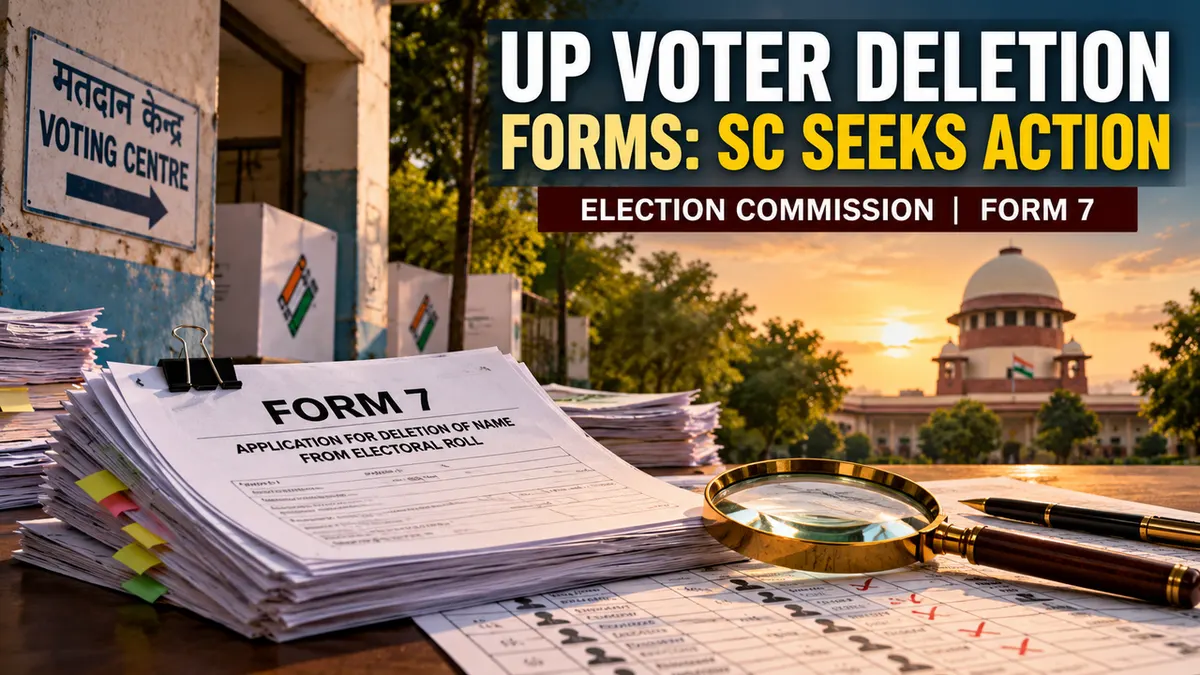
Form 7 is used to object to inclusion of a name in the electoral roll, including applications seeking deletion where legally permissible. The dispute before the Court concerned the alleged use of numerous forms in a manner that petitioners said could affect voters improperly. Their submissions included a claim that 32 forms were submitted in one constituency against members of a particular community.
The petitioners also pointed to alleged inconsistencies in the material placed before the Court and questioned signatures on certain forms. Those matters remain allegations requiring verification; the available record does not establish that the signatures were forged or that any affected voter was unlawfully removed. The Court’s order was framed to obtain a more reliable factual account.
Election Commission response
Senior Advocate D. S. Naidu, appearing for the Election Commission, acknowledged that bulk applications had been submitted. He said election officials checked and cross-checked the forms, found the relevant applications false and did not act on them. This was the Commission’s reported position before the Bench, not an independent finding that all the petitioners’ concerns had been resolved.
The Commission’s counsel indicated that a formal complaint would allow officials to investigate the specific claims. The Court’s instruction that petitioners prepare a note accordingly provides a practical channel for identifying the disputed applications. It also creates a record against which the Commission’s subsequent verification and proposed corrective measures can be assessed.
Why electoral roll safeguards matter
The accuracy of electoral rolls is fundamental to meaningful voting rights. Wrongful inclusion and wrongful deletion can each affect the integrity of the process. An objection mechanism must therefore operate with sufficient checks to distinguish a genuine eligibility concern from a coordinated attempt to interfere with another person’s registration.
At the same time, a large number of applications is not by itself proof of illegality. The legal question is whether the applications meet the applicable requirements, whether officials properly verify them and whether affected persons receive the procedural protections due to them. The Supreme Court’s directions address those questions through evidence-gathering and administrative accountability rather than an immediate merits finding.
Kerala revision deadline considered separately
The hearing also touched on a request to extend the verification deadline in Kerala. The Court did not grant that extension on the material reported. It indicated that persons who still require corrections or inclusion could bring their concerns through representations, with the process of examining such requests continuing.
That part of the hearing should not be conflated with the Uttar Pradesh Form 7 allegations. The Uttar Pradesh issue concerns allegedly irregular objections for deletion, whereas the Kerala discussion concerned the timetable and opportunities to correct or complete roll entries. Both are electoral-roll questions, but they involve different operative concerns.
Compliance and practical consequences
The Commission is expected to assess the note, examine the relevant forms and supporting records, decide whether any corrective step is justified and file its compliance report. Petitioners will have an opportunity to identify concrete examples instead of relying solely on general allegations. Any later court order will depend on the material produced and the Commission’s response.
The development matters for election administrators and voters because it illustrates judicial oversight without replacing the statutory fact-finding role of the election authority. It also demonstrates why claims of targeted deletion must be reported carefully: a petitioner’s accusation, an authority’s denial and a court’s direction to investigate are three distinct things.
Case Details
Bench: Chief Justice Surya Kant and Justices Joymalya Bagchi and V. Mohana
Relevant Bare Act
Registration of Electors Rules, 1960
Form 7 (objection to inclusion of name); precise rules not independently verified from primary text
- Election Commission
- Form 7
- Uttar Pradesh
- Electoral Rolls
- SIR
- Supreme Court