SC
Supreme Court Declines Roving Inquiry into Andhra Pradesh Poll Complaints, Considers CCTV Safeguards
Nyaya Prep • Published • 4 min read
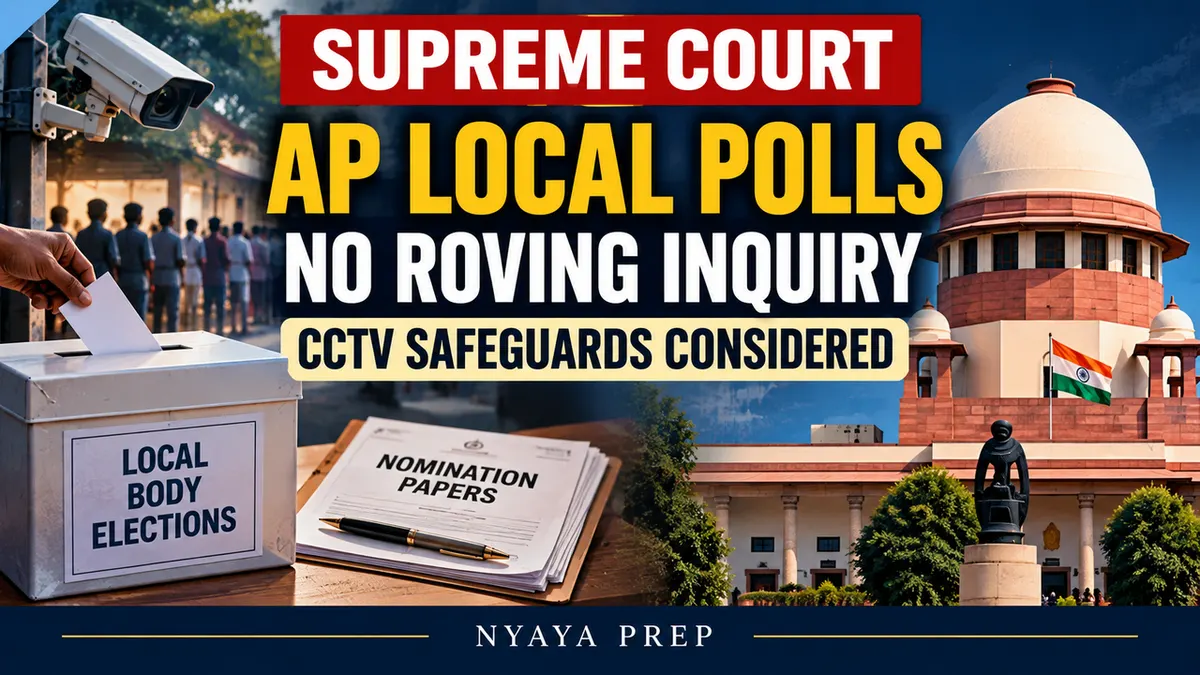
Court declines fact-finding exercise
The Supreme Court indicated that it would not undertake a broad fact-finding inquiry into allegations that candidates associated with the YSR Congress Party had been prevented from filing nominations in Andhra Pradesh local body elections. A bench comprising Chief Justice Surya Kant and Justices Joymalya Bagchi and V. Mohana said the allegations involved disputed facts and that the ongoing proceedings were not a suitable forum for resolving every individual grievance. The Court nevertheless discussed the possibility of general safeguards for the electoral process, including preservation of CCTV recordings. The matter was deferred for three weeks. The discussion was reported on 27 October 2026; it should not be represented as a final ruling that every allegation was false.
What the petitioners alleged
The YSR Congress Party approached the Supreme Court after earlier litigation concerning nomination arrangements and deadlines. Its representatives alleged intimidation and obstruction of candidates in several locations, including Kadapa, Tirupati, Punganur and Rayachoti. The party contended that candidates had been unable to file nominations despite attempts to participate in the election. These were allegations advanced in court, not facts conclusively found by the bench. Counsel urged a stronger judicial response, drawing comparisons with interventions in other election disputes. The Court was required to consider whether its limited role in the pending proceedings could accommodate the extensive factual investigation sought by the party.
Earlier direction to the election authority
At an earlier hearing on 21 October, a bench had directed the State Election Commission to consider representations, including electronic material, from persons claiming to have been prevented from filing nominations because of law-and-order problems. The earlier directions contemplated extension of deadlines where such obstruction was established and postponement of publication of the final candidate list until 25 October. At the later hearing, the Supreme Court noted that the Commission had considered representations and extended nomination deadlines in some cases. The petitioners nevertheless argued that the response had not addressed the full scale of alleged exclusion. This background explains why the Court’s discussion turned to compliance, proof and the limits of continued judicial supervision.
Disputed facts and election petitions
The bench stressed that whether a particular person actually attempted to file nomination papers and was unlawfully prevented from doing so requires evidence. Such questions cannot ordinarily be resolved merely by comparing competing assertions during a short hearing. The Court indicated that affected candidates may pursue the remedies available through election petitions. That route permits a more structured examination of relevant records and testimony. The Court did not state that nomination obstruction is unimportant. Rather, it distinguished the seriousness of an allegation from the procedural mechanism capable of establishing it. The distinction matters for election law because relief affecting an ongoing election can have consequences for other candidates and the public process.
Why CCTV preservation was discussed
The judges considered whether general directions could improve the preservation of evidence at nomination centres. CCTV footage can be relevant to claims that candidates were prevented from entering offices, approaching officials or submitting papers. Preservation is different from deciding the merits: a recording may help a later forum assess disputed events, but it does not establish a violation without examination of its context and authenticity. The bench discussed issuing guiding principles to safeguard electoral processes while resisting an open-ended investigation into all allegations in the present proceeding. No final, comprehensive CCTV protocol was reported as having been issued at this hearing.
Arguments, next hearing and significance
Senior Advocate Maninder Singh pressed the petitioners’ case, while Senior Advocate Siddharth Luthra opposed further intervention on behalf of the State. Solicitor General Tushar Mehta also raised concerns about repeated applications affecting the election process. The bench differentiated the circumstances from an earlier Punjab matter and adjourned the case for three weeks. The practical significance lies in the balance between judicial protection of free electoral participation and the need to use appropriate fact-finding remedies. For law students, the development is a reminder to distinguish oral observations, prospective guidance and operative orders. The Court contemplated safeguards; it did not finally decide the truth of every nomination-related allegation.
Case Details
Case name: YSR Congress Party election-nomination proceedings concerning Andhra Pradesh local polls
Court: Supreme Court of India
Bench: CJI Surya Kant; Justices Joymalya Bagchi and V. Mohana
- Supreme Court
- Andhra Pradesh Local Elections
- State Election Commission
- Nomination Process
- Election Petitions
- CCTV Evidence