Judicial Appointments
Supreme Court Collegium Recommends Four Advocates and Two Judicial Officers for Chhattisgarh High Court
Nyaya Prep • Published • Updated • 4 min read
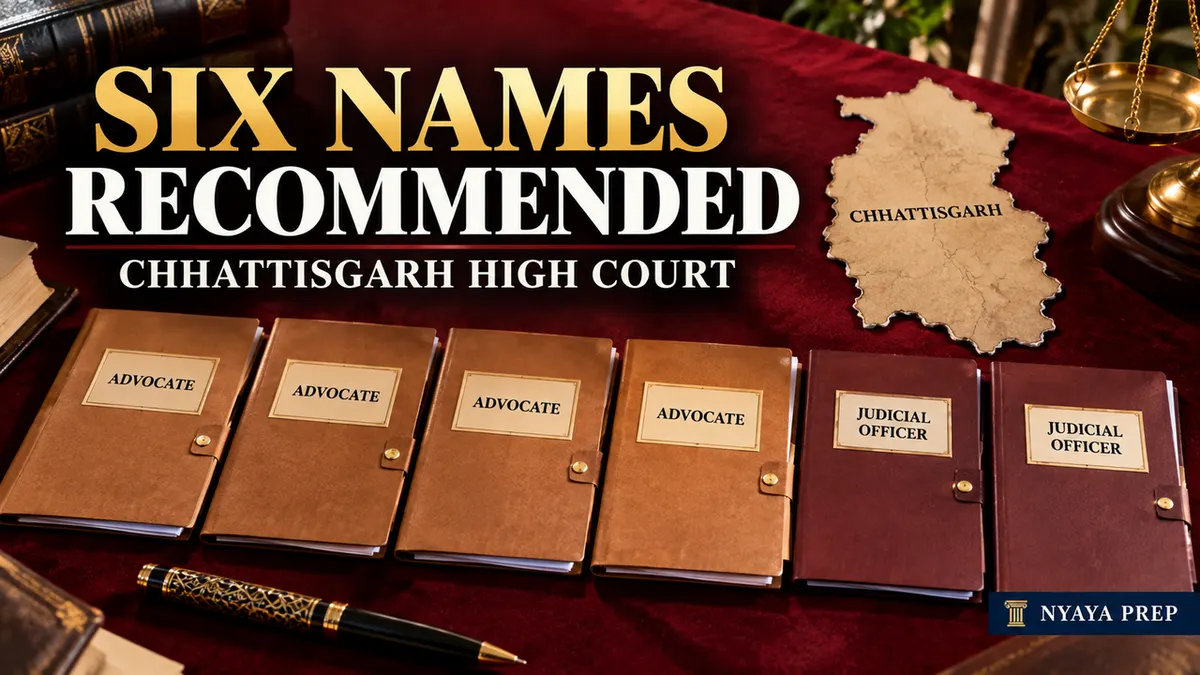
Names and professional backgrounds
The advocates named in the official statement are Anand Shukla, Ratna Nidhi Pusty, Shashank Thakur and Sourabh Sharma. For the second advocate, the statement expressly records the alternative forms R.N. Pusty and Ratan Pusty. Those variants refer to the same recommended person and should not be counted as separate candidates. The two judicial officers recommended are Rajnish Shrivastava and Balram Prasad Verma.
The distinction between four advocates and two judicial officers is stated in the primary document itself. It is therefore appropriate to describe the list as a mixed recommendation from the Bar and the judicial service. The statement does not supply detailed profiles, comparative evaluations, existing court assignments or dates of prospective appointment. No additional biographical claims are necessary to report the decision accurately.
Constitutional status of the proposal
Article 217 of the Constitution provides the governing framework for the appointment of judges of High Courts. The Collegium's recommendation is part of the established selection and consultation process. Formal appointment remains a separate constitutional act. The language used in the statement is deliberately prospective: the Collegium approved a proposal for appointment, rather than announcing that the named individuals had already become High Court judges.
That distinction matters for institutional reporting. A recommendation does not by itself authorise a person to sit on a High Court bench, issue judicial orders or exercise the jurisdiction of that office. Such functions follow the completion of the constitutional appointment and oath process. The official document also does not provide an effective date or an appointment notification number, and none should be invented.
Why the professional mix matters
Candidates from the Bar and from the judicial service may bring different forms of legal experience to appellate judging. Advocates often have extensive exposure to contested legal submissions and litigation strategy, while judicial officers typically have direct experience in recording evidence, managing trials and deciding disputes. These are general institutional distinctions; the statement does not assess the individual strengths of the six recommended persons.
The Chhattisgarh High Court hears matters arising under constitutional, civil, criminal and other legal jurisdictions. If the proposed appointments are eventually completed, the court's administrative roster will determine the allocation of work. The announcement alone does not show how many vacancies would remain, whether any new bench would be constituted, or how quickly pending cases might be disposed of. Such consequences require additional verified data.
Reading the primary document carefully
The Collegium statement dated 30 October 2026 is a short administrative record. It provides the date, the court for which the candidates are recommended, and the names divided by professional category. It contains no adversarial findings, no reasoning on the merits of a case and no decision about the rights of litigants. Describing it as a judgment would confuse the nature of the action.
This Chhattisgarh recommendation is separate from the Collegium's announcement on the same date concerning five judicial officers proposed for the Madhya Pradesh High Court. The two decisions relate to different High Courts, different lists of individuals and different numbers of proposed judges. They should not be merged into one article merely because they came from the same constitutional institution on the same day.
Next procedural stage and practical significance
The names will require further action under the applicable appointments framework before they can be treated as judicial appointments. If the process culminates in appointment, an official notification and the prescribed oath would provide the subsequent verifiable milestones. The statement does not specify when those steps may occur, so no schedule can responsibly be projected from it.
For the legal profession and judiciary-examination candidates, the immediate importance is twofold: the official identification of six recommended candidates and the constitutional distinction between recommending and appointing judges. The 30 October announcement establishes the first point. The second remains governed by the Constitution and the subsequent official record. Reporting should preserve both distinctions throughout.
Case Details
Case: Not applicable: Supreme Court Collegium recommendation
Citation: Collegium statement dated 30 October 2026
Bench: Not a judicial bench; Collegium administrative decision
Advocates: Not applicable
Relevant Bare Act
Constitution of India: Article 217 (appointment and conditions of office of High Court judges)
- Supreme Court Collegium
- Chhattisgarh High Court
- Judicial Appointments
- Article 217
- Advocates
- Judicial Officers