Judicial Appointments
Supreme Court Collegium Recommends Five Judicial Officers for Madhya Pradesh High Court
Nyaya Prep • Published • Updated • 4 min read
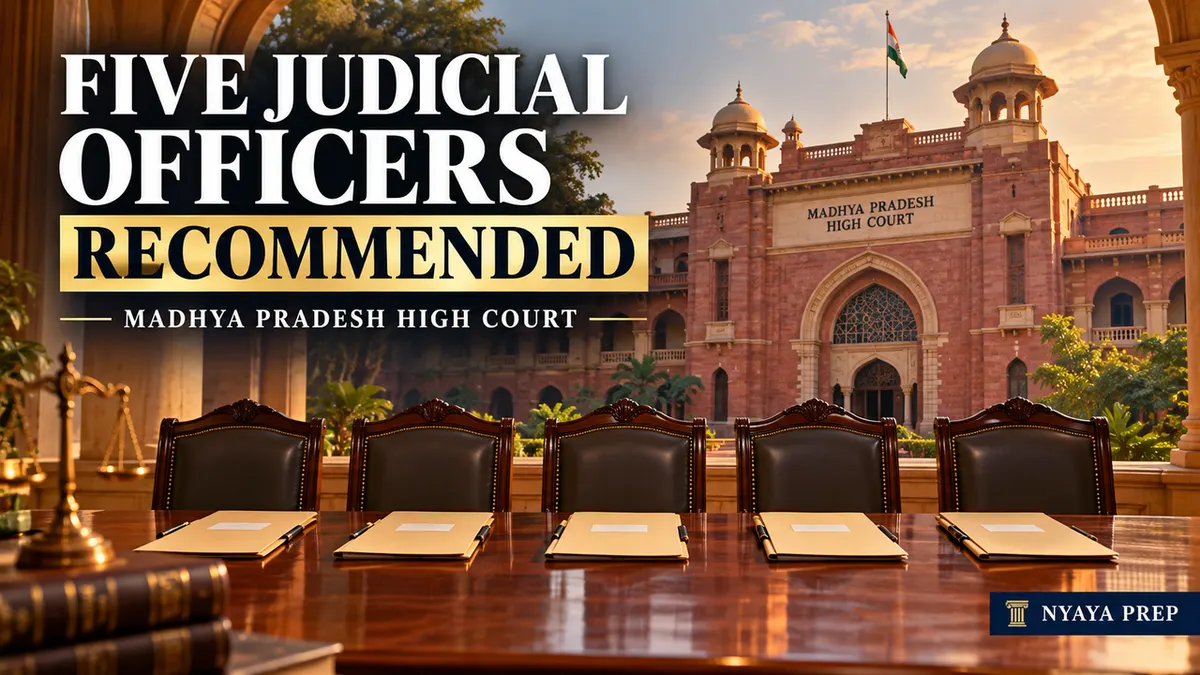
The five names in the official statement
The Collegium statement, issued on 30 October, lists Renuka Kanchan, Krishnamurty Mishra, Virendra Singh Rajput, Mamta Jain and Ashita Shrivastava. All five are described as judicial officers. This description matters because the recommendation concerns candidates drawn from the judicial service, rather than advocates proposed for elevation from the Bar. The document is concise and supplies no individual biographies, seniority assessments or detailed reasons for the selections.
The statement says that the Collegium approved the proposal for their appointment as judges of the High Court of Madhya Pradesh. It does not specify a date for issuance of warrants of appointment, the future composition of benches, or whether any of the recommended officers will be assigned to a particular seat of the High Court. Such details should not be inferred from the recommendation itself.
What the recommendation legally means
Article 217 of the Constitution governs appointment of High Court judges. It places the formal appointment in the constitutional framework involving the President and the prescribed consultations. Collegium recommendations form part of the established judicial appointments process, but they are not themselves presidential appointment instruments. Accordingly, the five officers should be described as recommended candidates until the relevant appointment notifications are issued.
A High Court judge exercises constitutional judicial authority only after appointment and the necessary oath or affirmation. The present statement neither creates a new judgeship nor changes the status of the five officers on its own. Any reporting that treats the recommendation as an appointment already in force would therefore overstate the operative effect of the announcement. The distinction is especially important for readers following vacancies, bench strength and judicial administration.
Judicial-service representation in High Courts
The Indian High Court system draws eligible candidates from more than one professional background, including the Bar and the judicial service. Officers recommended from the service bring experience of conducting trials, managing evidence, deciding procedural disputes and administering courts. These are general features of judicial-service work, not findings about the individual suitability of any particular candidate in the statement.
The proposed elevations are institutionally significant because judges appointed to the High Court may hear appeals, writ petitions, criminal matters and other proceedings according to the court's roster. The precise effect on case disposal, vacancies or bench strength cannot yet be quantified from the short statement. No vacancy figures or expected date of joining are supplied in the primary document, so any numerical projection would be speculative.
Verification and limits of the announcement
The full list of five names has been checked against the dated Collegium statement, rather than inferred from a headline or secondary summary. The statement is the controlling source for the identities and the nature of the action taken. It contains no allegations, contested judicial findings or party submissions because it is an administrative recommendation, not a judgment in an adversarial case.
It is also important to distinguish this proposal from other Collegium recommendations concerning different High Courts. Recommendations for Madhya Pradesh do not amount to a combined national appointment order, and a separate list issued for another State must be reported as a separate institutional decision. The relevant State and the exact number of candidates are therefore material facts, not interchangeable details.
What happens next
The recommended names must proceed through the applicable constitutional appointments process. If appointments are ultimately made, the competent authorities would issue the necessary notifications and the appointees would take the prescribed oath before assuming office. The present statement supplies no deadline for those steps. Nyaya Prep will treat any later notification as a new development only when its content and date are independently verified.
For students and practitioners, the immediate takeaway is the difference between a recommendation, a formal appointment and the assumption of judicial office. The first is the action established by the 30 October statement. The latter two require additional official acts and should not be presumed merely because the Collegium has approved a proposal.
Case Details
Case: Not applicable: Supreme Court Collegium recommendation
Citation: Collegium statement dated 30 October 2026
Bench: Not a judicial bench; Collegium administrative decision
Advocates: Not applicable
Relevant Bare Act
Constitution of India: Article 217 (appointment and conditions of office of High Court judges)
- Supreme Court Collegium
- Madhya Pradesh High Court
- Judicial Appointments
- Article 217
- High Court Judges