SC
Supreme Court Clarifies BNSS Prohibitory Orders Near Court Remain in Force Despite Earlier Notice Removal
Nyaya Prep • Published • Updated • 5 min read
Background and earlier direction
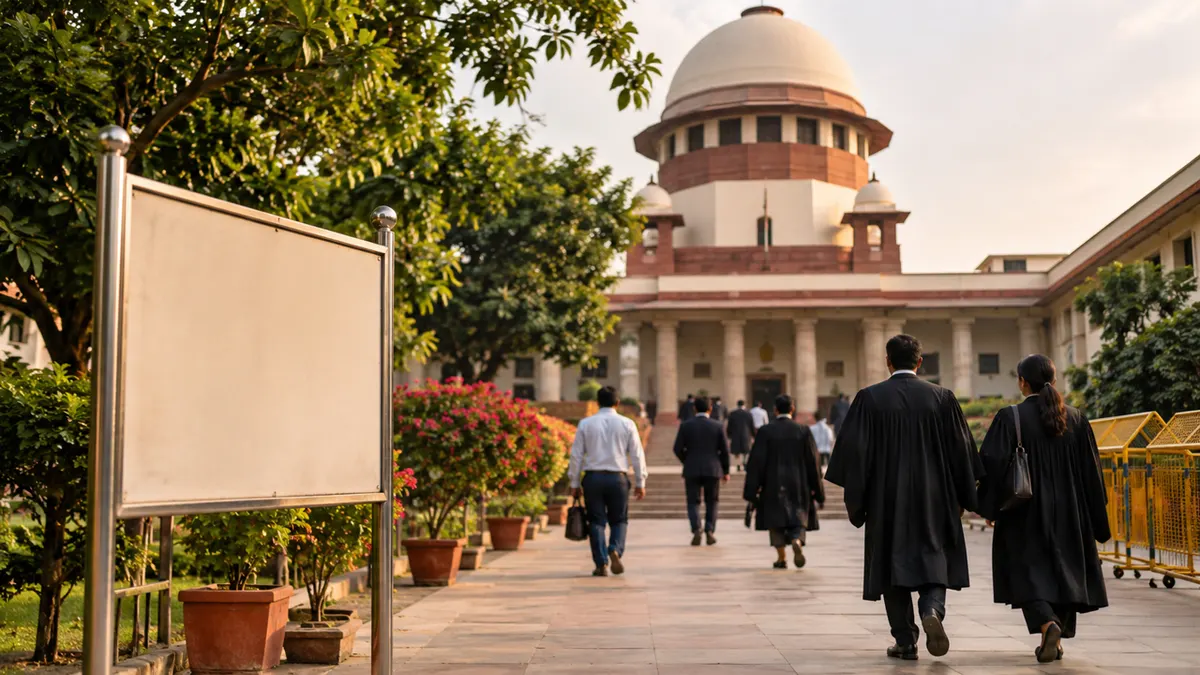
The proceedings arise from challenges connected with the police response to protests in Delhi on 10 October 2026 against the Chief Election Commissioner. During those proceedings, the Supreme Court had addressed concerns that a notice announcing prohibitory orders near its premises might discourage or impede access to the courts. Its earlier direction, dated 11 October, required removal of the displayed notice board.
That earlier intervention concerned the practical ability of advocates, litigants and persons seeking legal consultation to enter and leave courts. It did not, the subsequent Bench explained, determine the legality of the underlying prohibitory orders. The distinction became important after the Court was informed that the removal direction was being represented as though the restrictions themselves had ceased to operate.
What the Supreme Court clarified
A Bench comprising Chief Justice Surya Kant and Justices Joymalya Bagchi and V. Mohana clarified in its order dated 3 November that the October direction had a limited purpose. It recalled paragraph 16(e) of the earlier order, which had required removal of the notice board, and stated that the competent authority could display a notice again. The renewed display must not obstruct the movement of people who have legitimate business before the Supreme Court or another court.
The Bench distinguished the continued legal effect of a prohibitory order from the separate question of how authorities communicate and implement that order near a judicial institution. The removal of a sign, it explained, was not an interim stay, suspension or dilution of the underlying restriction. Whether the orders under Section 163 of the Bharatiya Nagarik Suraksha Sanhita are valid remains a live issue in the pending criminal writ petitions.
This clarification is procedural and interpretive. It should not be read as a final endorsement of every restriction imposed in the vicinity, nor as a ruling that the restrictions violate constitutional rights. Those questions require adjudication in the appropriate pending proceedings.
Access to justice and public-order regulation
The immediate concern identified by the Court was access to legal institutions. A court can require practical safeguards against interference with entry and exit without necessarily deciding the validity of every police restriction operating in the surrounding area. The two questions engage different considerations and should not be collapsed into a single conclusion.
Section 163 BNSS concerns urgent orders in cases of nuisance or apprehended danger. The existence of that statutory power does not itself answer whether a particular order satisfies its legal conditions or whether its enforcement impermissibly affects movement. Equally, removing a notice board does not automatically invalidate an order made under that provision.
The clarification therefore places responsibility on competent authorities to regulate movement without blocking advocates, litigants and others visiting courts for legitimate purposes. Its practical effect is to permit renewed notice while preserving the essential ability to approach a judicial forum. Any enforcement action must be assessed on its own facts and under applicable law.
Case management and next hearings
The Court also reorganised a batch of thirty-three related matters into eleven categories, following classifications supplied by nodal counsel for the parties. The respondents may submit category-specific counter-affidavits, while advocates are expected to coordinate arguments through nodal counsel and indicate in advance the time required for oral submissions.
The stated aim of the case-management arrangement is to avoid repeated arguments across overlapping petitions and allow the Bench to address distinct issues in an orderly manner. These directions do not determine the merits of the petitions; they establish how the pending disputes will proceed.
The principal writ petition and contempt petitions were listed for 18 November 2026. Challenges to the Section 163 BNSS orders were listed for 26 November along with other matters concerning restrictions on protests. Those listings are the operative next steps identified in the reported order.
Why the clarification matters
The development illustrates why a court direction must be read in the context of the specific problem it addresses. An order protecting unobstructed access to court premises should not be transformed into a broader declaration that police restrictions are no longer in force. Conversely, the existence of public-order measures cannot be treated as a licence to prevent lawful access to legal remedies.
For lawyers and litigants, the immediate point is that the Court expressly protected ingress and egress. For public authorities, the clarification permits a notice to be displayed again but requires movement to be regulated without obstruction. For those challenging the underlying restrictions, the legality of the prohibitory orders remains undecided and will be considered in the separately listed proceedings.
The reported clarification was issued on 3 November and became the subject of a fresh report on 11 November. It is included here as a catch-up development on the date of reporting, not described as an order passed on 11 November.
Case: Proceedings arising from October 2026 protests; W.P.(Crl.) Nos. 427/2026 and 429/2026 concern Section 163 orders
Citation: Not independently verified
Bench: CJI Surya Kant, Justices Joymalya Bagchi and V. Mohana
Advocates: Multiple counsel appeared; individual representation not independently mapped to the clarification
Act: Bharatiya Nagarik Suraksha Sanhita, 2023
Section: 163
- Supreme Court
- BNSS
- Section 163
- Access to Justice
- Prohibitory Orders