SC
Supreme Court Clarifies Assessment and Reconnection Safeguards in Electricity Theft Cases
Nyaya Prep • Published • Updated • 4 min read
The question before the Court
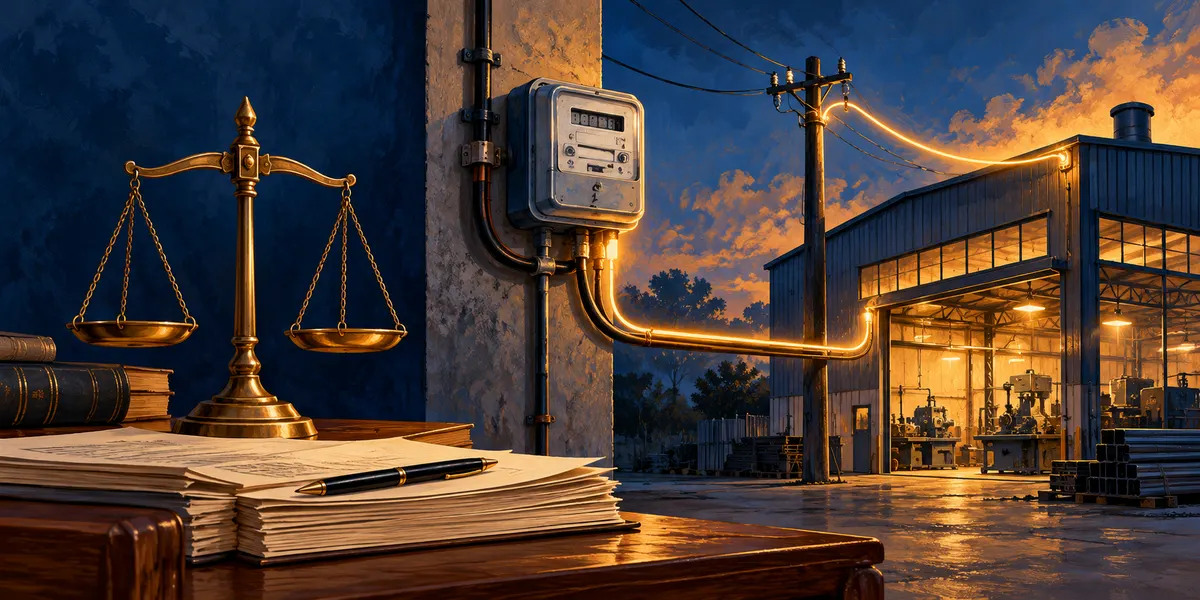
The Supreme Court has resolved a recurring problem for electricity consumers and distribution companies: how should a reconnection amount be fixed after supply is cut on an allegation of theft? In Dakshin Gujarat Vij Company Limited v. Vaibhav Metal Crusher, decided with a connected appeal, the Court held that the procedural safeguards used for assessment under Section 126 of the Electricity Act, 2003 ordinarily govern the amount payable for restoration under the third proviso to Section 135(1A). The judgment carries neutral citation 2026 INSC 1157. Justices Manoj Misra and K.V. Viswanathan heard the appeals; Justice Misra wrote the judgment.
The ruling was delivered on October 26 and reported the following morning. It does not erase allegations of theft or determine whether either consumer committed an offence. It addresses the administrative assessment and interim supply position while those questions are dealt with through the statutory process.
Two Gujarat disputes
In the first case, a distribution company issued Vaibhav Metal Crusher a supplementary bill of about ₹92.99 lakh after accusing it of electricity theft. It also sought about ₹23.45 lakh in compounding charges. The Gujarat High Court allowed reconnection after a 50 percent deposit and directed the company to consider the consumer’s objections to the bill. The utility maintained that theft assessment differed from ordinary unauthorised use and that reconnection on half payment was unwarranted.
The connected appeal concerned Jamanbhai Nanajibhai Bhuva, who challenged a supplementary bill for alleged theft. A High Court order allowed a fresh connection process after a deposit of half the demanded amount. The Supreme Court considered both appeals together because they raised the same issue about assessment, hearing and restoration.
Why Section 126 matters
Section 135(1A) permits disconnection in an electricity theft case and its third proviso deals with restoration following payment of the assessed amount. The Court found that the Act did not set out a separate assessment procedure for that particular reconnection payment. Unless an applicable Electricity Supply Code supplies one, the familiar Section 126 procedure fills the gap. That procedure entails a provisional assessment, an opportunity to object, a hearing and a final assessment by the competent officer.
The Bench connected that conclusion to natural justice. A demand made after disconnection can be large and can affect an essential service, so the consumer must have a meaningful way to contest its calculation. This procedural holding does not treat an accusation of theft as routine billing error. The utility remains free to pursue a theft prosecution, and the consumer remains liable for sums lawfully assessed.
An appeal under Section 127 lies against the assessment relevant to restoration. The appellate decision is final for that limited reconnection purpose. If a criminal complaint proceeds, the Special Court separately determines civil liability under Section 154(5); the administrative or appellate figure does not bind it. Any excess paid over the Special Court’s determination is dealt with under Section 154(6).
When a High Court may intervene
The Court also addressed the exceptional position where a provisional demand appears arbitrary on its face. A High Court exercising writ jurisdiction may give interim relief restoring supply if it records reasons and requires payment of an appropriate part of the demand. The amount ordered for this purpose should not be less than 50 percent. The Bench drew that floor from the half-deposit required to entertain a Section 127 appeal.
This is a qualified power, rather than an automatic right to reconnection on half payment. A court must examine the apparent defect in the provisional assessment and explain its intervention. A bare challenge to a theft bill does not itself justify restoration. Equally, the utility cannot bypass the statutory hearing process by describing a provisional calculation as a theft demand.
The appeals by the distribution companies were dismissed. For consumers, the practical route is to scrutinise the provisional calculation, submit objections and use the statutory appeal where needed. For utilities, the judgment requires a defensible assessment process before relying on the restoration-payment condition.
Case Details
Case: Dakshin Gujarat Vij Company Limited & Anr. v. Vaibhav Metal Crusher; connected appeal: Paschim Gujarat Vij Company Limited & Anr. v. Jamanbhai Nanajibhai Bhuva
Citation: 2026 INSC 1157
Bench: Justices Manoj Misra and K.V. Viswanathan
Advocates: Ranjeet Kumar and Pradeep Misra for the appellants; Raghenth Basant and Jaikriti S. Jadeja for respondents
Relevant Bare Act
Electricity Act, 2003: Sections 126, 127, 135(1A), 154(5)–(6), 181(2)(x) and 50
- Supreme Court
- Electricity Act
- Electricity Theft
- Power Restoration
- Natural Justice