HC
Rajasthan High Court Gives State Five Weeks to Frame Policy on Delayed Appeals Against Acquittals
Nyaya Prep • Published • Updated • 3 min read
The new direction
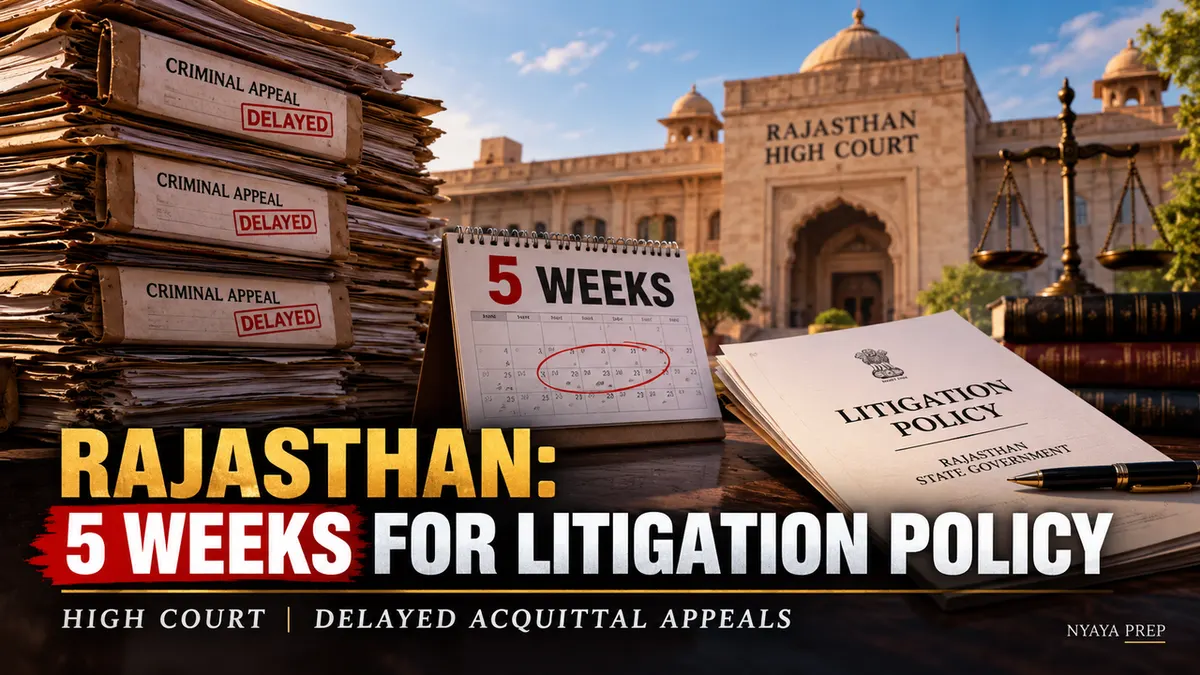
Justices Mahendra Kumar Goyal and Bhuwan Goyal directed the Rajasthan government to produce an effective litigation policy within five weeks to address late criminal appeals against acquittals. The Court said that if the deadline is not honoured, the Chief Secretary, Principal Law Secretary and Finance Secretary must appear on the next date. The order is an administrative-compliance direction arising from pending appeals; it is not itself a ruling allowing or dismissing each delayed criminal appeal.
Why the issue reached the Bench
The Court was dealing with a group of State appeals against acquittals filed after substantial delays. Applications seeking condonation under Section 5 of the Limitation Act were found to contain inadequate or routine explanations. The Bench called for additional affidavits to understand why the delays had occurred. It became concerned that accepting repetitive excuses without systemic correction would normalise late filing and undermine the discipline of appellate time limits.
From individual delay applications to policy reform
The State had previously indicated that it would develop a new litigation policy. Such a policy could address internal responsibility for obtaining certified copies, processing legal opinions, approving appeals and filing within prescribed time. The Court did not publish a completed policy or dictate its entire text. Instead, it required the government to take responsibility for creating a functioning mechanism rather than continue seeking indulgence in individual cases without addressing the institutional causes of delay.
Legal framework of delay condonation
Section 5 of the Limitation Act permits certain delayed proceedings to be entertained on sufficient cause being shown. The inquiry is fact-specific and does not give a government litigant an automatic extension. The High Court’s concern was that formulaic explanations might be treated as acceptable simply because the State was the appellant. A credible process must identify what actually caused delay, when officers acted and whether reasonable diligence was exercised. The present direction focuses on institutional arrangements rather than rewriting the statutory test.
Why appeals against acquittals matter
An appeal challenging an acquittal has serious implications for the person acquitted, who should not remain indefinitely uncertain because of avoidable government delay. At the same time, the State has an interest in bringing legally sustainable challenges where an acquittal warrants appellate scrutiny. Timely decision-making serves both interests. The Court’s insistence on a policy reflects the need to balance lawful prosecution with finality, fairness and efficient use of judicial time.
The warning to senior officials
By requiring the possible appearance of the Chief Secretary and two senior departmental secretaries, the Bench signalled that delay management cannot be left entirely to the advocate handling a case after limitation has expired. Administrative accountability may require coordination among police, prosecutors, legal departments and finance or personnel authorities. The Court’s warning is conditional; the report does not establish that the officials have already been summoned for non-compliance or that any sanction has been imposed.
Next step and significance
The State must present the proposed policy within the five-week period. If it fails, the identified officials may be required to attend the next hearing. The substantive appeals and applications remain subject to separate judicial decisions. The order illustrates a broader shift from case-by-case criticism of delayed government litigation to demands for measurable institutional reform, while leaving the government room to design the specific policy response.
Case Details
Citation: Not independently available
Bench: Justices Mahendra Kumar Goyal and Bhuwan Goyal
Advocates: Not independently available
Relevant Bare Act
Limitation Act, 1963
Sections: Section 5
- Rajasthan High Court
- Litigation Policy
- Criminal Appeals
- Delay
- Limitation Act
- State Government