HC
Rajasthan High Court Full Bench Allows Exceptional Open-Air Camp Consideration for Sexual-Offence Convicts
Nyaya Prep • Published • Updated • 3 min read
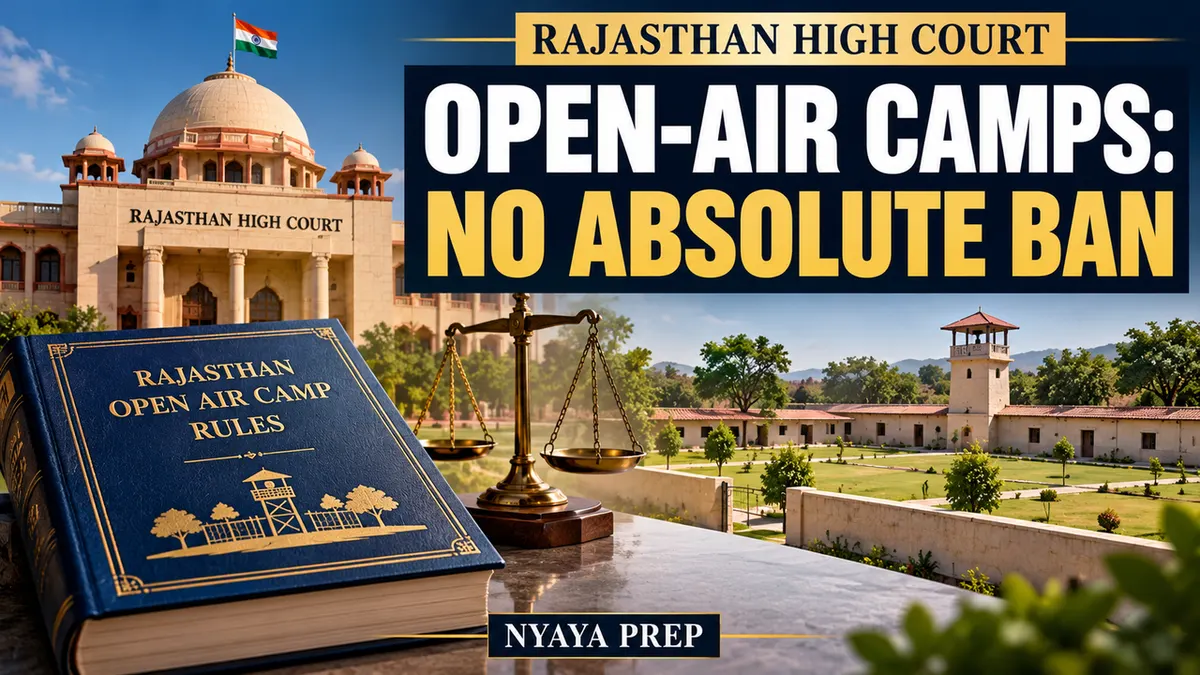
Full Bench resolves conflicting interpretations
The Rajasthan High Court answered a reference in Gangaram v State of Rajasthan and connected matters on 26 October 2026. Chief Justice Sanjay K. Agrawal and Justices Sameer Jain and Praveer Bhatnagar considered conflicting Division Bench decisions concerning Rule 3(d) of the Rajasthan Prisoners Open Air Camp Rules, 1972. Some earlier decisions treated convictions under Section 376 IPC or the Protection of Children from Sexual Offences Act as an effective bar to admission; others allowed limited discretion.
The Full Bench held that neither an absolute prohibition nor an unrestricted entitlement correctly expresses the Rules. The decisive word is “ordinarily”, which qualifies the exclusion. Giving that word legal meaning requires authorities to consider whether special circumstances justify departure from the normal rule, while maintaining the serious restrictions intended by the framework.
What the prison rules require
Open-air camps are part of a pre-release correctional scheme designed to encourage discipline, productive work and gradual social readjustment. Rule 3 identifies classes ordinarily ineligible for admission, including specified sexual-offence convicts. Rules 6 and 14 govern selection and the consideration of applications through prison authorities and the advisory mechanism.
The Court held that the ordinary exclusion remains the starting point. A person convicted of rape or an offence under POCSO cannot demand transfer merely because the word “ordinarily” is used. Equally, an authority cannot close the file solely by citing the conviction category without considering a properly presented exceptional case. The distinction between a right to admission and a right to fair consideration is central to the decision.
Individualised and reasoned assessment
The Full Bench required decision-makers to evaluate relevant circumstances and give reasons. It identified institutional conduct, reformative potential, risk, readiness for reintegration, the gravity of the offence, the age of the victim and the circumstances of the case as legitimate considerations. The evaluation must not treat all prisoners as identical, nor disregard the safety concerns associated with an open institution.
Article 14 of the Constitution informed the requirement of non-arbitrary exercise of discretion. The Court did not find a fundamental right to live in an open-air camp. Instead, it held that a statutory scheme conferring discretion must be administered rationally, consistently and on relevant material. Reasons are necessary both when an exception is granted and when it is refused.
Reformative justice and public protection
The judgment considered the reformative purpose of imprisonment and referred to Supreme Court observations on open correctional institutions, including Rama Murthy v State of Karnataka and Suhas Chakma v Union of India. Those decisions recognise that humane prison administration can include carefully structured opportunities for reintegration. But the Rajasthan bench also recognised that eligibility safeguards are particularly important where offences involve sexual violence or children.
The result is a calibrated rule. The severity of the offence can weigh heavily against admission and may justify refusal in most cases. Nevertheless, the competent committee must exercise the discretion actually conferred by the Rules, not replace the qualified text with an unqualified ban that the rule-maker did not enact.
What happens next
The reference question was answered; the judgment establishes the governing interpretation for connected proceedings and future decisions under the Rules. It does not direct that every prisoner in the specified category be transferred, nor does it announce that any named applicant automatically satisfies the exceptional-circumstances threshold.
For prison administrators, the immediate lesson is procedural as well as substantive: applications require case-specific scrutiny and recorded reasons. For legal practitioners, the decision is relevant to the interpretation of qualifying words such as “ordinarily” and to the relationship between rehabilitation, public safety and Article 14.
The bench's approach also protects the role of the Prisoners Open Air Camp Advisory Committee. That body must assess the circumstances of each application and can refuse transfer where risks or the nature of the offence outweigh evidence of reform. The judgment does not direct automatic release from prison; an open-air camp remains a form of regulated custody governed by administrative conditions.
- Rajasthan High Court
- Prison Reform
- POCSO
- Open Air Camp
- Article 14