HC
Meghalaya High Court Quashes Orders Interfering with Presbyterian Church’s Religious Administration
Nyaya Prep • Published • Updated • 3 min read
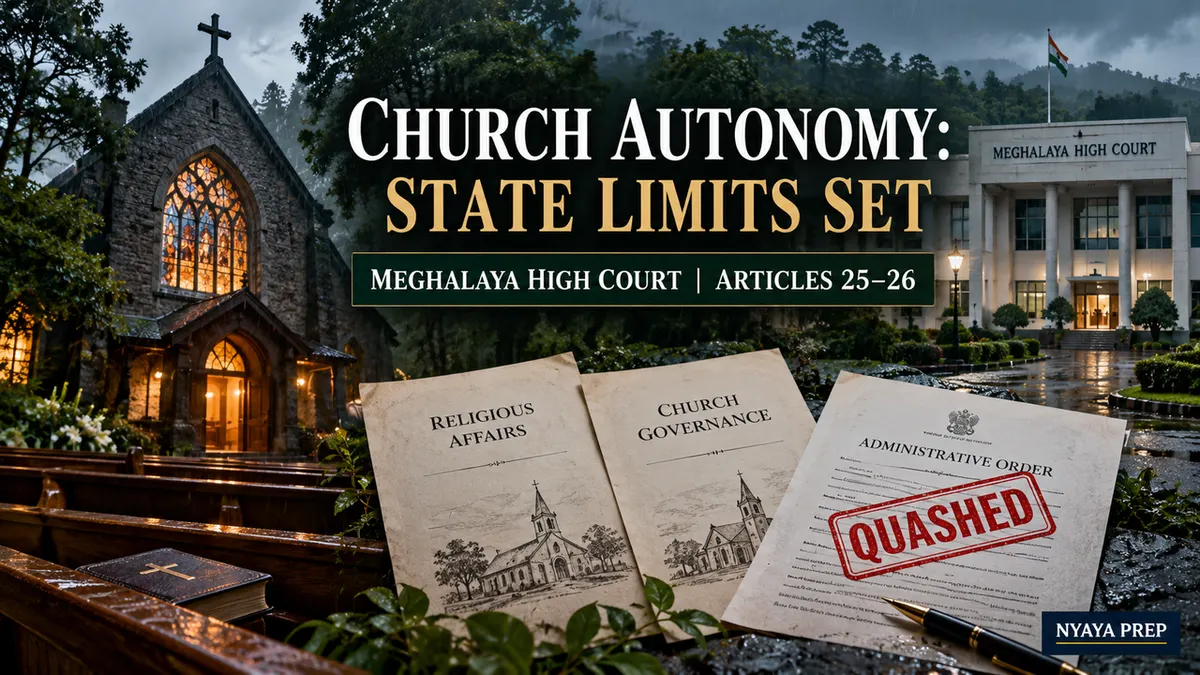
What the Court ordered
Justice H. S. Thangkhiew partly allowed a writ petition brought by Mawkhar Presbyterian Church, Shillong, and its Secretary. The Court quashed a show-cause notice and related directions issued by the Deputy Commissioner, East Khasi Hills, to the extent they attempted to determine which church body could administer sacraments and provide pastoral care. It also interfered with blanket restrictions on meetings in church premises. The judgment was delivered on 15 September 2026 and newly reported during the present review window.
Background of the denominational dispute
A disagreement had arisen within the congregation concerning its relationship with two synods, KJP Synod Sepngi and KJP Synod Mihngi. The petitioners said that the congregation had resolved to disassociate from one synod and seek pastoral services from the other. Amid the disagreement, the district administration issued directions concerning use of church buildings, third-party participation and administration of religious rites. The petitioners challenged those measures as an intrusion into religious self-governance, while the State defended its intervention as necessary to maintain public order.
Limits of preventive jurisdiction
The Court accepted that public authorities may act to prevent an actual or reasonably apprehended disturbance of peace. However, it drew a firm boundary between public-order measures and deciding internal religious authority. A Deputy Commissioner cannot convert a preventive function into an ecclesiastical adjudication by reading the denomination’s constitution and deciding which synod may perform sacraments. The Court found that the challenged directions went beyond what was justified by the asserted need to avoid confrontation.
Articles 25 and 26 in the analysis
Articles 25 and 26 of the Constitution protect religious practice and aspects of denominational management, subject to constitutional limits. The Court relied on the distinction between secular administration and religious matters, referring to the Supreme Court’s Shirur Mutt decision. Registration of the church as a society for property or banking purposes did not authorise executive officials to take over spiritual decisions. The Court did not suggest that religious institutions are immune from ordinary criminal law or lawful public-order regulation.
The problem with indefinite restrictions
The administration had restricted meetings in church schools, halls and premises and had attempted to prevent ministers from one synod from providing pastoral services. The Court found that an indefinite or blanket prohibition required a rational connection to a concrete threat. It also noted that an Executive Magistrate had earlier declined to continue preventive proceedings under Sections 126 and 164 of the Bharatiya Nagarik Suraksha Sanhita. Against that background, the restrictions could not be sustained merely because rival groups disagreed.
Questions the Court deliberately left open
The judgment did not decide which synod ultimately possessed religious jurisdiction, whether the congregation’s resolution to disassociate was valid, or who should be appointed or removed as pastor. Those matters remained outside the Court’s operative determination in this writ proceeding. It likewise did not rule out fresh lawful action if an actual or imminent threat to public peace arises. The relief was directed at the specific excess of administrative power, not at the underlying doctrinal disagreement.
Effect and significance
The impugned directions were set aside to the extent stated in the judgment, restoring space for religious administration without executive adjudication of ecclesiastical rights. The decision is important for the boundary between State public-order authority and denominational autonomy. It also demonstrates that the existence of a factional dispute, even a serious one, cannot substitute for statutory jurisdiction and proportionate action. The judgment carries the identifier 2026:MLHC:1030 in W.P.(C) No. 285 of 2026.
Case Details
Case: Mawkhar Presbyterian Church, Shillong and Another v. State of Meghalaya and Others
Citation: 2026:MLHC:1030; W.P.(C) No. 285/2026
Bench: Justice H. S. Thangkhiew
Advocates: Senior Advocate S. Dutta and team for petitioners; AAG N. D. Chullai and other counsel for respondents
Relevant Bare Act
Constitution of India
Sections: Articles 25, 26
Bharatiya Nagarik Suraksha Sanhita, 2023
Sections: Sections 126, 164 (preventive proceedings discussed)
- Meghalaya High Court
- Religious Freedom
- Articles 25 and 26
- Church Governance
- Public Order