HC
Madras High Court Says Going-Concern Sale in Liquidation Does Not Automatically Extinguish GST Dues
Nyaya Prep • Published • 4 min read
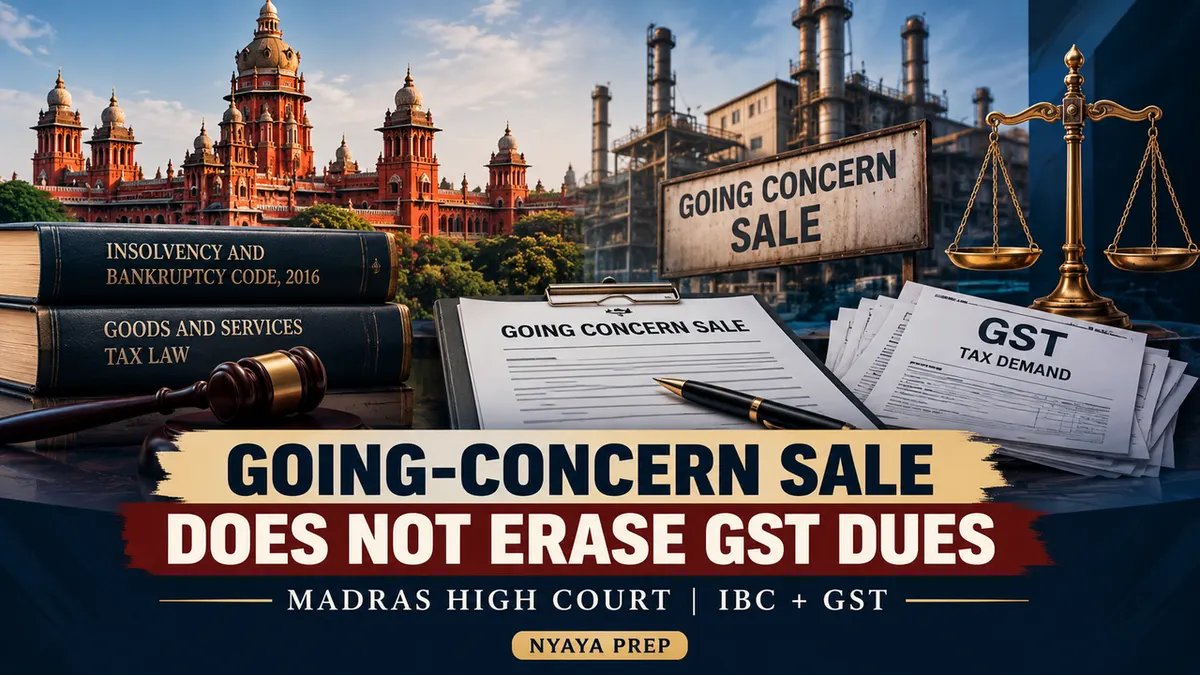
The High Court's ruling
The Madurai Bench of the Madras High Court considered a tax dispute involving EMC Limited and the State Tax Officer in a judgment dated 15 October 2026. The case concerned whether GST liabilities connected with a company could be treated as extinguished after the company was sold as a going concern during liquidation under the Insolvency and Bankruptcy Code, 2016. Justice C. Saravanan rejected the proposition that the purchaser necessarily acquires the enterprise free of every prior liability.
The Court's reasoning drew a distinction between a going-concern sale during liquidation and the consequences of an approved resolution plan under the corporate insolvency resolution process. It did not simply endorse the tax demand in every respect. The matter was remitted for fresh adjudication, leaving the competent tax authority to examine the issues in accordance with law.
How the dispute arose
EMC Limited faced GST proceedings concerning the tax period 2021-22. The proceedings resulted in a demand under Section 73 of the relevant GST enactments for tax, interest and penalty. The company challenged the demand on the basis that insolvency proceedings had intervened and that a sale of the corporate debtor as a going concern during liquidation should protect the business from claims that had not been addressed in the insolvency process.
The taxpayer relied on the Supreme Court's decision in Ghanshyam Mishra and Sons v. Edelweiss Asset Reconstruction Company, reported at (2021) 9 SCC 657, which discusses the binding effect of an approved resolution plan and treatment of claims. The tax department resisted the extension of that reasoning to the circumstances of the present liquidation sale. It also pointed to the timing of the GST liabilities, which it said arose during insolvency proceedings.
Resolution plans and liquidation sales are different
The High Court examined the structure of the Insolvency and Bankruptcy Code and the regulations governing the sale of a corporate debtor as a going concern. Such a transaction is intended to preserve a functioning enterprise rather than merely sell isolated assets. A purchaser receives the continuing business and may also assume liabilities associated with that undertaking, depending on the legal framework and the terms governing the sale.
That is why the 'clean slate' principle could not be applied mechanically. The consequences of a resolution plan approved under the IBC are not automatically identical to those of a going-concern sale conducted in liquidation. The question is not whether insolvency law is irrelevant, but which statutory process occurred, what liabilities were involved and whether the legal conditions for their extinguishment were satisfied.
The relevance of Section 85 GST
The Court referred to Section 85 of the GST enactments, which deals with liability where a business is transferred. The provision contemplates joint and several responsibility of transferor and transferee for specified tax dues in circumstances governed by its terms. This statutory feature was relevant to the contention that all tax liabilities vanished merely because the business had changed hands in liquidation.
The judgment also distinguished liabilities arising during the moratorium, corporate insolvency resolution process or liquidation from claims whose treatment is specifically controlled by an approved resolution plan. The timing and character of the demand therefore matter. The case should not be read as declaring that every purchaser in every insolvency sale is automatically liable for every historic tax claim, irrespective of the governing provisions or transaction documents.
Remand and commercial implications
Although the High Court rejected the taxpayer's broad extinguishment argument, it concluded that the dispute required fresh consideration. The reported decision indicates that the taxpayer had not fully presented certain aspects of its case before the tax authorities, including arguments relating to Section 85. The remand provides an opportunity for the relevant authority to examine those matters rather than treating the court's legal analysis as a substitute for the statutory adjudication.
For insolvency professionals and potential purchasers, the ruling underlines the need to investigate tax exposure when structuring a going-concern sale. Sale terms, the stage of insolvency, the date on which dues arose and applicable tax-transfer provisions may all be significant. The operative outcome is a remand, not an unconditional final recovery order. Further adjudication will determine the precise liability on the facts and statutory record.
Relevant Bare Act
Central Goods and Services Tax Act, 2017, Section 85.
- Madras High Court
- Insolvency
- Liquidation
- GST
- Going Concern