HC
Madras High Court Orders Selection of Srirangam Jeeyar Within Six Months, Protects Religious Autonomy
Nyaya Prep • Published • Updated • 4 min read
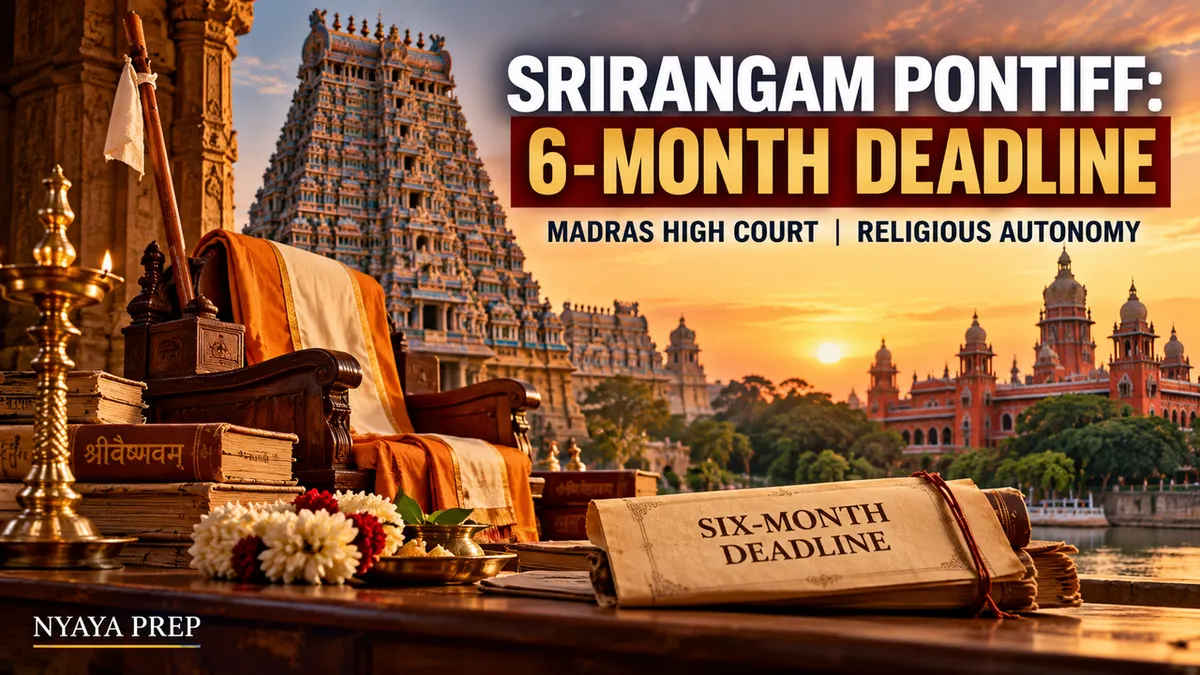
The operative directions
A Division Bench of Justices G.R. Swaminathan and P. Murugan allowed S. Veeraraghavan’s writ petition on 23 October 2026 in W.P.(MD) No. 30431 of 2026. The order was published for public access on 28 October and reported on 29 October. It addresses a spiritual office that has remained vacant since the death of the fiftieth Jeeyar in 2018.
The Court directed the jurisdictional Joint Commissioner of the Hindu Religious and Charitable Endowments Department to call upon the Sthalattars, the customary body responsible for choosing the successor, to convene a meeting. Eligible persons are to be invited and the process completed within an outer limit of six months. The Court expressly left the detailed roadmap to the Sthalattars.
The religious institution and the dispute
The petitioner described himself as a devotee of the Srirangam Ranganathaswamy Temple and disciple of the Sriranganarayana Jeeyar Mutt. He argued that the continued vacancy prevented performance of functions assigned to the Jeeyar under long-standing religious practices. The office has spiritual responsibilities and an institutional role in preserving compliance with the temple’s traditional norms.
The Court recorded that the predecessor had occupied the office for decades and died without nominating a successor. According to the applicable usage, the Sthalattars choose the next head, either unanimously or by majority. The prolonged failure to complete that process formed the basis of the public interest petition.
The State’s Additional Advocate General indicated that steps would be taken to ensure the Mutt had a head within six months. The Bench nevertheless considered it necessary to clarify the division between the department’s limited administrative role and the religious community’s authority to select its spiritual leader.
Religious freedom and limits of government intervention
The judges examined the Tamil Nadu Hindu Religious and Charitable Endowments Act, 1959, including its definitions of religious institutions and Mutts. They distinguished provisions permitting temporary arrangements from a power to choose a permanent spiritual successor. The judgment concluded that the department may acknowledge a selection made according to established usage but cannot take over the religious choice.
The Bench regarded the absence of a Jeeyar as an interference with disciples’ protected religious interests. It invoked Article 25 and earlier decisions addressing the maintenance of religious institutions. It also rejected the idea that the office should be treated as an ordinary temple employment post subject to the department’s hiring and disciplinary authority.
The judgment’s comparison with the election of a Pope was used as an illustration of the need for the selecting body to complete its internal process. It was not a direction importing Catholic election procedures into Hindu law. The legally operative direction remains a meeting, a customary selection, and a six-month deadline.
How the Court intends to ensure compliance
The Bench said it did not wish to micromanage the religious body. But if the Sthalattars failed to perform their responsibility, the Court indicated that it could exercise its protective jurisdiction and enlist assistance from respected Vaishnavite figures or a kindred institution. Such a possibility was described as a response to future default, not as an appointment already made by the Court.
The judges also noted that a successor would be entitled to residence at the Cheran Mutt within the temple campus and maintenance from Mutt income. Those observations connect the office to the practical conditions needed for performance of its duties.
The immediate next step is for the Joint Commissioner to convene the Sthalattars and for that body to complete a lawful selection. The ruling illustrates how a constitutional court may compel action to remedy a religious institutional vacancy while leaving the essential religious decision to the persons authorised by custom.
Case Details
Case: S. Veeraraghavan v. State of Tamil Nadu & Ors.
Bench: Justices G.R. Swaminathan and P. Murugan
Advocates: Raguvaran Gopalan for petitioner; P.V. Balasubramanian, assisted by M.P. Senthil, for State; M. Saravanan for temple authorities.
Relevant Bare Act
Constitution of India: Articles 25 and 226
Tamil Nadu Hindu Religious and Charitable Endowments Act, 1959: Sections 6(13) and 6(18)
- Madras High Court
- Religious Freedom
- Article 25
- Temple Administration
- Srirangam
- HRCE