HC
Madras High Court Issues Notice on Plea Seeking Inquiry and Social-Media Restrictions Against Journalist Saurav Das
Nyaya Prep • Published • Updated • 3 min read
What happened in court
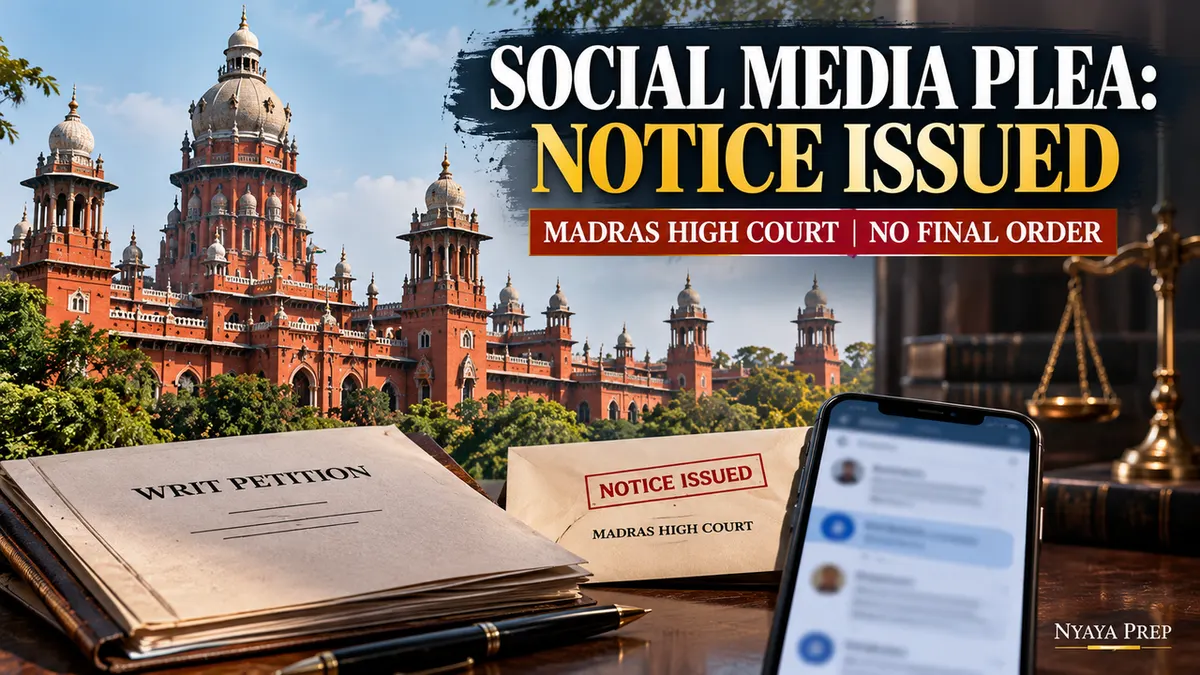
A Division Bench comprising Chief Justice S. A. Dharmadhikari and Justice G. Arul Murugan issued notice to respondents on a writ petition filed by Ganesh Kumar of Kanchipuram district. The petition seeks inquiries and administrative action concerning journalist and Cockroach Janata Party spokesperson Saurav Das. The Court made the matter returnable in six weeks and adjourned the hearing. Issuing notice allows the respondents to answer the allegations; it is not a finding that the allegations are correct or that any social-media account must be blocked.
Relief requested by the petitioner
The petitioner asked for a detailed inquiry into Das’s antecedents and sought cancellation of passport and Aadhaar documentation. He also requested directions to the Ministry of Electronics and Information Technology to block social-media handles and prevent further statements described in the petition as derogatory toward the judiciary. These were requests made by one litigant, not steps the Court was reported to have ordered. The distinction is particularly important because passport cancellation, identity-document action and online speech restrictions involve different legal regimes and decision-making authorities.
The respondents and the hearing
Notice was issued to authorities including the Regional Passport Officer in Chennai, the UIDAI Chairperson, the Union Home Ministry, the Foreign Secretary, the Union Law Ministry, the electronics and information technology ministry, and grievance officers associated with X and Instagram. Advocate B. Jagannath appeared for the petitioner and submitted that earlier complaints had not produced action. The reported hearing did not contain a substantive adjudication of the accuracy of the complaints or the lawfulness of the online statements.
Why a notice order is limited
A writ petition may seek directions against public authorities, but a court ordinarily considers the applicable statutory powers, factual basis and constitutional safeguards before ordering coercive measures. The issuance of notice indicates that the Bench wants a response; it does not prejudge whether any respondent owes a particular duty to act. The petitioner’s description of statements as derogatory is an allegation. No criminal conviction, finding of contempt or verified breach of social-media law is established by this procedural order.
Speech and administrative powers
Requests to block online accounts may raise questions of lawful authority, procedural fairness and freedom of expression. Requests involving identity documents or passports raise their own statutory prerequisites. Those questions cannot be resolved simply from the filing of a petition. The Bench has not yet ruled on whether the petition is maintainable in all respects, whether the alleged content attracts a legal restriction, or whether the authorities previously failed to perform any legally enforceable duty. Reporting must keep the petitioner’s allegations separate from a judicial finding.
Significance for digital-rights litigation
The case illustrates how multiple administrative remedies may be sought together in a writ petition concerning online speech. It also highlights the importance of procedural precision: different respondents may be responsible for different decisions, and a court’s notice does not automatically authorise action by any of them. A fair account of the proceeding must not imply that the journalist’s passport or Aadhaar has been cancelled, or that his online accounts have already been blocked by the High Court.
Next hearing and status
The matter is listed for further consideration after the six-week return period stated at the hearing. The next meaningful development will be the respondents’ position and any subsequent judicial direction. The reported case number is W.P. 44399 of 2026. Until the Bench decides the merits, the only verified new judicial action is issuance of notice and adjournment.
Case Details
Case: Ganesh Kumar v. The Regional Passport Officer
Citation: W.P. No. 44399/2026
Bench: Chief Justice S. A. Dharmadhikari and Justice G. Arul Murugan
Relevant Bare Act
No direct bare-act section is independently verified as the operative basis of this development.
- Madras High Court
- Saurav Das
- Social Media
- Writ Petition
- Passport
- UIDAI