Constitutional Law
Madras High Court Directs Police to Prevent Intimidation of Judges While Protecting Lawful Criticism
Nyaya Prep • Published • 4 min read
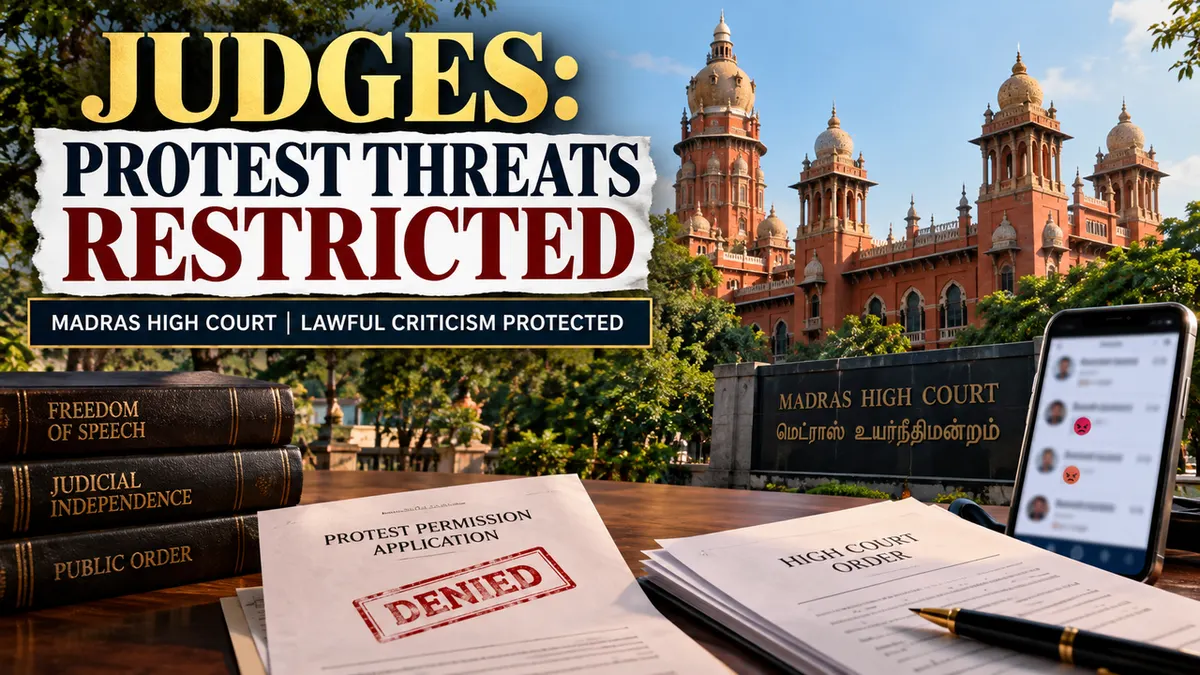
Court draws a line between criticism and intimidation
The Madras High Court has directed Tamil Nadu police and district authorities not to permit public meetings or marches whose purpose is to personally target, defame or intimidate sitting judges. The Division Bench of Chief Justice Sushrut Arvind Dharmadhikari and Justice G Arul Murugan also required action when a permitted gathering turns into a personal attack and instructed cybercrime police to address online criminal intimidation.
The Court expressly rejected a blanket ban on public discussion of judgments. Its order distinguishes criticism of a judicial conclusion, which is part of democratic debate, from organised personal threats and abuse directed at a judge. The ruling was delivered on 30 October 2026 in a public interest petition.
Background to the petition
Petitioner R Karthikeyan sought preventive and penal measures following public protests connected with a Madurai Bench judgment of 25 June 2026. That earlier ruling concerned a Tamil Nadu government order about backward-class benefits after religious conversion. The petitioner alleged that subsequent meetings, posters and online material crossed the boundary from criticism of the decision into abusive and caste-based attacks against a sitting judge.
The allegations were directed at the conduct of organisers and participants in protests, including two named organisations. Those allegations must be distinguished from the High Court’s legal directions: the Court did not pronounce every protest unlawful or find all named persons guilty of offences.
State response and the Court’s assessment
The State informed the Court that police had refused permission for a protest in Madurai and had registered FIRs concerning gatherings held despite restrictions. It also referred to another FIR arising from a subsequent incident. The Bench considered those steps but stressed the need for a consistent approach when alleged intimidation takes place across physical meetings and digital platforms.
The Court noted that an FIR need not contain an exhaustive list of every potential offender at the outset. The absence of a particular name in an FIR does not, without more, establish that authorities are refusing to act. The police were directed to investigate the registered cases fairly, thoroughly and expeditiously.
Constitutional balance under Article 19
Freedom of speech under Article 19(1)(a) protects disagreement with judgments and public discussion of legal questions. The Court observed that constitutional protection does not extend without limit to abusive, defamatory or caste-based attacks and intimidation. Article 19(2) permits specified reasonable restrictions on expression under law.
Crucially, the Bench refused to treat every assembly about a judicial decision as a threat to judicial independence. A blanket prohibition would improperly restrict lawful democratic activity. The correct approach is a case-specific assessment of the proposed event and a proportionate response to conduct that actually crosses the legal line.
Specific directions to the authorities
The State police and district administration must assess applications for meetings, marches and protests concerning judicial matters individually, applying the relevant statutory powers. Permission is to be refused where the event is directed at personally targeting, defaming or intimidating a sitting judge. If an authorised assembly turns into a personal attack, officers must stop the unlawful conduct and take action in accordance with law.
The Cyber Crime Division was also directed to monitor digital platforms for content that amounts to criminal intimidation of judges and to act against violations. These directions are not a general licence for arbitrary censorship: the conduct addressed must be assessed under the applicable law and the constitutional limits identified by the Court.
Primary order and practical consequences
The written order is W.P. No. 30622 of 2026, reserved on 27 October and delivered on 30 October. It disposes of the public interest litigation with directions concerning public assemblies, investigations and online intimidation. The primary judicial text confirms the balance between legitimate criticism and the need to protect the independence of the courts.
For protest organisers, the ruling underscores the importance of keeping criticism focused on legal reasoning and policy consequences rather than threats against individuals. For police, it requires reasoned, case-by-case decision-making rather than an automatic prohibition of meetings about controversial judgments.
Case Details
Case: R Karthikeyan v. Union of India and Others
Citation: W.P. No. 30622 of 2026
Bench: Chief Justice S A Dharmadhikari and Justice G Arul Murugan
Advocates: Rajendran Raghavan; G Babu; S Ganesh Babu; John Sathyan; N Palanivel
Relevant Bare Act
Act: Constitution of India
Relevant provisions: Articles 19(1)(a), 19(2) and 226
- Madras High Court
- Freedom of Speech
- Judicial Independence
- Public Protests
- Article 19