High Court Judgments
Madras High Court Constitutes Five-Member Board for Chidambaram Nataraja Temple Administration
Nyaya Prep • Published • 4 min read
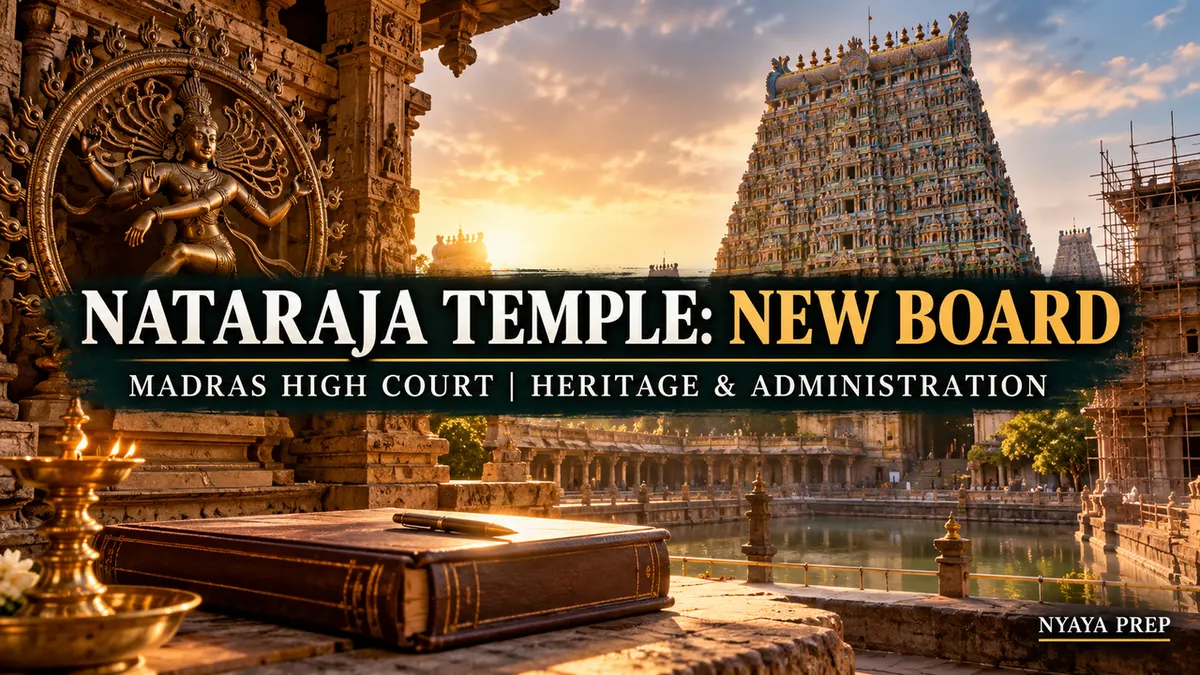
Court intervenes in temple administration
A Division Bench of Justice G. Jayachandran and Justice E. Manoharan delivered its common judgment on 30 October 2026 in three writ petitions concerning the administration of the historic Chidambaram temple. The judgment, bearing neutral citation 2026:MHC:4389, establishes a temporary management structure rather than transferring the denomination’s religious functions to the State on a permanent basis.
The Court found that the condition of heritage structures, disputed constructions, the handling of temple property and inadequate financial accounting warranted corrective intervention. It directed the newly constituted board to take charge forthwith and implement specified measures concerning conservation, assets, accounts and public access.
How the dispute reached the High Court
The litigation began with challenges to a Tamil Nadu government order dated 17 May 2022 permitting devotees to climb the Kanagasabai Mandapam to obtain darshan of Lord Nataraja. The Podhu Dikshitars, who administer the temple as a religious denomination, contended that the order interfered with their constitutional rights under Article 26. Two connected petitions also questioned the order.
The proceedings expanded to examine issues relating to the temple’s ancient fabric, property management and the accounts maintained by its administrators. The Bench considered materials and rival submissions concerning alterations to heritage structures, alleged encroachments and the handling of donations. Its eventual findings went beyond the original dispute about the place from which devotees could offer prayers.
Constitutional limits on administrative intervention
A central legal issue was how the State’s power to correct maladministration should be reconciled with the religious denomination’s right to manage its own affairs. The Court considered Dr. Subramanian Swamy v. State of Tamil Nadu, (2014) 5 SCC 75, which had rejected indefinite State control of this temple through an executive officer.
The Bench distinguished temporary corrective supervision from permanent displacement of denominational administration. It noted that constitutional protection does not confer a licence to damage heritage property, deny lawful public access or avoid proper accounting. At the same time, any intervention must remain connected to remedying the established defects rather than extinguishing the denomination’s religious identity.
The judgment records adverse findings on the maintenance of historic structures and the absence of satisfactory accounts. Those findings are judicial conclusions in these proceedings; allegations made by parties about individual acts should not be treated as separate criminal convictions.
Composition and mandate of the five-member board
Retired Justice V. Bharathidasan will chair the board, with retired Justice R. Suresh Kumar as co-chairman. Retired IAS officer C. Rajendran, the Secretary of the Podhu Dikshitars and the Secretary to the Tamil Nadu Hindu Religious and Charitable Endowments Department complete the five-member body.
The Court set out a detailed programme for the board. Among its express responsibilities are:
- Ensuring fair and equal opportunity for devotees to have darshan from the Kanagasabai, consistently with established religious customs.
- Consulting the Tamil Nadu Heritage Commission before removing unauthorised or unnecessary constructions that hinder or damage the ancient structure.
- Working with district authorities to recover encroached temple properties, possession and outstanding rents or lease amounts.
- Maintaining proper accounts, safeguarding valuables and pursuing conservation without altering the temple’s heritage character.
Ritual autonomy, donations and financial safeguards
The Bench expressly reserved daily rituals and periodic festivals to the Podhu Dikshitars. Fixed deposits and other income already handled by them will remain under their control, but monthly account statements must be submitted to the board by the fifth day of each calendar month. The board will separately supervise accounting for temple properties and related endowments.
All donations are to be received through a single-window electronic payment arrangement. Donations earmarked for particular renovation works must be maintained and spent for those purposes. The Court also provided for remuneration and logistical support for the three non-ex-officio members, with board expenditure borne by the HR&CE Department and a contingency allocation of ₹10 lakh.
Practical significance and next steps
The order creates an unusual court-supervised mechanism at the intersection of religious freedom, heritage conservation and public accountability. Its immediate effect is to place administrative repair, property recovery and financial transparency under a defined board, while avoiding a blanket takeover of worship practices.
The board is expected to assume charge forthwith and act in consultation with the relevant authorities and temple representatives. The judgment disposes of the connected writ petitions. Its stated corrective purpose matters: the board’s authority is tied to addressing maladministration, not to establishing permanent governmental management of religious rites.
Case Details
Case: Sri Sabanayagar Temple and connected writ petitions v. State of Tamil Nadu
Citation: 2026:MHC:4389; W.P. Nos. 36022, 20467 and 30365 of 2023; judgment dated 30 October 2026
Bench: Justices G. Jayachandran and E. Manoharan
Advocates: K. Harishankar for Podhu Dikshitars; R. Bharanidharan, Special Government Pleader, for the State and HR&CE Department; Naveen Aravindhan for a connected petitioner.
Relevant Bare Act
Constitution of India: Articles 25 and 26 (religious freedom and denominational rights considered in the proceedings).
Tamil Nadu Hindu Religious and Charitable Endowments Act, 1959: Sections 45(1) and 107 (provisions discussed in the litigation and earlier administrative-control dispute).
- Madras High Court
- Chidambaram Nataraja Temple
- Article 26
- Temple Administration
- Heritage Conservation