Constitutional Law
Kerala High Court Strikes Down Rule Barring Women from Employment in Toddy Shops
Nyaya Prep • Published • Updated • 4 min read
The constitutional ruling
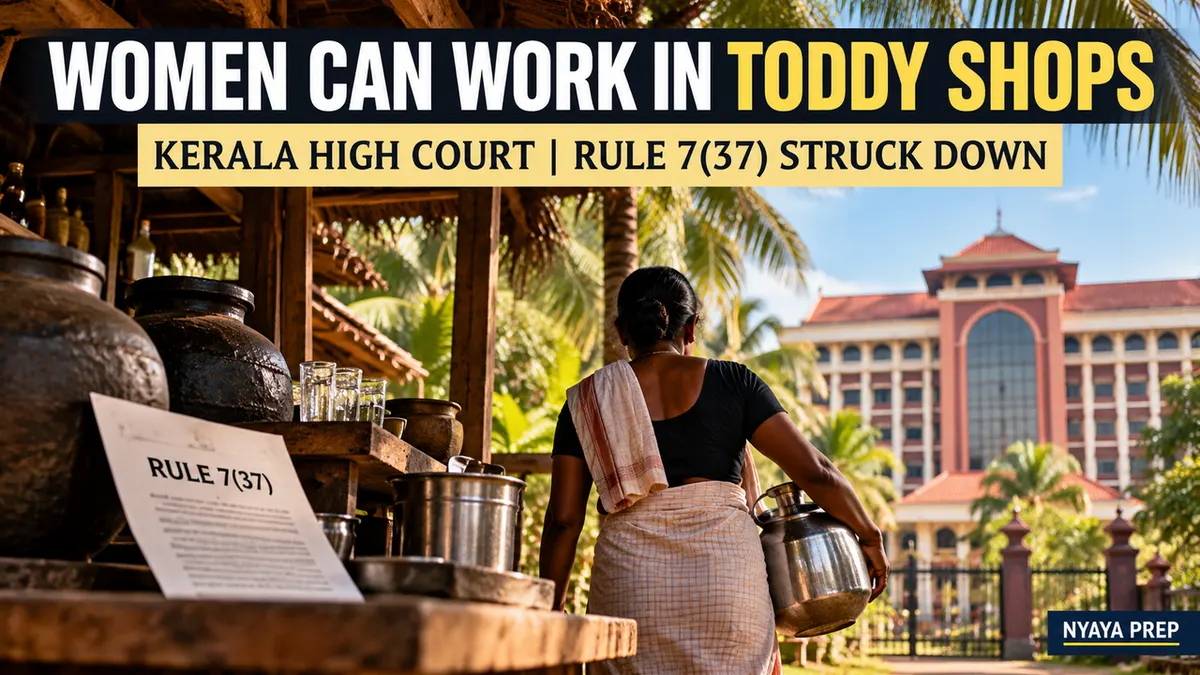
Justice Gopinath P declared Rule 7(37) of the Kerala Abkari Shops Disposal Rules, 2002 unconstitutional. The rule prohibited employment of women in any capacity in toddy shops. The Court found that the prohibition violated Articles 14, 15, 19 and 21 of the Constitution and could not be sustained as a protective measure.
The judgment was delivered on 5 August 2026 in Sophy v State of Kerala and others, W.P.(C) No. 27762 of 2024, and carries the Kerala High Court neutral citation 2026:KER:59925. It was reported as a legal-news development on 29 October. The distinction between the decision date and the publication date is important.
The Court also held that any licence condition resting on the invalid rule could not survive. It directed consideration of the petitioner’s claim without applying the prohibition; it did not automatically appoint her to the position.
The widow’s request for employment
The petitioner, Sophy, sought compassionate employment at a toddy shop in the Thrissur district after her husband, K. J. Kunjupalu, died on 20 May 2024. He had worked at the shop. Her claim was based on a settlement concerning employment in the toddy industry.
Authorities denied the request because the rule excluded women from all work in toddy shops. Since the disqualification was the decisive obstacle, the Court considered the validity of the prohibition rather than undertaking a broad examination of every condition in the industrial settlement.
The factual dispute therefore brought a wider constitutional question before the Court: may the State prevent women from working in a lawful occupation on the ground that the workplace might be unsafe?
Safety cannot become an exclusion
The State defended the restriction as a measure to protect women from harassment and exploitation. It referred to the location and conditions of toddy shops, including the possibility that some are in remote areas. The government also argued that sex-based distinctions can be lawful when supported by occupational requirements.
The Court rejected the justification on the record before it. It held that protecting workers is a responsibility of the State, but a blanket ban is not a proportionate way to discharge that duty. Instead of excluding women, the government should secure conditions that allow them to work safely.
The Court distinguished situations where a particular role may have demonstrable requirements from a rule barring every woman from every role in an entire category of establishments. The record did not justify that breadth of exclusion.
Precedent and constitutional reasoning
The judgment examined Anuj Garg v Hotel Association of India, (2008) 3 SCC 1, where the Supreme Court considered restrictions on women’s employment in establishments serving liquor. It also discussed Kerala decisions including Sanuja v Kerala State Beverages Corporation, 2017 (1) KLT 44, which addressed similar restrictions.
The State relied on decisions recognising that some employment classifications may be justified by genuine differences in duties. Justice Gopinath P explained that those cases were tied to their facts and did not establish an unrestricted power to exclude women from toddy-shop employment.
The Court also rejected an argument based on the special regulatory status of liquor trade. Restrictions on carrying on that trade do not automatically justify denying eligible workers employment in the industry. The rights of an employee cannot simply be equated with the claimed freedom of an operator to conduct liquor business.
Effect of the judgment
The authorities must assess Sophy’s request for compassionate employment without treating Rule 7(37) as a disqualification. Whether she satisfies the remaining lawful conditions of the employment arrangement is a separate administrative question.
The decision is relevant to workplace rules framed as protective restrictions. It requires the State to identify actual risks and adopt proportionate safeguards rather than exclude an entire sex from employment. It does not prevent employers or regulators from enforcing lawful health, safety and licensing conditions.
The immediate result is that the challenged prohibition has been struck down and the petitioner’s application must be reconsidered. Any later appeal or stay was not independently verified at the time of preparing this article.
Case Details
Case: Sophy v. State of Kerala & Others
Citation: 2026:KER:59925; W.P.(C) No. 27762 of 2024
Bench: Justice Gopinath P.
Advocates: Senior Advocate Ranjith Thampan with Advocates V. M. Krishnakumar and P. R. Reena for the petitioner; Government Pleader Chithra P. George; Advocate M. C. John for licensee
Relevant Bare Act
Kerala Abkari Shops Disposal Rules, 2002: Rule 7(37)
Constitution of India: Articles 14, 15, 19 and 21
- Kerala High Court
- Women Employment
- Toddy Shops
- Equality
- Rule 7(37)
- Constitution