High Court Judgments
Kerala High Court Invalidates Vizhinjam Coastal Erosion Expert Committee and Orders Fresh Independent Panel
Nyaya Prep • Published • 4 min read
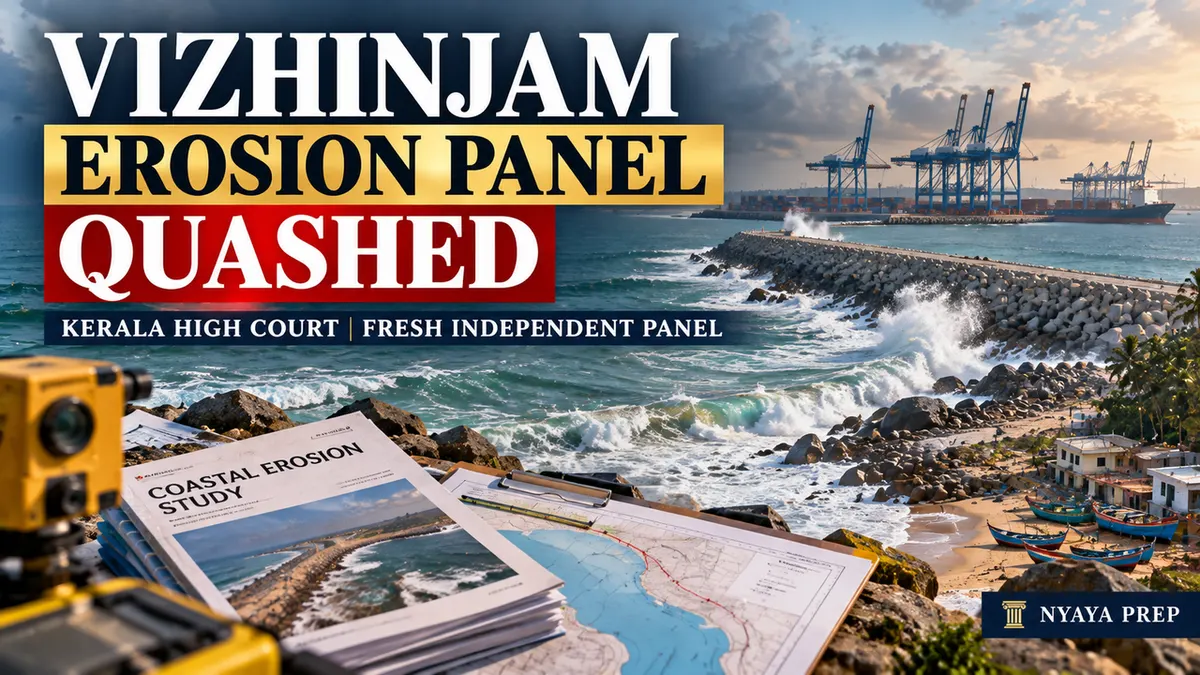
The dispute brought by coastal residents
The petition was brought by residents of fishing communities near the Vizhinjam International Deepwater Multipurpose Seaport. They alleged that construction activities, particularly breakwaters, had contributed to erosion north of the port and accumulation of sediment to its south. They also described damage to homes and livelihoods. Those assertions were the petitioners' case, not scientific findings adopted by the High Court as proven consequences of the project.
The State had issued a Government Order on 6 October 2022 constituting an expert committee to study whether coastal erosion had occurred as a result of port construction and to consider remedial measures. The committee was chaired by M.D. Kudale. Its eventual report did not attribute the erosion to the project. Residents challenged the committee's composition and its ability to provide an independent assessment, rather than asking the Court to conduct a scientific investigation itself.
Alleged conflicts and the parties’ positions
The petitioners questioned Kudale's earlier involvement with a technical subcommittee concerned with the development of Vizhinjam seaport. They also raised concerns about another member, P.V. Chandramohan, because of his professional association with an engineering company linked to entities involved in the project. They relied in part on a previous technical publication discussing the possible impact of breakwaters on longshore sediment movement.
The State and port-related respondents resisted the challenge. They argued, among other things, that the project possessed statutory approvals, that erosion could be explained by waves and cyclonic activity, and that prior professional expertise could assist rather than disqualify a committee member. They also raised delay and laches. The High Court treated these as competing submissions and examined the committee's independence without reopening the validity of the port's environmental clearances.
How the High Court approached independence
Justice Menon considered the principles of impartial decision-making and the need to avoid conflicts between personal interests and public duties. The judgment referred to A.K. Kraipak v. Union of India and N.K. Bajpai v. Union of India. The Court found that Kudale's previous role connected with the project was not disputed and considered that his inclusion in the committee ought to have been avoided. It also examined the unresolved concerns relating to Chandramohan.
The Court did not accept every objection made by the residents. In particular, it declined to invalidate the inclusion of another member, Riji K. John, merely because his earlier appointment as Vice-Chancellor had been quashed, in the absence of a demonstrated disqualification for committee membership. This distinction is important: the ruling was not a general finding that every expert was biased, but an assessment of the concrete circumstances undermining the committee's independence.
Judicial review without deciding coastal science
The High Court acknowledged the limited scope for judicial interference with large infrastructure projects involving specialised technical assessments. It referred to Union of India v. Kushala Shetty and National High Speed Rail Corporation v. Montecarlo on that broader principle. The immediate question, however, was not whether the port should operate or whether a particular coastal model was scientifically correct. It was whether the Government's chosen fact-finding body had been constituted lawfully and impartially.
The judgment therefore avoided declaring the seaport responsible for the alleged environmental harm. It also rejected the suggestion that the existence of another monitoring committee associated with National Green Tribunal proceedings cured defects in the State committee. Once the Government had established a specific expert body to examine residents' concerns, that body had to meet standards of independence appropriate to the task entrusted to it.
Operative directions and next steps
The Court allowed the writ petition on the committee issue. It declared the committee constituted under the 2022 Government Order flawed and directed that its final report not be acted upon. The Government must form a new independent expert committee to carry out the studies contemplated by that order, ensuring that proposed members do not have conflicts of interest. The Court left selection of suitable members to the Government, taking account of the judgment and stakeholder views.
The practical significance is that public authorities cannot rely on a compromised expert process to resolve serious environmental disputes. The new committee will have to investigate the contested coastal impacts independently. Its future findings, and any administrative measures based on them, remain to be seen. The judgment should not be reported as either a final scientific finding against the port or a judicial endorsement of the port's environmental impact.
Case Details
Case: Nirmala Johny and Others v. State of Kerala and Others
Citation: 2026:KER:83112; W.P.(C) No. 34157 of 2022
Bench: Justice Harisankar V. Menon
Advocates: Petitioners: Prashant Bhushan, Ajit Joy and others; respondents: V.J. Mathew, Vipin P. Varghese and others, as recorded
Relevant Bare Act
Constitution of India: Article 226 (High Court writ jurisdiction)
- Kerala High Court
- Vizhinjam Port
- Coastal Erosion
- Conflict of Interest
- Judicial Review
- Environment