Motor Vehicle Law
Kerala High Court Bars Retrospective Use of Traffic Challan Rule to Block Vehicle Registration
Nyaya Prep • Published • 4 min read
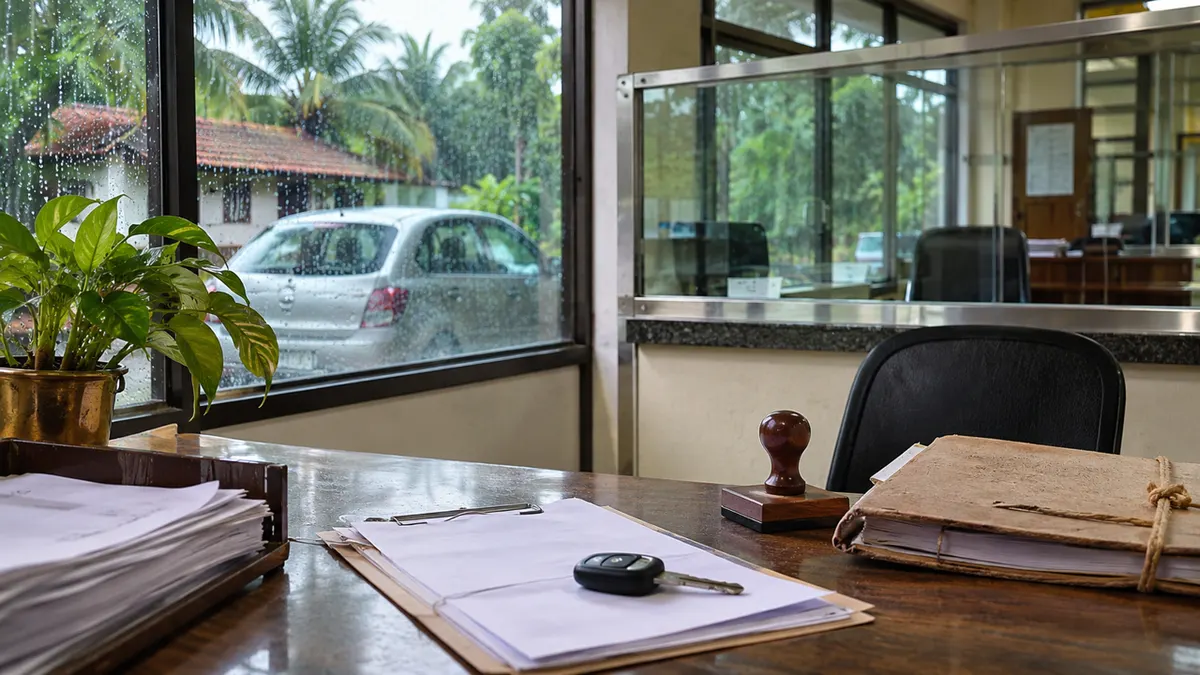
High Court directs processing of vehicle application
The Kerala High Court has directed the Regional Transport Officer at Ernakulam to receive and process a motorist’s application for cancellation of a vehicle hypothecation entry without relying on unpaid traffic challans issued before 1 October 2020. Justice Murali Purushothaman held that Rule 167(7) of the Central Motor Vehicles Rules, 1989, which restricts certain registration-related services where challans remain outstanding, is a substantive restriction operating prospectively. The judgment was delivered on 6 October 2026 and reported on 6 November. It concerns the temporal reach of a regulatory disability, not a general cancellation of traffic fines.
Why the dispute arose
Petitioner T. N. Arun Kumar purchased a motor car in 2015 using a Bank of Baroda loan. Once the loan account was closed, he sought removal of the hypothecation entry from the registration certificate. The transport office declined to accept the request because the vehicle had been flagged on account of challans remaining unpaid for more than ninety days. The petitioner distinguished older challans from those issued after the regulatory amendment. He stated that the post-amendment compounding fees had been paid, while the disputed speeding challans related to 2015 through 2019.
The rule and the precise legal question
Rule 167 was introduced through the Central Motor Vehicles (Eleventh Amendment) Rules, 2020, with effect from 1 October 2020. Sub-rule (7) prevents licensing or registering authorities from processing specified applications relating to a driving licence or vehicle registration when qualifying challans remain unpaid beyond the prescribed period. The provision expressly excepts applications concerning permits, fitness and motor-vehicle taxes. The petition required the Court to decide whether this newly introduced restriction could be applied to an application solely because challans from an earlier period remained pending. The issue was not whether speeding violations were proved or whether the authorities could otherwise pursue lawful recovery.
Submissions and judicial reasoning
The petitioner argued that the amendment imposed a new disability and therefore could not be used retrospectively against conduct predating its commencement. He relied on Supreme Court authority concerning the presumption against retrospective burdens. The Regional Transport Officer filed a statement identifying challans from both sides of the commencement date. After examining the rule, the High Court observed that unpaid challans had not previously operated, by themselves, as a bar to processing registration applications. It treated the new administrative restriction as substantive rather than merely procedural. Nothing in the amended rule clearly authorised retrospective operation.
Precedents on prospectivity
The judgment discussed Panchi Devi v. State of Rajasthan, concerning the ordinarily prospective character of subordinate legislation, and Zile Singh v. State of Haryana, concerning the presumption against retrospectivity where new burdens or disabilities are imposed. It also relied on Commissioner of Income Tax v. Vatika Township Private Limited, in which the Supreme Court explained the fairness rationale behind prospective interpretation. These authorities supported the distinction between regulating future transactions under a new rule and attaching a newly created adverse consequence to past events. The High Court applied that distinction to the transport authority’s refusal to process the application.
What the Court ordered
The Court held that Rule 167(7) could not be invoked to obstruct processing merely because challans issued before 1 October 2020 remained unpaid. It directed the Ernakulam Regional Transport Officer to receive and process the petitioner’s request for cancellation of the hypothecation entry in accordance with law, disregarding those pre-commencement challans. The officer was directed to act as expeditiously as possible and in any event within one month after receiving a copy of the judgment. The writ petition was disposed of. The Court did not order the authority to ignore later challans or declare that every outstanding penalty was extinguished.
Practical significance and limits
The ruling matters to owners seeking registration-related services where legacy e-challans remain on official systems. It confirms that an administrative platform flag cannot expand a rule beyond the period for which the law permits it to operate. A motorist relying on this decision must still distinguish the dates of the challans, the nature of the requested service and any other lawful grounds for refusal. The judgment is a High Court decision on the relevant rule and facts; it should not be represented as a blanket exemption from paying traffic penalties. The central proposition is that a newly imposed statutory disability needs clear authority before it can operate retrospectively.
Case: T. N. Arun Kumar v. Ministry of Road Transport and Highways and Others
Citation: 2026:KER:77134; WP(C) No. 27715 of 2026
Bench: Justice Murali Purushothaman
Advocates: Vipin Narayan and Ashwanth Padman for petitioner; Sarath, Government Pleader; Amal Parthasaradhy, Central Government Counsel.
Central Motor Vehicles Rules, 1989: Rule 167(7), Rule 61.
Motor Vehicles Act, 1988: Section 51(3).
- Kerala High Court
- Traffic Challans
- Motor Vehicles
- Retrospectivity